Ingredients
Method
Boil the Potatoes
- Wash the 1.2kg of yellow potatoes well and place them whole and unpeeled in a large pot. Cover with cold water by about 3cm and add a generous pinch of salt. Bring to a boil over high heat, then reduce to a steady simmer and cook for 18–25 minutes, depending on size, until a knife slides into the centre with no resistance but the potato still holds its shape. Drain and leave until just cool enough to handle. That cold start and gentle simmer is what cooks the centre at the same rate as the outside, instead of leaving a mushy rim around a firm core.
Cook the Eggs
- While the potatoes simmer, place the 4 large eggs in a small pot, cover them with cold water, and bring to a boil. Once the water is boiling, cook the eggs for 10 minutes for fully set, hard-boiled yolks. Transfer them straight into a bowl of cold water and leave until completely cool, then peel and halve each egg lengthwise to make 8 halves. That cold-water stop is what halts the cooking, so the yolks stay pale yellow and creamy instead of turning chalky with a grey ring.
Peel and Slice the Potatoes
- When the potatoes are cool enough to handle but still slightly warm, peel off the skins with your fingers or a small knife. Slice the potatoes into thick rounds, about 1–1.5cm thick, and lay them in a single layer on a tray or plate. Leave them to cool further while you make the sauce, so they are cool or at room temperature by plating. That slightly warm peeling is what lets the skins slip away cleanly, and the thick cut is what lets each round hold its shape under a generous coating.
Blend the Huancaína Sauce
- Break 5–6 plain crackers (about 25–30g) into pieces, or tear 2 crustless slices of soft white bread. In a blender, combine the 180g crumbled queso fresco, 3–4 tbsp ají amarillo paste, the crackers or bread, 120ml evaporated milk, 2 tbsp neutral oil, 1 small garlic clove, ½ tsp salt, and ⅛ tsp black pepper. Blend for about 1 minute, scraping down the sides once, until completely smooth, creamy, and golden with no grainy specks. Start with 3 tbsp of paste and add the fourth if you want a stronger ají amarillo flavour. That cracker or bread is what thickens and emulsifies the cheese, oil, and milk into one velvety sauce instead of a loose, separated mixture.
Adjust the Sauce Consistency
- Check the sauce: it should be thick enough to coat the back of a spoon generously, yet fluid enough to spread and flow slightly. If it is too thick to blend or too stiff to spoon, add up to 60ml more evaporated milk, 1 tablespoon at a time, blending briefly after each addition. Taste and adjust the salt, remembering that the queso fresco and olives are already salty, and confirm the ají amarillo, cheese, and cream all come through clearly. Keep the sauce covered at room temperature until serving. That gradual loosening is what lets you stop at the right consistency, because a sauce thinned too far cannot be thickened again without more cheese or crackers.
Assemble and Serve
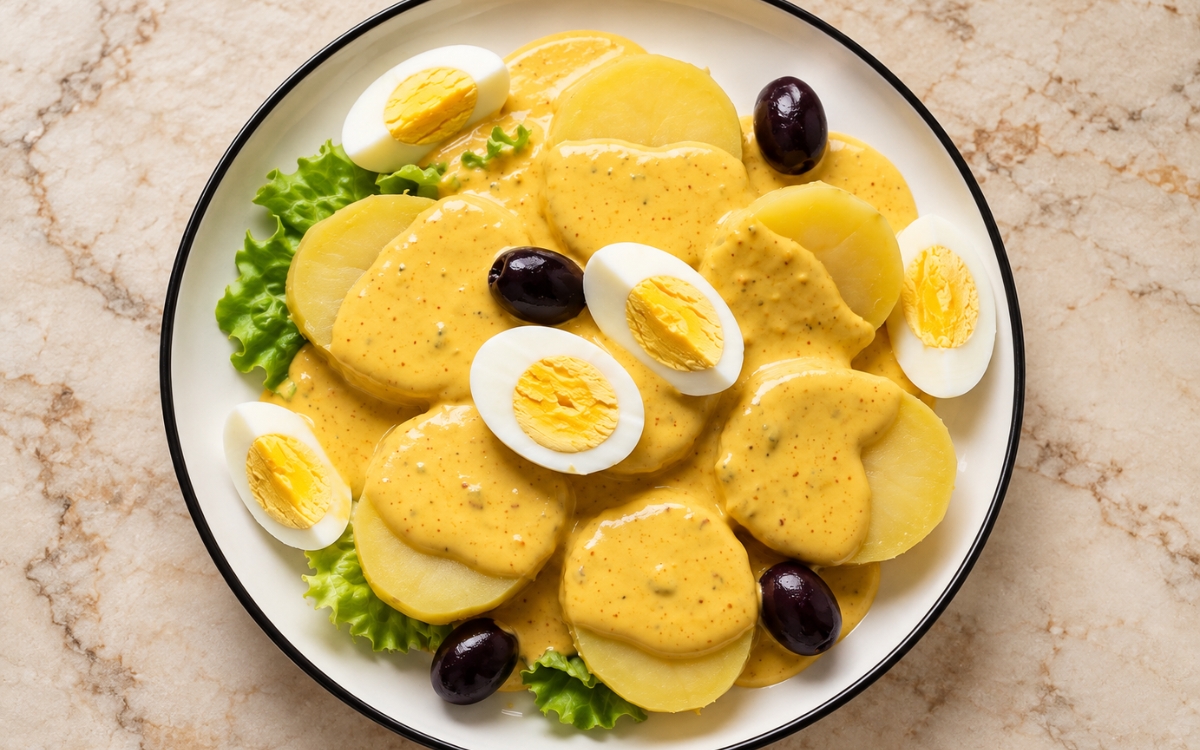
- Place 1 small lettuce leaf, or a bed of 2 smaller crisp pieces, on each of 4 plates. Arrange the sliced potatoes over the lettuce in a neat, slightly overlapping layer rather than a pile. Spoon the Huancaína sauce generously over the potatoes so most of the surface is covered and a little sauce naturally settles around them, while the shape of the slices stays identifiable underneath. Garnish each plate with 2 egg halves and 2 black olives, and serve cool or at room temperature. That generous but not drowning coat is what gives the dish its signature look of golden sauce, pale potato, and bright yolk.
Notes
The sauce consistency deserves genuine recognition as the technique most directly responsible for whether this dish reads as a proper Huancaína or a pale cheese soup. Evaporated milk added gradually keeps the sauce thick enough to coat the potatoes generously yet fluid enough to flow around them, whereas a single large pour makes it watery and sends it running off the slices.
Starting the potatoes in cold water deserves the same attention this technique receives throughout this collection’s other potato and root-vegetable dishes. Dropping them into boiling water cooks the outside long before the heat reaches the centre — the exterior turns crumbly and waterlogged while the core stays firm, and neither survives thick slicing or a generous coating of sauce.
The cracker or soft white bread deserves genuine respect as the detail most directly responsible for the smooth, stable texture of the sauce. Its starch absorbs the oil and milk and holds the blended cheese in suspension, so the sauce thickens evenly and stays creamy and glossy instead of turning grainy or separating into a greasy layer.
Serving the dish cool or at room temperature deserves attention as a genuine, checkable serving cue rather than a matter of taste. Warm potatoes soften and thin the sauce where it touches them, so the coating slides off and pools on the plate, while cooled slices stay firm and let the golden sauce sit thick and cleanly on top.