Ingredients
Method
Salt the Tomatoes First
- Add the 400g of heirloom tomato wedges and 250g of halved cherry tomatoes to a large, wide serving bowl. Season generously with fine sea salt — more than feels instinctively correct for a salad, because the salt is not only seasoning the tomatoes but actively drawing out their juice, which becomes the primary liquid component of the final dressing. Toss gently and allow to sit at room temperature while every other component is prepared — a minimum of 15–20 minutes. This is not a passive waiting step; it is the most important single preparation in the recipe. The accumulated tomato juice at the bottom of the bowl after 15–20 minutes — sweet, complex, lightly acidic, carrying the tomatoes' full flavour — is what makes panzanella a cohesive, unified salad rather than vegetables and bread with dressing. Without this juice, the sourdough absorbs only the vinaigrette and the salad tastes dry and disconnected; with it, the bread absorbs a combination of tomato essence and seasoned dressing that produces a specifically more complex, more Tuscan result.
Macerate the Onion and Build the Vinaigrette
- Add the ½ red onion sliced into thin feathers to a small bowl. The feather cut — slicing from the root to the tip following the onion's natural curve rather than slicing across it — produces thinner, more supple, more evenly flavoured pieces that integrate into the salad better than rings or half-rings. Add the minced or grated garlic clove, 2 tbsp of red wine vinegar, and the finely chopped thyme leaves. Stir briefly and allow to macerate for 10 minutes. The macerating period is the technique that produces the sharp, lightly pickled onion character specific to panzanella — different from raw onion's aggressive pungency and different from a cooked onion's sweetness. Over 10 minutes, the red wine vinegar's acid draws out the onion's harshest sulfur compounds through osmosis and lightly pickles its surface, producing a more pleasant, more specifically acidic onion that contributes to the dressing's character rather than dominating it. The garlic simultaneously loses some of its raw sharpness in the vinegar's acid environment. After 10 minutes, whisk in 5–6 tbsp of extra-virgin olive oil, a pinch of black pepper, and a small pinch of salt until the dressing is combined. The vinaigrette will not fully emulsify without a binding agent but will combine sufficiently with whisking to distribute evenly when poured.
Tear and Toast the Sourdough
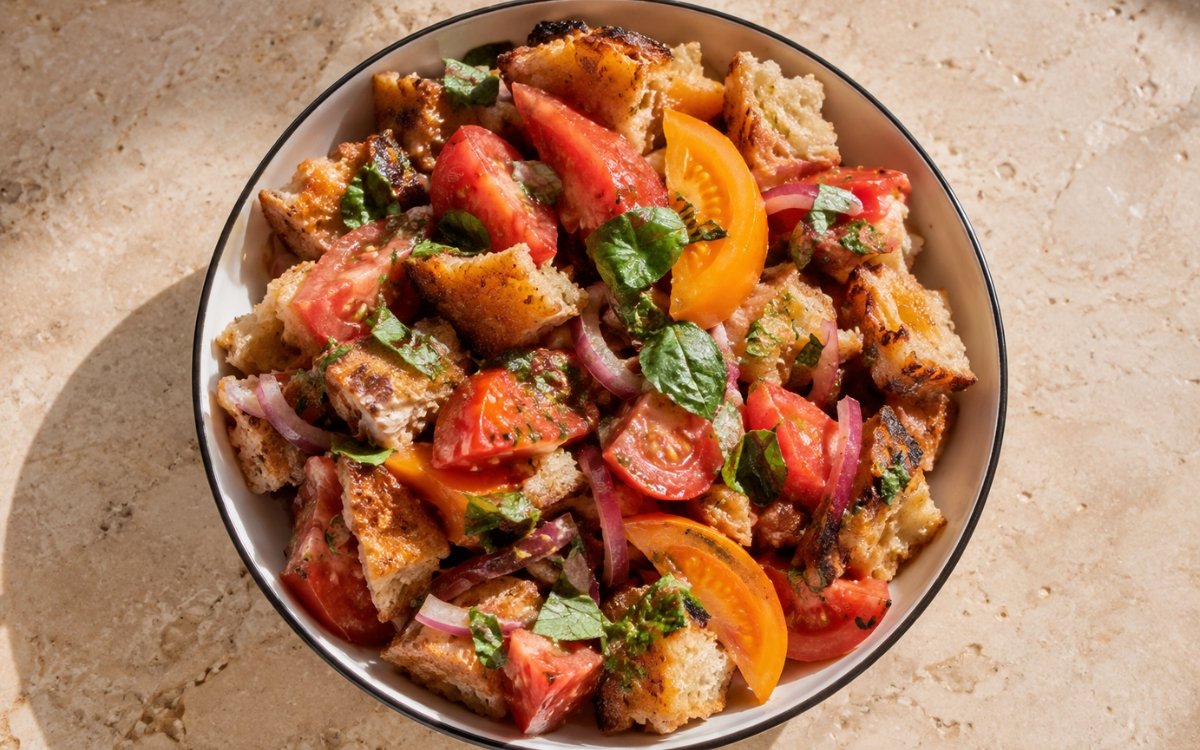
- Tear the 180g of sourdough bread by hand into rough, irregular chunks — varying in size from roughly 2cm to 4cm. The hand-tearing rather than knife-cutting is the specific texture decision that makes panzanella's bread component work properly. Cut bread has smooth, sealed surfaces produced by the knife blade compressing the crumb — these surfaces absorb dressing and tomato juice slowly and unevenly from the cut face only. Torn bread has rough, jagged, irregular surfaces — compressed crumb alongside fully open crumb structure exposed at every tear point — that absorb liquid rapidly and from multiple directions simultaneously. The irregular size variation also produces the specific rustic appearance that distinguishes panzanella from a crouton salad. Toss the torn sourdough chunks with the 2 tbsp of olive oil in a bowl until every surface is lightly coated. Toast using one of the following methods: In an air fryer at 190°C for 4–6 minutes — the most efficient method, producing even crisping across every surface simultaneously. In the oven at 200°C for 8–10 minutes, turning once at the midpoint. In a pan over medium heat, tossing every 60–90 seconds until golden at the edges. The target texture is bread that has developed a definite crust and golden colour on its exterior surfaces while retaining some chew at its centre. Fully dried, uniformly crunchy croutons are specifically wrong for panzanella — they absorb the dressing and tomato juice too rapidly and produce a uniformly soggy, dissolved bread within the resting period. Bread with crust-and-chew absorbs at the correct slower rate, retaining some textural identity in the finished salad while still becoming saturated with the tomato-dressing mixture.
Combine and Rest
- To the bowl of salted tomatoes and their accumulated juice, add the toasted sourdough, the torn basil leaves, and the vinaigrette with all the macerated onion, garlic, and thyme. Toss everything together thoroughly — turning the salad over itself repeatedly so the bread pieces come into contact with the tomato juice and dressing on all surfaces. The bread will immediately begin absorbing the liquid. Allow the assembled salad to rest for 10 minutes at room temperature before serving. During this rest the sourdough's interior absorbs the tomato juice and dressing progressively — the bread becoming saturated from the inside out rather than merely coated on the surface — and the flavours of every component integrate. The 10-minute rested panzanella tastes cohesive and specifically Tuscan; the immediately-served version tastes of separate components that happen to be in the same bowl.
Taste, Adjust, and Serve
- After the 10-minute rest, taste and make final adjustments: additional red wine vinegar if the brightness is insufficient; additional salt if the tomatoes and bread taste flat; additional olive oil if the dressing needs more body. The salad should taste of ripe, sweet tomatoes, slightly pickled onion, and sourdough that has absorbed all of the above — vivid, acidic, herbaceous from the basil and thyme, and specifically Italian in its simplicity. Serve slightly warm from the resting period or at room temperature. Cold panzanella from the refrigerator mutes the tomato and olive oil flavours — this is a room-temperature dish.
Notes
Heirloom tomatoes are the specific tomato for this recipe rather than beefsteak or Roma — their varietal diversity produces a bowl with tomatoes that differ slightly in acidity, sweetness, and texture from each other rather than a uniform single note. Combining 2–3 different heirloom varieties alongside cherry tomatoes produces the visual variety of different colours alongside the flavour variety of different sugar-to-acid ratios in the accumulated juice. The cherry tomatoes specifically provide the highest sugar concentration and brightest acidity among the tomatoes — their juice disproportionately sweetens and brightens the accumulated liquid.
Sourdough is specified rather than white sandwich bread, ciabatta, or baguette for the specific character its slightly tangy, open-crumbed, more robust structure provides. Sourdough's acidity complements the red wine vinegar and tomato's acid without competing; its denser, more open crumb absorbs the tomato juice at the correct rate — quickly enough to be saturated within the 10-minute rest but slowly enough to retain some textural identity. Bread with less structure — baguette, white sandwich loaf — absorbs too rapidly and dissolves into a mushy, undifferentiated mass.