Ingredients
Method
Dissolve the Honey in Citrus Juice Without Heat
- Add the 60g of honey and the zest of ½ orange to a medium mixing bowl. Pour the 30ml of fresh lemon juice over the honey and zest. Whisk vigorously until the honey is fully incorporated into the lemon juice — the lemon juice's acidity specifically aids in dissolving honey at room temperature more efficiently than plain water, and the small volume relative to the honey quantity means the whisking is essential rather than optional. Continue whisking until the mixture appears uniformly syrupy and no streaks of undissolved honey remain at the bowl's bottom. Gradually add the 120ml of fresh orange juice in four increments — pouring approximately 30ml at a time and whisking between each addition. The incremental addition rather than a single pour ensures the honey dissolves uniformly into the expanding liquid rather than clumping as the surface-tension is disrupted too rapidly by a large addition. The honey should be fully dissolved in the combined citrus juice by the final addition. The gradual-add technique is also the approach that prevents the aromatic compounds in the freshly squeezed orange juice from being disrupted by vigorous whisking of a large volume. The no-heat approach is the defining technique decision of this recipe. All volatile aromatic compounds in fresh orange juice — the limonene, neral, geranial, and various terpene family compounds that produce fresh orange juice's specifically bright, vivid citrus character — are fully present at the moment the fruit is squeezed and diminish rapidly at any elevated temperature. The lemon juice's compounds behave identically. By dissolving the honey without any heating, the entire aromatic profile of both citrus juices is preserved intact from preparation through serving.
Cold Zest Infusion
- Cover the bowl with a plate or plastic wrap and allow to stand at room temperature for 15 minutes. During this infusion period the orange zest's aromatic oils — concentrated in the coloured outer layer of the orange's peel — release progressively into the surrounding honey-citrus mixture. The zest's primary aromatic compounds (limonene, beta-myrcene, and various orange-specific terpenes) are fat-soluble and preferentially dissolve into the honey's sugar matrix rather than the more watery citrus juice, producing a specifically integrated aromatic depth in the honey component that makes each spoonful more aromatic than the juice alone. 15 minutes at room temperature is the optimal window — shorter provides less zest infusion; longer begins to make the zest's more bitter pith-adjacent compounds noticeable.
Strain and Add Orange Blossom Water
- Strain the mixture through a fine-mesh sieve into a clean jug, pressing lightly on the zest to extract any remaining infused liquid. The pressing should be light — the zest at this stage has given up its aromatic oils readily and forceful pressing would extract the slightly bitter white pith compounds. Discard the zest. Stir in the 10ml of orange blossom water. This is the most carefully calibrated quantity in any recipe in this collection: orange blossom water — the hydrosol produced during the steam distillation of Seville orange blossoms (Citrus aurantium), the same process that produces neroli oil — is among the most intensely aromatic culinary ingredients available. At 5ml in this quantity of base the floral note is subtle and might be missed entirely by some; at 15ml it becomes specifically perfumed, soapy, and dominant in a way that many people find unpleasant. At 10ml it is unmistakably present — floral, specifically fragrant, and identifiable — without crossing into the perfumed territory. Always add the precise quantity rather than approximating, and always taste before adding more. Transfer to the refrigerator and chill until cold — 15–20 minutes.
Prepare the Orange Peel Garnish
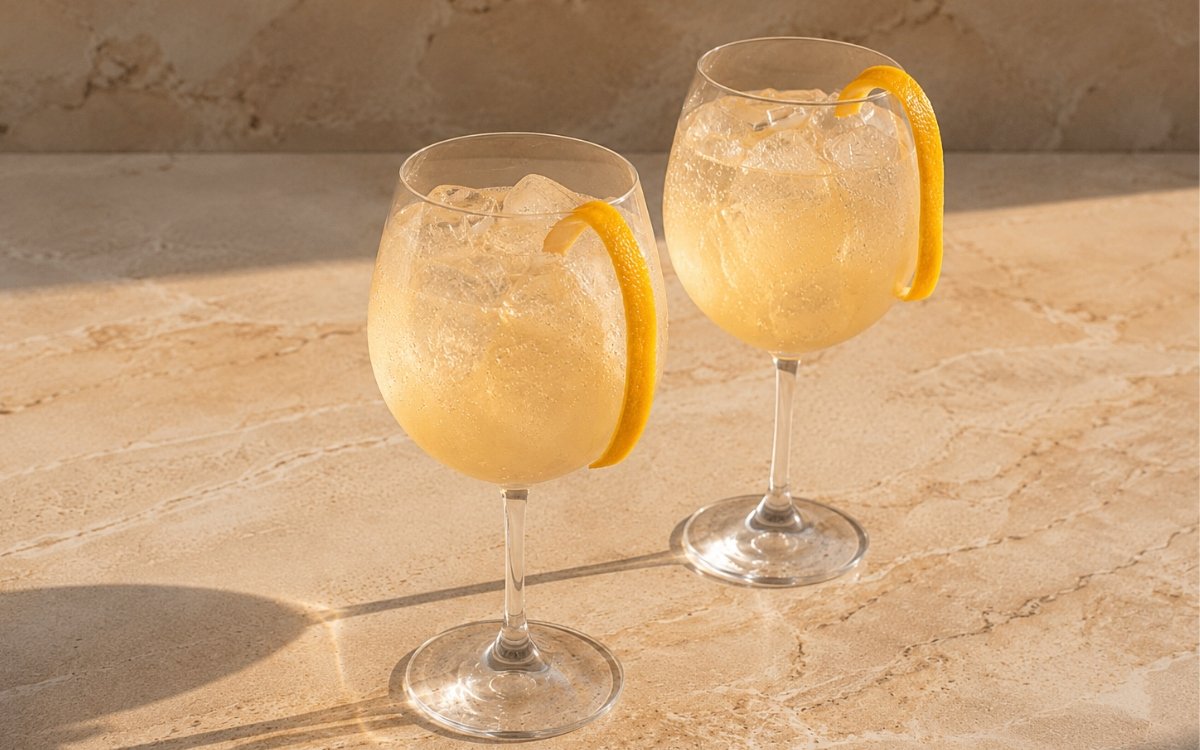
- Using a vegetable peeler, press firmly against the clean orange's surface and peel 4 long strips — each approximately 10–12cm long and 1.5cm wide — following the orange's curve with each pull for the cleanest, most continuous strips. The white pith on the underside of each strip should be minimal — a vegetable peeler set to a light angle produces strips with primarily coloured zest and minimal pith. Curl each strip around a bar spoon or a finger and allow it to hold its curl shape for a few seconds before releasing — the peel will retain the curl naturally. Set aside for garnishing.
Assemble and Serve
- Fill four wine glasses generously with ice cubes. Divide the chilled orange blossom base evenly — approximately 65–70ml per glass. Stir briefly against the ice. Top each glass with approximately 125ml of chilled club soda, poured gently down the inner side of the glass. Stir once or twice gently. Hook each curled orange peel strip over the rim of its glass — the curl hanging both inside and outside the glass, visually framing the pale golden drink. Serve immediately.
Notes
Orange blossom water is produced as a byproduct of neroli essential oil distillation — when Seville orange blossoms (bitter orange blossoms, Citrus aurantium) are steam-distilled for neroli oil, the steam condensate that separates from the oil is orange blossom water. It contains the same volatile aromatic compounds as neroli oil but at a much lower, food-appropriate concentration. It is a foundational ingredient in Middle Eastern and North African pastry and drink-making, appearing in baklava, ma'amoul cookies, Lebanese rice pudding, and countless traditional preparations. Available at Middle Eastern grocery stores, specialty food shops, and increasingly at mainstream supermarkets in the baking section. The quality and concentration varies significantly between brands — some are intensely aromatic and require less than specified; others are diluted and require slightly more. Always taste and adjust.
The preparation is classified as an aperitif mocktail specifically because of its flavour profile: the orange blossom's floral, slightly bitter-floral character alongside the citrus's brightness and the honey's gentle sweetness produces a clean, aromatic, lightly bitter combination that opens the appetite rather than providing the dessert-adjacent sweetness of many fruit-based mocktails. Serve before a meal with light appetisers — the combination of orange, honey, and orange blossom is specifically complementary to almonds, pistachios, fresh cheese, and mezze preparations.