Ingredients
Method
Char the Red Bell Peppers
- Preheat your oven to its broiler setting on the highest heat and position the rack close to the broiler element — approximately 10cm below it. Deseed the bell peppers by cutting off the tops and bottoms and slicing the four curved walls of flesh away from the central seed column, producing four flat pieces per pepper. Trim any remaining white pith or seed membrane from the inside of each wall piece — the pith is bitter and should be removed. Cut each flat wall piece into 4–5cm chunks. Place all the pepper pieces on a large rimmed baking sheet with the skin side facing up toward the broiler element — this orientation is deliberate and essential. With the skin facing the direct radiant heat of the broiler, the skin will blister, char, and caramelise while the cut interior heats and softens against the hot tray. You are aiming for black blisters covering most of the skin surface — irregular, dramatic charring with some patches remaining deep red rather than uniformly black. Uniformly black skin indicates the pepper has cooked past the point of caramelised sweetness into bitterness. The target is deeply blistered skin covering the majority of the surface with the flesh underneath fully softened and slightly collapsed. Broil for approximately 12–15 minutes, watching carefully from the 10-minute mark. Remove when the target charring is achieved. Allow to cool for 3–4 minutes. If you prefer the smoky character of the charred skin in the finished muhammara — which adds genuine depth — leave the skins on when transferring to the food processor. If you prefer a cleaner, brighter pepper flavour without any bitterness from the char, peel the skins away after cooling — they slip off easily from the blistered flesh. Either approach is correct and both produce excellent muhammara.
Toast the Walnuts and Bread
- While the peppers are under the broiler, prepare the walnut-bread base. Place a dry skillet over medium heat and add the walnuts first, spreading them in a single layer. Toast, stirring frequently, for approximately 2 minutes — the walnuts should be fragrant and showing very faint golden coloration on their surfaces but not darkened or smelling of burnt fat. Walnut fat content is high enough that they move from toasted to burnt in under a minute at medium heat if left unattended. After 2 minutes of walnut toasting, add the bread cubes to the same pan and continue toasting everything together, stirring constantly. The bread cubes need 2–3 additional minutes to turn golden and dry — they are ready when they feel crisp, have taken on an even golden colour on most surfaces, and smell of toasted bread. The bread in this recipe serves a specific structural function: it thickens the muhammara, gives it body and a slightly grainy, paste-like texture rather than the smooth, liquid consistency that pepper and walnut alone would produce, and contributes a mild, neutral toasted-grain flavour that grounds the more assertive ingredients. If using panko breadcrumbs rather than bread cubes, the same toasting applies — add the panko after the walnuts and toast together, stirring constantly, for 1–2 minutes until golden.
Process the Walnut and Bread Mixture
- Transfer the toasted walnuts and toasted bread to a food processor. Process on continuous high speed for 60–90 seconds, stopping once to scrape down the sides, until the mixture is ground to a fine, uniform crumb — the texture of a coarse nut flour rather than a paste. This fine-ground walnut-bread base is what gives muhammara its distinctive thick, slightly granular texture rather than the smooth, creamy consistency of a pure pepper dip. Do not over-process to a paste — the small, distinct walnut and bread particles are part of the muhammara's textural identity.
Add All Remaining Ingredients and Process
- Add the roasted pepper pieces to the food processor with the ground walnut-bread mixture. Add the garlic cloves — smashed or roughly chopped for more even processing. Add the olive oil, 1 tablespoon of pomegranate molasses as the starting amount, the lemon juice, Aleppo pepper, ground cumin, and fine sea salt. Process using a deliberate pulse technique rather than continuous blending — 5 seconds on, 2 seconds off, repeating 8–10 times. The pulse method gives you control over the final texture in a way that continuous blending does not. Muhammara should have a smooth overall consistency with visible small texture remaining — not a completely homogeneous paste, not a chunky rough blend, but a thick, spreadable mixture with a slightly rustic surface texture that retains visual character. Continuous blending produces a smooth, uniform paste that loses the character and personality of the individual ingredients. After 8–10 pulse cycles, check the texture — if it needs to be smoother, continue pulsing; if it has already reached the desired consistency, stop immediately.
Taste and Calibrate
- Stop the processor and taste carefully — this is the most important step in the recipe and cannot be rushed. Muhammara operates on a four-dimensional flavour balance that requires active management: sweetness from the pomegranate molasses, acidity from the lemon juice and the molasses's own tartness, heat and fruity warmth from the Aleppo pepper, and savory depth from the roasted pepper and walnut. Evaluate each dimension independently. If the dip tastes flat and one-dimensional despite having all ingredients present, it needs more salt — salt amplifies every other flavour and is almost always the first correction. If it tastes heavy and lacks brightness, it needs more lemon juice — add ½ tsp increments. If it needs more sweetness and depth, add additional pomegranate molasses — add ½ tbsp increments and process briefly after each addition, reassessing both the flavour and the consistency, as additional molasses loosens the texture. If the warmth from the Aleppo pepper is not present in the background, add a small additional amount. The finished muhammara should taste complex, assertive, and complete — every component should be perceptible in a balanced way, with no single element dominating.
Prepare the Garnish
- For the most visually striking presentation, prepare the garnish immediately before serving. Place 2–3 walnuts on a cutting board and roughly crush them with the flat side of a knife or the bottom of a heavy pan — the target is irregular shards and small pieces rather than a fine crumble, which would disappear visually against the muhammara. In a small dry pan over medium heat, add 1 tsp of cumin seeds and toast for 60–90 seconds, stirring continuously, until the seeds are fragrant and have taken on a slightly darker colour. Remove immediately from the heat — cumin seeds move from fragrant to burnt very quickly once fully toasted. Allow the seeds to cool for 60 seconds before scattering over the finished dip.
Serve
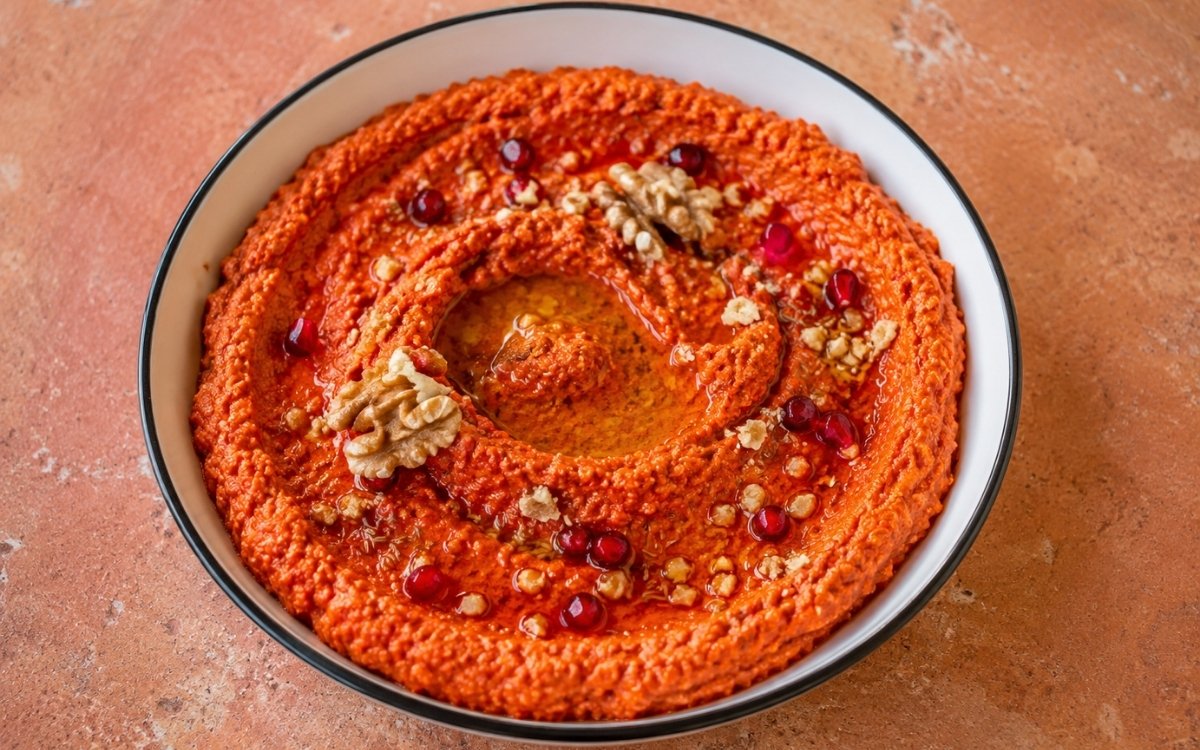
- Transfer the muhammara to a wide, shallow serving bowl. Using the back of a spoon, create a shallow well or swooping surface — press and sweep from the centre outward in a single circular motion, building a slight ridge at the outer edge and a depression in the centre. Drizzle extra-virgin olive oil generously over the entire surface — the oil pools in the well and gives the muhammara its characteristic glossy finish. Add a few drops of pomegranate molasses over the surface in an irregular, non-uniform pattern — not poured evenly, but dripped in a loose spiral or scattered drops that provide visual contrast and concentrated flavour hits at the surface. Scatter the toasted cumin seeds across the surface. Distribute the roughly crushed walnut pieces across the top. Scatter the pomegranate seeds last — their vivid ruby red provides the visual contrast against the deep red-orange muhammara that makes the dish immediately striking. Serve with warm Homemade Lavash, Fresh Pita Flatbread, or torn Sourdough Bread.
Notes
Muhammara is a Syrian dip originating in Aleppo — the city whose name it shares with its defining spice. Aleppo pepper (Pul Biber in Turkish) is a specific dried chili variety grown in the Aleppo region with a distinctive flavour profile: moderately spicy, slightly fruity, oily, and with a mild saltiness from the curing process. Its heat is building and warm rather than sharp, and its fruity complexity distinguishes it completely from generic dried chili flakes, cayenne, or paprika. Aleppo pepper is what makes muhammara taste specifically like muhammara — its character is not replicable by any other single spice. It is available at Middle Eastern grocery stores, specialty spice shops, and online. If genuinely unavailable, a combination of ½ tbsp sweet paprika, ½ tbsp smoked paprika, and a small pinch of cayenne is the closest functional substitute, but the result will lack the fruity depth of the original.
Pomegranate molasses varies considerably in concentration, sweetness, and acidity between brands. Some are thick, intensely sweet, and barely tart; others are thin, very sour, and barely sweet. Starting with 1 tablespoon and adjusting after tasting is essential — adding the full 3 tablespoons of a very concentrated, sweet molasses would make the muhammara unpleasantly sweet, while 1 tablespoon of a thin, sour version may be insufficient to register. Always taste after each addition and let your palate guide the quantity.
The walnut-bread thickener is the structural decision that gives muhammara its body and distinguishes it from a simple roasted pepper sauce. The walnuts contribute nutty fat richness and a slightly bitter edge that balances the sweetness of the roasted pepper and the molasses. The bread contributes neutral starch body that thickens the dip without adding competing flavour. The specific ratio of 100g walnuts to 60g bread at this quantity of pepper produces a muhammara that holds its shape on a spoon and spreads cleanly on flatbread without running — the correct consistency for a dip that will be served at a table. More bread produces a thicker, drier result; less bread produces a more liquid, sauce-like consistency suited to using as a pasta sauce or protein accompaniment.