Ingredients
Method
Loosen the Rice
- Tip the 600g of cold day-old rice into a large bowl and break up every clump gently with clean hands or a fork until the grains fall apart individually. If the rice is very firm from the refrigerator, drizzle over 1 tsp sesame oil and toss lightly with your fingertips to coat the grains. Work gently so the grains separate without being crushed into paste. Set the bowl beside the stove. That loosening is what lets the dry, firm grains fry on contact with the hot pan instead of steaming into one dense mass.
Prep the Flavour Base
- Chop the 220g of kimchi into small bite-size pieces and measure out the 3 tbsp of kimchi juice. Slice the 3 scallions thinly, keeping the white parts separate from the green tops, and mince the 2 garlic cloves. Dice the 180g of pork belly into small pieces about 1cm across so they brown quickly. In a small bowl, stir together the 1 tbsp gochujang, 1½ tsp soy sauce, 1 tsp sugar, and the kimchi juice until smooth and evenly red. That single mixed liquid is what colours and seasons the rice in one pour, with no pooling or last-minute splashing.
Render and Brown the Pork
- Heat a wok or large skillet over medium-high heat for about 1 minute, then add the diced pork in a single layer. Cook, stirring only occasionally, for 5–7 minutes until the fat has rendered and the meat is browned with caramelised edges. If more than about 1½ tbsp of fat has collected, spoon off the excess and discard it, and if the pork is lean and renders very little, add 1 tbsp neutral oil. That patient browning is what flavours the whole dish, because the rendered pork fat carries its savoury note into every grain.
Fry the Aromatics and Kimchi
- Add the scallion whites and minced garlic to the pork and stir-fry for 20–30 seconds, just until fragrant and not browned. Add the chopped kimchi and stir-fry for 2–3 minutes until it softens, its moisture reduces slightly, and the edges begin to catch and caramelise on the pan. Let a few pieces rest undisturbed for 10–15 seconds at a time so they pick up colour. That frying is what removes the raw sharpness of the kimchi and deepens it into a savoury, faintly sweet base.
Fry the Rice
- Add the loosened rice to the pan and pour in the kimchi juice mixture. Raise the heat to medium-high or high, break up any remaining clumps with the spatula, and stir-fry for 4–5 minutes until the rice is evenly orange-red, hot all the way through, glossy, and starting to pick up small charred spots. Cook in 2 batches if the pan looks crowded. Add 1 tsp sesame oil, ¼ tsp black pepper, and all but a small handful of the scallion greens, then toss for 10 seconds. That high heat is what fries rather than steams the rice, keeping every grain separate and lightly smoky.
Fry the Eggs
- Take the pan off the heat and cover it so the rice stays hot. In a separate nonstick skillet, heat 1½ tsp of the neutral oil over medium heat, crack in 2 eggs, and fry for 2–3 minutes until the whites are fully set, the edges are lightly crisp and lacy, and the yolks are still runny. Slide them onto a plate and repeat with the remaining 1½ tsp oil and 2 eggs. That soft yolk is what breaks into a silky sauce over the hot rice, while the crisp edge adds contrast.
Assemble and Serve
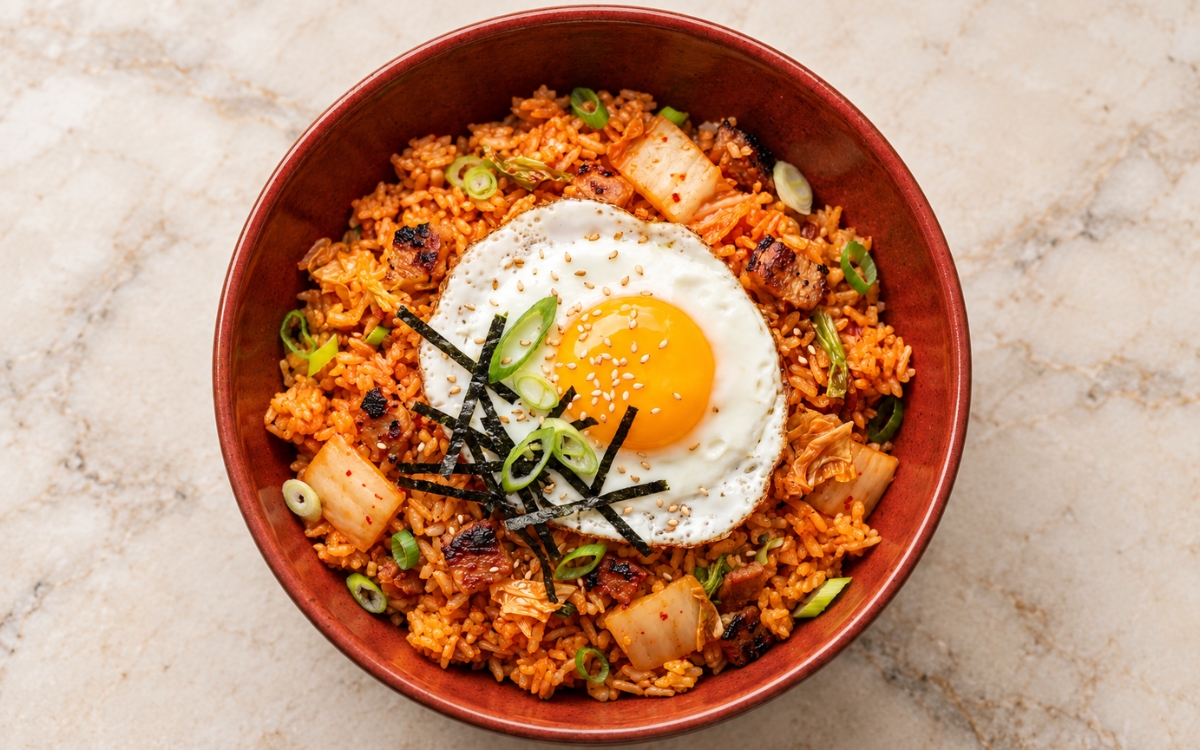
- Divide the fried rice among 4 bowls, mounding it loosely rather than packing it down. Set 1 fried egg in the centre of each bowl. Scatter the 2 tsp toasted sesame seeds over the top, lay on the thin strips of roasted seaweed, and finish with the 1–2 extra sliced scallions and the reserved scallion greens. Serve immediately while hot. That loose mounding and immediate serving are what keep the rice light and the yolk runny when the bowl reaches the table.
Notes
Frying the kimchi before the rice goes in deserves genuine recognition as the technique most directly responsible for the deep, savoury flavour of this dish. Kimchi straight from the jar is sharp, acidic, and wet — two to three minutes in the hot pork fat cooks off that moisture and caramelises its sugars, so the rice tastes properly fried and rounded rather than simply sour.
Using cold, day-old rice deserves the same attention this technique receives throughout this collection’s other fried rice dishes. Freshly cooked rice carries surface moisture and soft, swollen starch that mash and clump under the spatula, while chilled rice has firmed and dried enough to fry into separate grains that stay visible in the finished bowl.
Browning the pork slowly deserves genuine respect as the detail most directly responsible for the caramelised, savoury background of the whole pan. Pulling it early leaves pale meat and unrendered fat, whereas patient rendering gives crisp-edged pieces and a flavourful fat that coats the kimchi and rice, with bacon as a practical substitute when pork belly is hard to find.
Judging the kimchi juice deserves attention as a genuine, checkable seasoning cue rather than a loose guess. If the kimchi is not very sour, an extra ½ to 1 tsp of kimchi juice or a small splash of rice vinegar restores the tang, but too much liquid steams the rice, so add it a little at a time and stop once the grains are evenly coloured yet still individually visible.