Ingredients
Method
Salt and Drain the Cabbage
- Place the finely chopped napa cabbage in a bowl and toss with the 6g salt. Let sit for 15–20 minutes until wilted and releasing moisture. Squeeze the cabbage very firmly by hand or in a clean kitchen towel to remove as much liquid as possible. The cabbage must be well drained or the filling will turn watery and can split the wrappers or make the dumplings soggy. That aggressive squeezing removes moisture the cabbage would otherwise release directly into the filling once mixed, protecting both the filling's own texture and the wrappers it's about to be sealed inside.
Make the Filling
- In a mixing bowl combine the ground pork, squeezed cabbage, garlic chives, scallions, ginger, garlic, soy sauce, sake, sesame oil, sugar, white pepper, and cornstarch or potato starch. Mix vigorously for 2–3 minutes until the filling becomes sticky, cohesive and slightly tacky. The filling should bind together and cling to the bowl slightly. If it still looks loose and crumbly, keep mixing a little longer. That vigorous, sustained mixing works the pork's own proteins into a genuinely cohesive matrix, which is directly what lets the filling hold its shape cleanly once it's spooned into individual wrappers.
Fill and Shape the Gyoza
- Keep the wrappers covered so they do not dry out. Place one wrapper in your palm. Add about 1 heaped teaspoon to 1 tablespoon filling to the center, depending on wrapper size. Moisten the edge lightly with water. Fold into a half-moon and pleat the front edge toward the center, pressing firmly to seal. Keep the bottom fairly flat so the gyoza sit upright in the pan. Set the formed dumplings on a tray lightly dusted with starch or lined with parchment. Keep covered with a towel or plastic wrap. Press out excess air while sealing. Any gaps will open during steaming. Deliberately pressing out trapped air before sealing each pleat protects the dumpling from a real, specific risk — any pocket of air left inside would expand under the steaming stage's own heat, forcing the seal open.
Make the Dipping Sauce
- Mix together the soy sauce, rice vinegar, chili oil and sesame seeds. Add scallion if using. Set aside. Having the sauce fully mixed and ready well before the dumplings ever hit the pan means it's simply waiting at the table the moment the first hot batch is ready to serve.
Pan-Fry and Steam the Gyoza
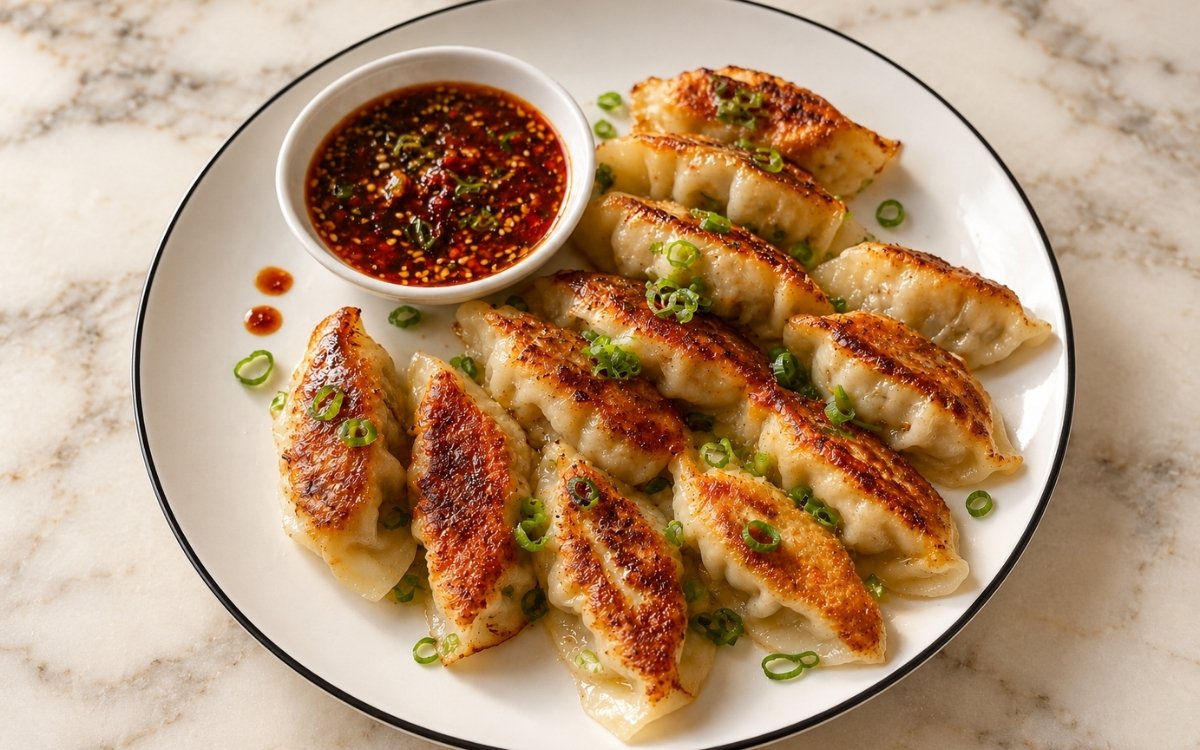
- Cook in batches. Heat a nonstick or well-seasoned skillet over medium heat. Add enough neutral oil to thinly coat the base. Arrange the gyoza flat-side down in the pan, close together but not crushed. Fry for 2–3 minutes until the bottoms are evenly golden brown. Add 60–80ml water to the pan and immediately cover with a lid. Steam for 3–4 minutes, until the wrappers turn slightly translucent and the filling is cooked through. Uncover and let the remaining water evaporate. Cook 1–2 minutes more so the bottoms re-crisp. Transfer to a plate with the browned side showing. Repeat with the remaining dumplings. Add the water only after the bottoms are properly browned. Do not move the dumplings too early or the skins may tear. The final uncovered stage is what brings back the crisp base. That specific sequence — brown first, then steam, then re-crisp — is what delivers both textures in the same dumpling: a genuinely crisp base developed before any moisture is introduced, and a tender, cooked-through top and filling from the covered steaming stage that follows.
Serve
- Serve hot with the dipping sauce. Serving each batch immediately, straight from the pan, delivers the dumplings at their intended contrast — that crisp, just-recrisped base begins softening the moment the gyoza sit, working against the whole point of the final uncovered cooking stage.
Notes
Salting and thoroughly squeezing the napa cabbage before it ever joins the pork deserves genuine recognition as the technique most directly responsible for whether these gyoza turn out cohesive or watery. The recipe's own explicit warning that unsqueezed cabbage can split the wrappers or make the dumplings soggy reflects a real, common failure point — that aggressive squeezing removes real, considerable moisture before it ever has the chance to work against the filling's own texture.
Mixing the filling vigorously until it turns genuinely sticky and cohesive deserves the same attention this technique receives throughout this collection's other ground meat dumpling fillings. That sustained mixing develops the pork's own protein structure into something that actually binds and holds shape, rather than staying loose and crumbly once it's portioned into individual wrappers.
Pressing out excess trapped air while sealing each dumpling deserves genuine attention as a small but consequential detail specific to gyoza's own two-stage cooking method. Any air pocket left behind expands under the steaming stage's heat, and that expansion is exactly what forces weak seals open — thorough sealing at this stage protects the dumpling right through both frying and steaming.
The specific sequence of pan-frying, then steaming, then uncovering to re-crisp deserves recognition as the technique responsible for gyoza's whole defining textural contrast. Each stage does genuinely distinct work — browning the base first, steaming the top and filling through, then re-crisping the base once more — and skipping or reordering any one of these stages would compromise the finished dumpling's signature combination of crisp bottom and tender top.