Ingredients
Method
Cook the Rice
- Rinse the 360g of Japanese short-grain rice in cold water, swirling and draining several times, until the water runs mostly clear, then drain well. Cook it with water measured according to your rice cooker or usual method, using short-grain rice rather than jasmine, and start it before anything else so it finishes while the pork is frying. Rest the rice covered for 10 minutes after cooking, then fluff it gently with a paddle, keeping the grains moist and tender rather than dry. That moist, lightly sticky texture is what lets the rice absorb a little broth later without turning pasty.
Prep the Pork
- Trim the excess fat from the 4 pork cutlets, about 170–200g each, and make 2–3 small cuts through the outer fat edge of each one so the cutlet stays flat instead of curling in the oil. If needed, lightly pound the pork to an even thickness of about 1.5 cm, then season both sides with salt and black pepper. Set the cutlets aside while you arrange the breading station. That even thickness is what lets the whole cutlet cook through at the same rate, so the thin edges do not dry out before the centre is done.
Bread the Cutlets
- Set out three shallow bowls: 80g of all-purpose flour in the first, 3 eggs beaten with 1 tbsp of water in the second, and 180–220g of panko in the third. Dredge each cutlet in the flour and shake off the excess, dip it in the egg, then press it into the panko, coating it thoroughly and pressing gently so the crumbs adhere. Use coarse panko rather than fine breadcrumbs, and rest the coated cutlets on a tray. That shaken-off flour layer is what stops the coating separating from the pork, and the coarse panko is what gives the craggy tonkatsu crust katsudon needs.
Fry the Tonkatsu
- Heat enough neutral oil for deep frying in a deep, heavy pot to 170–175°C. Fry the cutlets 1–2 at a time, depending on pot size, for about 3–4 minutes per side, until deeply golden and cooked through to at least 63°C in the centre, with the pork still juicy. Transfer each cutlet to a rack and rest for 3–5 minutes, then slice it into strips, keeping the pieces aligned in cutlet shape for easy transfer later. Do not overcrowd the oil, or the temperature drops and the crust turns greasy. That rest on a rack, rather than on paper towels, keeps the underside crisp while the juices settle, so slicing afterwards leaves the pork moist.
Mix the Katsudon Broth
- In a bowl or measuring jug, combine the 500ml of dashi, 60ml of soy sauce, 60ml of mirin, and 2 tbsp of sugar, then stir until the sugar fully dissolves. Taste it: the broth should be light and savoury, slightly sweet, and never harshly salty, because it will concentrate a little as it simmers. Keep the jug beside the stove, since each bowl uses about 120–140ml. This is a simmering broth rather than a thick sauce, and that thin, balanced consistency is what seasons the onion and the underside of the cutlet without drowning the crisp crumb.
Simmer the Onion
- For the most classical result, cook each bowl separately in a small skillet, or cook 2 servings at a time in a larger pan if you need to. For each serving, add about 120–140ml of broth to the pan along with one-quarter of the sliced onions, and have one sliced cutlet, 2 lightly beaten eggs, and a bowl of hot rice ready beside the stove. Bring the broth to a gentle simmer and cook for 2–4 minutes, until the onion softens and turns translucent without falling apart or browning. That head start is what lets the onion sweeten the broth before the cutlet goes in, so the crumb only needs a very brief soak.
Add the Cutlet and Egg
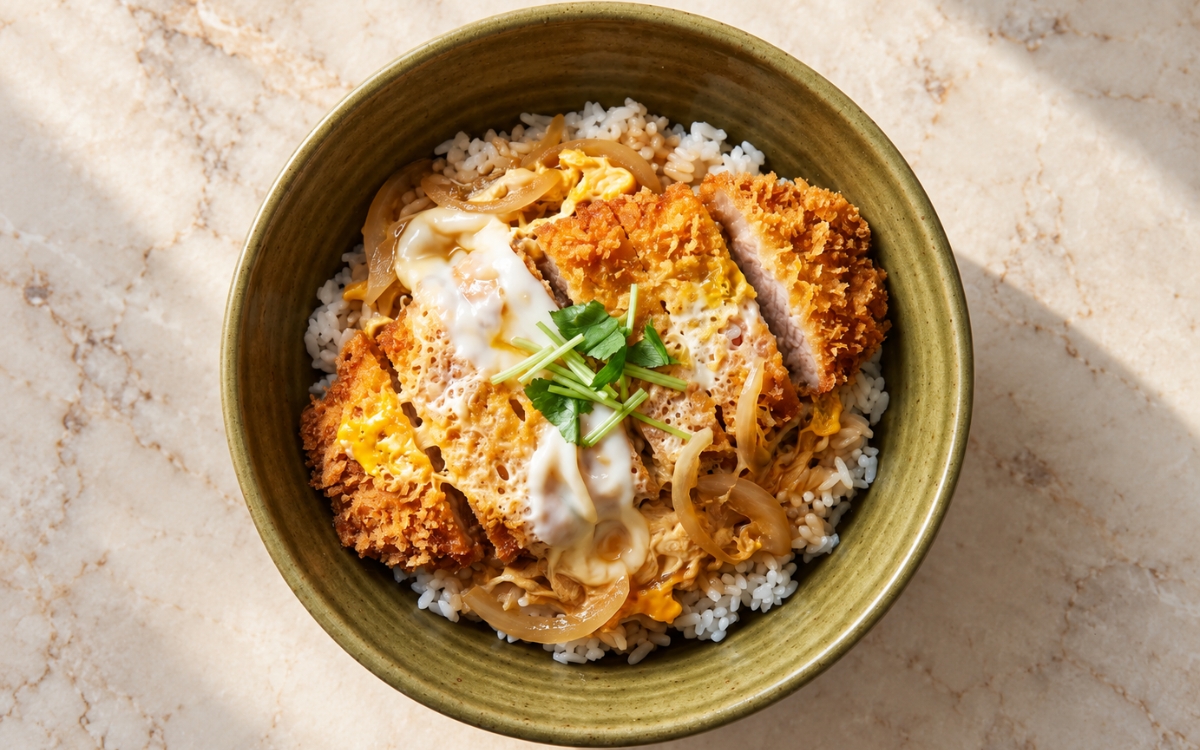
- Lay the sliced cutlet over the onion and simmer for 30–60 seconds, so the underside absorbs some broth and softens slightly while the top edges stay crisp. Pour the 2 lightly beaten eggs over and around the cutlet, aiming for uneven coverage so some pork remains visible. Cover the pan and cook on low for 30–60 seconds, just until the egg is softly set with custardy ribbons and a few slightly runny patches. Add the egg only when everything else is ready, because it cooks fast. That short, gentle finish keeps the egg glossy and the crust partly crisp, since a hard boil toughens the egg and soaks the crumb through.
Build the Bowls and Serve
- Divide the hot rice among 4 bowls, about 190–200g of cooked rice each, and slide each finished cutlet-onion-egg mixture over the rice in one piece, spooning in some of the broth from the pan. Garnish with the thinly sliced green onions, or with mitsuba added at the very end so it stays fresh and aromatic, and serve immediately. Repeat the onion, cutlet, and egg stages for each remaining bowl, so every serving is assembled just before it is eaten. That small amount of broth seasons and moistens the rice without flooding the bowl, leaving soft egg, juicy pork, some broth-soaked crumb, and a few still-crisp golden edges.
Notes
Frying the tonkatsu properly before it ever meets the broth deserves genuine recognition as the technique most directly responsible for the texture of the finished bowl. A genuinely deep golden cutlet holds a crisp crust that can survive a brief simmer, whereas a pale, under-fried cutlet dissolves into a soggy crumb the moment it touches the hot liquid.
Cooking each bowl separately in a small skillet deserves the same attention this technique receives throughout this collection’s other quick skillet dishes. A shallow pan keeps the broth, onion, and egg within easy reach and makes the exact moment to cover the pan obvious, whereas four portions in one large pan spread the egg thin and hide the doneness window.
A gentle simmer deserves genuine respect as the detail most directly responsible for tender egg and a crust that stays partly crisp. A hard boil toughens the egg into dry curds and soaks the breading through, which is why the burner stays low from the moment the cutlet goes into the pan and the egg is poured over it.
The softly set egg deserves attention as a genuine, checkable doneness cue rather than a loose approximation of timing. Glossy, custardy ribbons with a few slightly runny patches mean the pan is ready to leave the heat, because residual heat keeps setting the egg on the way to the table and a fully firm egg ends up dry.