Ingredients
Method
Prepare the Peppers
- Preheat the oven to 190°C / 375°F. Halve the bell peppers lengthwise through the stems to make 8 halves. Remove the seeds and white membranes. If needed, trim a very thin slice from the outside bottom of any unstable half so it sits flat, but do not cut through the flesh. Place the pepper halves cut-side up in a baking dish or snug oven-safe dish large enough to hold them in one layer. Drizzle with 1 tbsp olive oil and season with ½ tsp salt and ¼ tsp black pepper. Bake for 15 minutes to give them a head start. The peppers should just begin to soften but still hold their shape well. Do not fully cook them yet. That genuine head start is exactly what accounts for the peppers' own longer cooking time relative to an already-fully-cooked filling — without it, the final bake would need to fully tenderize the peppers while the filling risks drying out well before they're ready.
Cook the Rice
- While the peppers pre-bake, cook the rice in salted water until just tender. Drain well and spread briefly so excess steam escapes. You want about 450g cooked rice. The rice should be cooked but not wet or mushy. Excess water makes the filling loose. Spreading the drained rice briefly, rather than leaving it piled in the pot, lets residual steam escape rather than continuing to soften and wet the grains further.
Make the Filling Base
- Heat 1 tbsp olive oil in a large skillet over medium heat. Add the onion and cook for 5–7 minutes until softened and lightly translucent. Add the garlic and cook for 30 seconds. Add the ground beef and ground pork. Season with 1¼ tsp salt, ¾ tsp black pepper, oregano, dried basil, and chili flakes if using. Cook for 8–10 minutes, breaking the meat up well, until browned and no pink remains. If there is a lot of rendered fat, spoon off the excess, leaving about 1–2 tbsp in the pan. Stir in the tomato paste and cook for 1–2 minutes until slightly darkened. Add 300g passata or crushed tomatoes and simmer for 5–7 minutes until slightly thickened. The filling mixture should be rich and moist, but not watery. Most of the free liquid should be absorbed or reduced. That deliberate reduction protects the finished, stuffed peppers from turning watery once baked — any excess liquid left in the filling at this stage would only have more time to seep out and pool during the extended bake still ahead.
Finish the Filling
- Remove the skillet from the heat. Add the cooked rice, parsley, 40g Parmigiano-Reggiano, 180g mozzarella, and the beaten egg. Mix thoroughly. Taste and adjust seasoning. The filling should hold together when spooned and look moist, not loose. If it seems too wet, let it sit for 5 minutes or add a small spoonful of grated Parmesan. If too stiff, add 1–2 tbsp tomato sauce. That beaten egg, folded in specifically off the heat rather than over direct heat, is what binds the whole mixture into a cohesive filling — added while still hot, it would begin scrambling rather than binding evenly throughout.
Prepare the Baking Dish
- Spread 350g passata or crushed tomatoes in the bottom of the baking dish around and under the peppers. Stir in 1 tbsp olive oil, a pinch of salt, and 2 tbsp water only if the sauce is very thick. The sauce should form a shallow layer to keep the peppers moist as they bake. That shallow sauce layer beneath the peppers does real, active work throughout the bake — keeping the peppers' own exterior moist and preventing them from drying out or scorching against the direct heat of the dish.
Stuff the Peppers
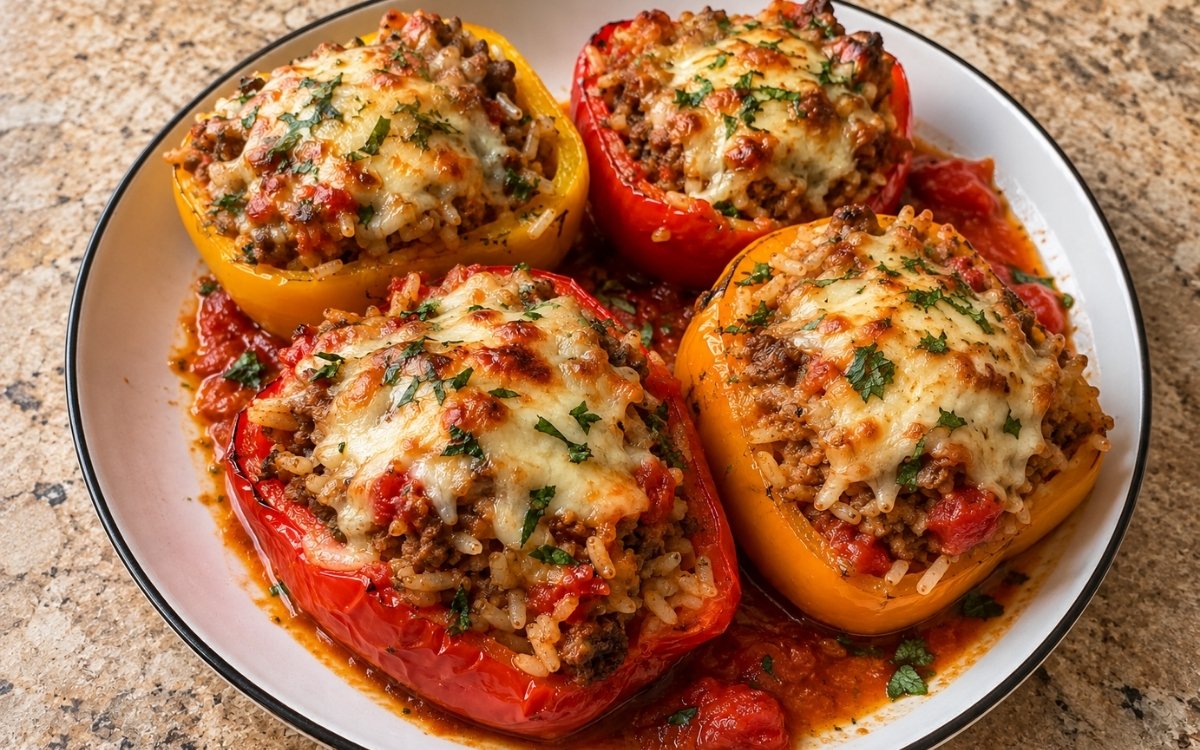
- Remove the partially baked peppers from the oven. Fill each pepper half generously with the meat-rice mixture, mounding it slightly. Pack the filling firmly enough so it stays in place, but do not compress it hard. Top evenly with 120g mozzarella and 20g Parmigiano-Reggiano. Each pepper should be well-filled and slightly domed, with cheese covering the top but not falling heavily into the sauce. That specific balance — firm enough to hold shape, gentle enough to avoid compacting — is what keeps the filling genuinely juicy and cohesive rather than pressed into something dense and dry.
Bake
- Cover the dish loosely with foil and bake at 190°C / 375°F for 25 minutes. Uncover and bake for another 15–20 minutes, until the peppers are tender, the filling is hot through, and the cheese is melted and lightly browned. If needed, finish under the broiler for 1–2 minutes for extra color. The peppers should be fully tender when pierced with a knife, but not collapsed. The filling should register piping hot in the center. That initial covered stage traps steam directly against the peppers, helping them soften fully, while the later uncovered stage lets the cheese on top actually melt and develop real, browned colour instead of steaming under the foil.
Rest and Serve
- Rest for 10 minutes before serving. Spoon some of the tomato sauce from the dish around or over the peppers and finish with chopped parsley. That brief rest lets the filling's own residual heat settle and the peppers firm up just slightly, making them considerably easier to lift and serve cleanly without collapsing.
Notes
Pre-baking the peppers for a genuine 15 minutes before they're ever stuffed deserves recognition as the technique most directly responsible for whether the peppers and filling finish cooking together. The recipe's own explicit note that skipping this step risks the filling being ready long before the peppers are fully tender reflects a real, practical timing mismatch this early bake exists specifically to correct.
Cooking the filling fully, including reducing it until most of the free liquid is absorbed, before it ever goes into the peppers deserves the same attention this technique receives throughout this collection's other stuffed, baked dishes. That thorough pre-cooking means the final bake's real job is heating through, tenderizing the pepper, and melting the cheese — not trying to cook raw filling and soften a vegetable simultaneously.
Packing the filling firmly enough to hold its shape, while deliberately avoiding hard compression, deserves genuine attention as a real, deliberate balance point. Filling pressed too hard bakes up dense and dry, while filling packed too loosely risks slumping or spilling out — the recipe's own specific guidance protects against both extremes at once.
The two-stage baking approach — covered first, then uncovered — deserves recognition as a deliberate technique addressing two distinct needs within the same bake. The covered stage traps steam to help the peppers soften fully, while the uncovered stage that follows gives the cheese on top real, open exposure to develop genuine melted, browned colour rather than steaming beneath the foil.