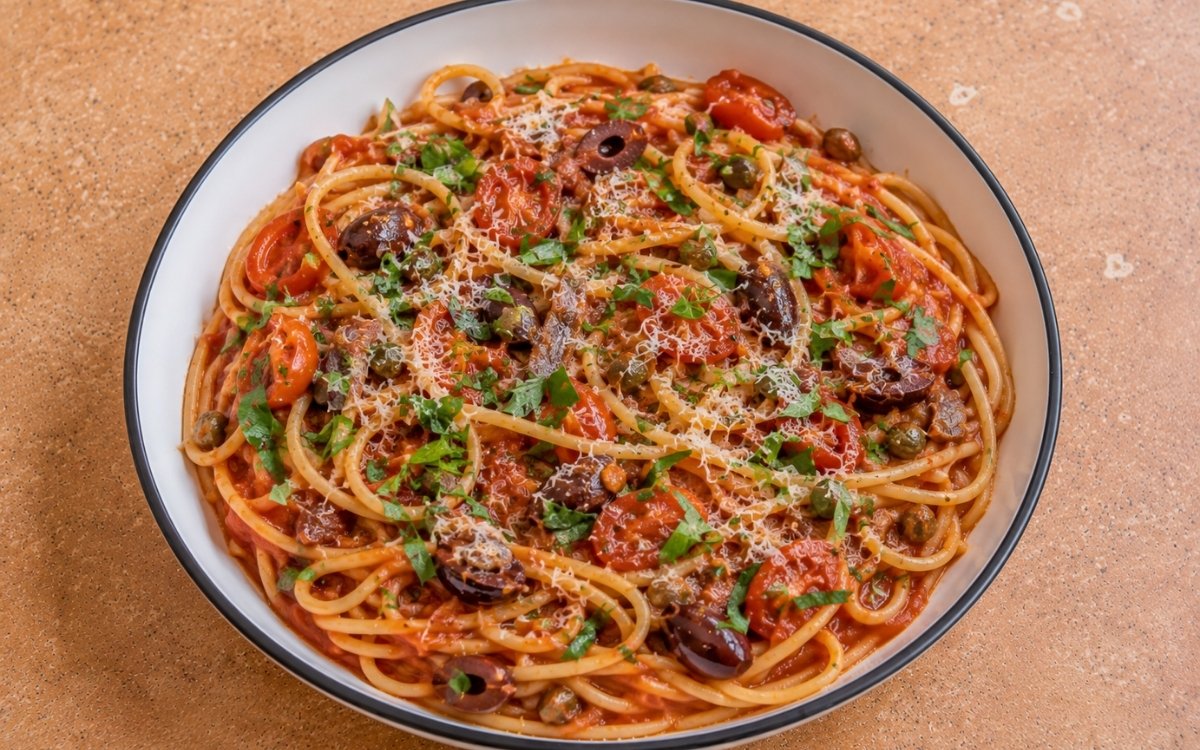
Ingredients
Method
Bring the Pasta Water to a Boil
- Bring a large pot of water to a full rolling boil. Add enough coarse sea salt so the water tastes assertively of the sea — approximately 2 tablespoons per 4 litres. The pasta water's seasoning is the only salt applied to the pasta itself and it must be present throughout every strand from the inside out — puttanesca's sauce is already very intensely flavoured from the anchovies, olives, and capers, which means under-seasoned pasta will create an imbalance where the sauce is overpowering and the pasta beneath it is bland. Hold at the boil while preparing the sauce.
Dissolve the Anchovies into the Oil
- In a large, deep sauté pan, heat the 80ml of extra-virgin olive oil over medium heat until it shimmers. Add the roughly chopped anchovy fillets and cook for 2–3 minutes, stirring and pressing continuously with a wooden spoon to break them down. The anchovies dissolve completely and visibly into the oil during this time — within 2 minutes there should be no intact fillet pieces remaining, only a slightly thickened, amber-tinged, intensely aromatic oil. This dissolution is the foundational step of the entire recipe and the reason puttanesca is not a fishy pasta despite its anchovy content. When anchovies are cooked in olive oil at medium heat, their proteins break down and their glutamate-rich flavour compounds distribute uniformly through the oil — producing an oil with a deep, savoury, umami-rich base character that is not identifiable as anchovy in the finished dish. People who are averse to the taste of anchovies consistently cannot detect them in correctly made puttanesca because the fillets have ceased to exist as a distinct ingredient. What they have become is the savory depth that makes puttanesca taste more complex and more satisfying than a plain tomato sauce. At no point in the finished dish does any piece of anchovy remain.
Add Garlic and Chili
- Add the thinly sliced garlic and red pepper flakes to the anchovy-infused oil simultaneously. Cook for 60–90 seconds, stirring continuously. The anchovy oil is already richly aromatic — adding the garlic to this flavoured medium rather than plain oil means the garlic blooms its compounds into an oil that is already carrying the anchovy's savoury depth, producing a more layered, more complex aromatic base than garlic in plain oil would produce in the same time. The red pepper flakes add their fat-soluble capsaicin to the oil during these 60–90 seconds — as in every recipe that begins with chili in oil, the fat-soluble extraction during this brief cooking period distributes the heat evenly through the sauce rather than concentrating it in individual flakes encountered during eating. The garlic should reach pale golden and the oil should be intensely fragrant — deeply savoury, garlicky, and warmly spiced simultaneously.
Build the San Marzano Tomato Base
- Add the 800g of hand-crushed San Marzano tomatoes with all their juices to the anchovy-garlic oil. Hand-crushing — squeezing each whole tomato directly over the pan until it breaks open — produces a varied texture with distinct tomato pieces alongside the sauce base, more visually interesting and more texturally layered than pre-crushed tomatoes. Increase the heat to medium-high and bring to a vigorous simmer. Cook for 8–10 minutes, stirring occasionally, until the sauce has thickened slightly, the raw tomato character has mellowed, and the oil from the anchovy-garlic base has integrated into the tomato rather than floating separately. At this stage the sauce should taste concentrated, deeply savoury, slightly spiced, and rich — the raw tomato sharpness of the uncooked canned tomatoes replaced by a rounder, deeper, more developed flavour that 8–10 minutes of vigorous simmering produces.
Add Olives, Capers, and Cherry Tomatoes
- Add the 400g of halved cherry tomatoes, 120g of halved Kalamata olives, and 60g of drained and rinsed capers to the sauce simultaneously. These three ingredients are the defining components that make puttanesca specifically puttanesca rather than a generic tomato sauce, and their addition together rather than sequentially is intentional — they each contribute to the same briny, acidic, intensely flavoured character and should develop together during the subsequent simmer. Simmer for 5–6 minutes, stirring occasionally. During this time the cherry tomatoes break down partially at their edges, releasing their juice into the sauce and adding a fresher, brighter tomato note on top of the concentrated San Marzano base — providing a two-layer tomato character. The olives soften slightly and release some of their brine into the surrounding sauce. The capers, rinsed of their strongest brine before adding, contribute a more measured, nutty, slightly floral flavour rather than a harsh pickled character. Add the roughly chopped fresh oregano in the final minute of this simmer — oregano's aromatic compounds are relatively stable at heat compared to basil but still most vivid when added near the end of cooking rather than from the start.
Cook the Pasta and Finish in the Sauce
- While the sauce has been simmering, cook the pasta in the boiling salted water for 2 minutes less than the package directions — it will finish cooking in the sauce. When the pasta is ready, use tongs to transfer it directly from the boiling water to the sauce, bringing approximately 120ml of starchy pasta water with the transfer. Increase the heat to high. Toss vigorously with the tongs for 2–3 minutes, turning the pasta continuously through the sauce. The pasta finishes cooking during this high-heat tossing period, absorbing the sauce's intense briny, savoury, spiced character directly into the pasta's structure. The pasta's surface starch releases into the sauce during the vigorous tossing and combines with the olive oil and tomato's water content to produce the lightly emulsified, coating consistency that distinguishes pasta tossed in the sauce from pasta simply plated with sauce poured over it. The high heat during this step is important for puttanesca specifically — it reduces and concentrates the sauce slightly around the pasta in a way that the lower-heat finishing step of cream-based dishes does not, producing a more intensely flavoured, more glossy coating.
Finish with Herbs and Parmigiano
- Remove the pan from the heat. Add three-quarters of the chopped parsley and toss briefly to distribute — the parsley wilts very slightly in the residual heat and releases its fresh, clean aromatic compounds into the sauce. Taste and assess — the seasoning of puttanesca requires careful evaluation because multiple very salty ingredients are present. The capers, olives, and anchovies all contribute saltiness throughout the dish; additional salt is almost never needed. Evaluate instead for heat level (can add more chili), acidity (a small squeeze of lemon juice brightens if needed), and pepper. Divide among four warm shallow bowls immediately. Scatter the reserved parsley over each bowl. Scatter the 40g of finely grated Parmigiano-Reggiano over each portion — traditionally puttanesca is served without cheese in Naples and Rome, where the convention of no cheese with intensely brined preparations holds. In this recipe a small amount of Parmigiano at serving adds a savoury, slightly creamy finishing note that balances the sauce's intensity without dominating it. Serve immediately.
Notes
Puttanesca's origin story — that it was invented by Italian women of the night who needed a quick, pantry-based dinner between clients — is the most famous culinary mythology in Italian pasta history and almost certainly apocryphal. The most likely actual origin is mid-20th century Naples, where the dish appeared in the 1950s as a quick, bold, pantry-based sauce using the preserved ingredients that coastal Southern Italian kitchens always had available: canned tomatoes, olive oil, anchovies, olives, and capers. The name puttanesca — from puttana, Italian for a woman of loose virtue — may simply refer to the sauce's bold, assertive, unapologetic character rather than any specific social history. It has been a staple of Neapolitan cooking since its first appearance and one of the most reproduced Italian pasta dishes internationally.
The anchovy question — whether to include them in a version served to people who believe they do not like anchovies — has a clear answer. Dissolved anchovies are not detectable as anchovy by any palate in a correctly made puttanesca. They are a flavour compound delivery system, not an ingredient with its own presence in the finished dish. The umami depth of puttanesca made without anchovies is noticeably flatter and less complex than the same sauce with them. If anchovy aversion is a concern, simply do not mention them — the sauce will be eaten and enjoyed by every person who believes they dislike anchovies.
The capers should be rinsed before use regardless of whether they are packed in brine or salt. Brine-packed capers retain intense salt and vinegar from the pickling liquid that, without rinsing, can make the sauce aggressively sharp. Salt-packed capers — available at Italian specialty stores and generally considered higher quality — require a more thorough rinse and a brief soak to remove the salt curing before use.