Ingredients
Method
Butterfly and Pound the Chicken Breasts
- Working with one breast at a time, place it flat on the cutting board with your palm pressed firmly on top to stabilise it. Using a sharp knife held parallel to the cutting board, slice horizontally through the thickest part of the breast from one side almost all the way through — stopping approximately 1cm before cutting completely through. Open the breast like a book so it lies flat as a single, wider, thinner piece. If the thickness is still greater than 1cm at any point, place the opened breast between two sheets of plastic wrap or inside a zip-lock bag and pound with a meat mallet, rolling pin, or the bottom of a heavy pan using firm, even strokes from the centre outward. The target is a uniform thickness of just under 1cm throughout the entire cutlet — no thick sections at the centre and no thin, torn sections at the edges. Uniform thickness is the single most important preparation step in this recipe because it determines the uniformity of the cooking: a cutlet with a 1.5cm centre and 0.5cm edges will have dry, over-cooked thin edges and undercooked thick centres when the surface has reached the correct golden colour. Consistency in thickness means every part of the cutlet reaches 74°C at the same moment the crust reaches its ideal colour. Repeat with all four breasts, producing 4 large, thin, even cutlets.
Set Up the Breading Station
- Arrange three shallow dishes or wide bowls in a line before you begin — the three-stage breading system must be set up completely before any breading begins, because once the first cutlet has started the process it should move through all three stages continuously without pausing. In the first dish, combine the all-purpose flour, 8g of fine sea salt, and several grinds of black pepper. Stir to distribute the seasoning evenly through the flour. In the second dish, crack the three eggs and beat until the yolks and whites are completely uniform with no streaks of unincorporated white remaining — unblended egg produces uneven coating adhesion. In the third dish, combine the Italian-style breadcrumbs, finely grated Parmesan, dried oregano, and an additional small pinch of salt and black pepper. Mix thoroughly to distribute the Parmesan and oregano evenly throughout the breadcrumbs. The Parmesan adds saltiness, nuttiness, and browning — its protein content contributes to Maillard reaction development during frying. The oregano adds the aromatic, slightly earthy herbal note that makes these specifically Italian-style cutlets rather than a generic breaded preparation. Arrange the dishes in flour — egg — breadcrumb order.
Bread the Cutlets Without Delay
- Working with one cutlet at a time, proceed through the three stations in sequence without pausing between them. Place the cutlet in the flour dish and turn to coat both sides completely, pressing gently so the flour adheres to every surface — including the edges. Shake off any excess flour — a light, even coat is correct; a thick, clumped flour coating produces a paste-like inner breading layer rather than the thin, crunchy film that allows the egg to adhere directly to the meat surface. Transfer the flour-coated cutlet to the egg dish. Submerge fully and turn to coat both sides completely, lifting and allowing the excess egg to drip back into the dish for 3–4 seconds — excess egg dripping off in the breadcrumb dish produces breadcrumb clumps rather than an even coating. Transfer to the breadcrumb dish and press both sides firmly into the mixture — use the heel of your hand to apply even, consistent pressure across every square centimetre of both sides. The pressing motion is as important as the breadcrumbs themselves: gently placed cutlets lose significant coating during frying; firmly pressed cutlets have a mechanically adhered coating that stays intact through the frying process. Place each breaded cutlet on a clean plate and proceed to frying without delay. Breaded cutlets left to sit release moisture from the meat surface through the flour-egg layer and begin to soften the coating from the inside — the sooner they reach the hot oil after breading, the crispier the finished crust. Use the wet hand, dry hand technique throughout: designate one hand for the flour and breadcrumb stages, the other for the egg stage, to prevent the thick, gummy clumping that occurs when the same hand moves between wet and dry stations.
Heat the Oil Correctly
- Pour approximately 100ml of vegetable oil into a large, heavy-bottomed skillet — cast iron or stainless steel. The oil depth should be approximately 3–4mm — enough to come partway up the sides of the cutlet and ensure even browning on the bottom surface without requiring the cutlet to be submerged. Heat over medium-high heat for 2–3 minutes. The correct oil temperature is approximately 175°C — if you do not have a thermometer, test with a pinch of breadcrumbs: they should sizzle immediately and show golden colour within 20–30 seconds. If they sink and barely sizzle, the oil is too cold — greasy, pale, crust-absorbed-oil cutlets result. If they brown immediately and darken in 5 seconds, the oil is too hot — the crust will burn before the chicken cooks through. The shimmering, lightly smoking appearance without heavy smoke is the visual indicator of correct temperature. The oil temperature is the variable that most directly determines the quality of the finished cutlet and it requires maintenance throughout the frying: the oil cools when cold chicken is added, requiring a brief recovery period between batches.
Fry the First Batch
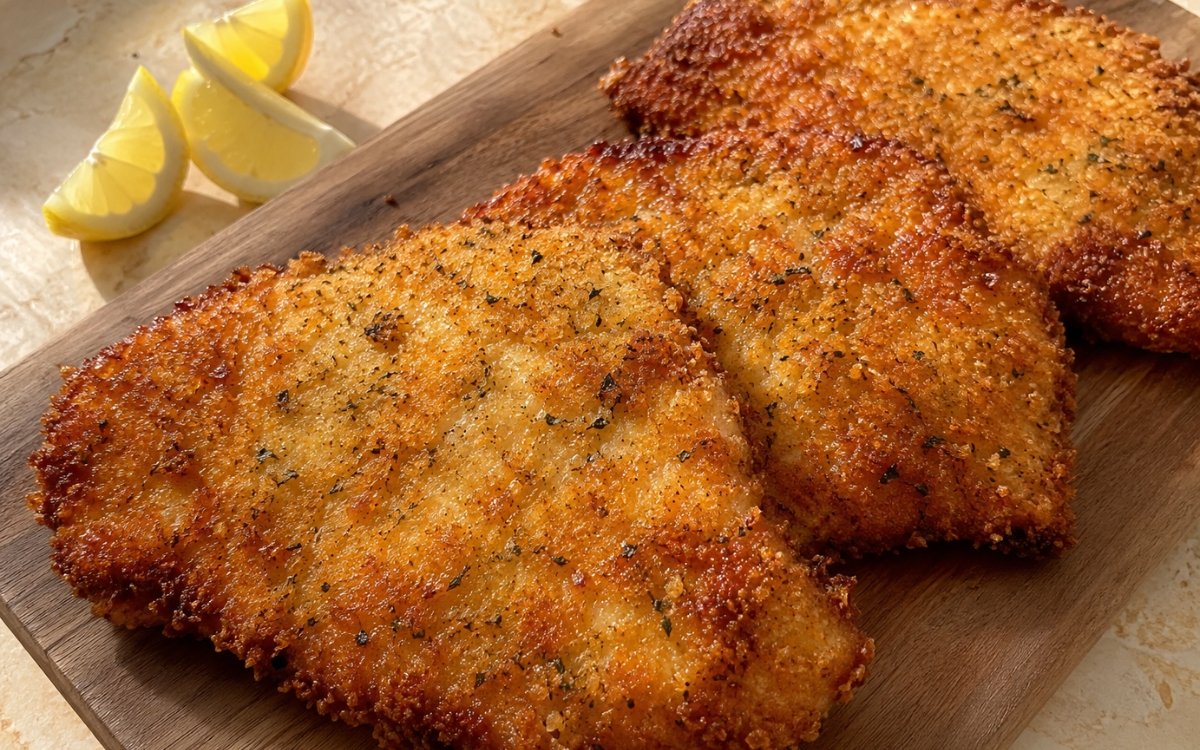
- Carefully lower 2 cutlets into the hot oil, laying them away from you to prevent oil splashing. Do not add a third — crowding drops the oil temperature significantly and causes steaming rather than frying. Leave undisturbed for exactly 3 minutes without moving or pressing. The crust sets and adheres during this undisturbed period — any movement before the crust has fully set on the underside tears it from the meat and produces uneven, patchy browning. At 3 minutes, lift one edge gently with tongs or a spatula — the underside should be a deep, uniform golden-brown. Flip decisively and cook the second side for 3 minutes. Use an instant-read thermometer to confirm the internal temperature has reached 74°C at the thickest point. Transfer to a wire rack set over a baking sheet — not to paper towels. A wire rack allows air circulation on all sides and prevents the bottom crust from steaming against the paper and softening immediately. Sprinkle immediately with a small pinch of fine salt while still hot — salt applied to a freshly fried surface adheres and seasons the crust in a way that salt applied after cooling does not.
Hold and Finish Remaining Batches
- Transfer the drained, salted cutlets to a wire rack on a baking sheet and place in an oven set to 95°C to keep warm while the remaining cutlets fry. This low holding temperature maintains warmth without continuing to cook the chicken — a higher holding temperature would continue cooking the interior and a lower one would cool too rapidly. Allow the oil to return to 175°C between batches — a 1–2 minute recovery period at medium-high heat is sufficient. Add another 50ml of oil if the pan appears dry. Fry the remaining cutlets in the same way. Serve all cutlets simultaneously while the crust is at maximum crispness.
Serve with Lemon
- Transfer to serving plates and add lemon wedges alongside each portion. The lemon is squeezed directly over the hot cutlet immediately before eating — the acid's function here is not marinading or flavouring in advance but providing an immediate, sharp citrus brightness that cuts through the fried crust's richness and the Parmesan's saltiness in a way that no other garnish achieves. The combination of hot, crisp, Parmesan-salted crust and fresh lemon is the complete flavour experience the recipe is designed to produce.
Notes
The butterflying and pounding technique deserves emphasis because it is the step most often hurried and the one whose quality most determines the result. A cutlet that is 1.5cm in the centre and 0.7cm at the edges will always produce overcooked edges and either an undercooked centre or a burnt crust — there is no correct frying time for an uneven thickness. Taking 2 additional minutes to pound each cutlet to true uniform thickness produces a cutlet where the crust is perfect and the interior is perfectly cooked simultaneously. The plastic wrap between the meat and the mallet prevents tearing and produces a smoother, more even surface.
Italian-style breadcrumbs versus plain breadcrumbs is a real and noticeable difference. Italian-style breadcrumbs contain dried herbs, garlic powder, and usually Parmesan or Romano cheese already incorporated — they produce a seasoned, aromatic crust with more flavour depth than plain breadcrumbs. Adding Parmesan and oregano to Italian-style breadcrumbs compounds these qualities further. If only plain breadcrumbs are available, add 5g of garlic powder and 3g of dried parsley to the mix alongside the Parmesan and oregano.
The wire rack cooling and holding method is the single most impactful quality-of-life technique in fried food preparation. Paper towels trap steam between the crust and the paper, producing a soft, slightly soggy underside within 60 seconds of placement. A wire rack allows the steam released from the hot chicken to escape in all directions, maintaining maximum crust crispness for 5–10 minutes rather than the 30–60 seconds that paper towels permit.