Ingredients
Method
Prepare the Components
- Prepare the Salsa Roja and Salsa Verde Mexican from their linked recipes, or have them ready in advance. Warm both salsas separately in small saucepans over low heat. They should be hot and spoonable but not watery. Warm the refried beans gently in a small saucepan or skillet over low heat, stirring occasionally. If they are very thick, loosen with a small splash of water until creamy and spreadable. Set out the crumbled queso fresco, diced onion, and sliced avocado so everything is ready for fast assembly. Keeping every salsa and side warming in its own separate pan, rather than combined in one, protects both the physical separation this dish depends on and each component's own individual character right up until plating.
Lightly Fry the Tortillas
- Heat a thin layer of neutral oil in a skillet over medium heat. Lightly fry the tortillas one at a time for about 10–15 seconds per side, just until softened, lightly blistered, and flexible. They should not become crisp like tostadas. Transfer to a plate or rack and keep warm. This brief, controlled fry gives the tortillas real, if modest, structural resistance against the egg and sauce about to sit on top, without pushing them toward the rigid crispness that would make the whole plate harder to eat with a fork and knife.
Fry the Eggs
- In the same skillet, add a little more oil if needed and fry the eggs 2–4 at a time over medium to medium-low heat. Season lightly with salt and black pepper. Cook until the whites are set and the yolks are still runny or just softly set, depending on preference. The bottoms should be lightly golden but not aggressively crisp. Frying in the same skillet used for the tortillas means the eggs pick up a light layer of that same residual oil and flavour, tying the two components together even before they meet on the plate.
Assemble the Plates
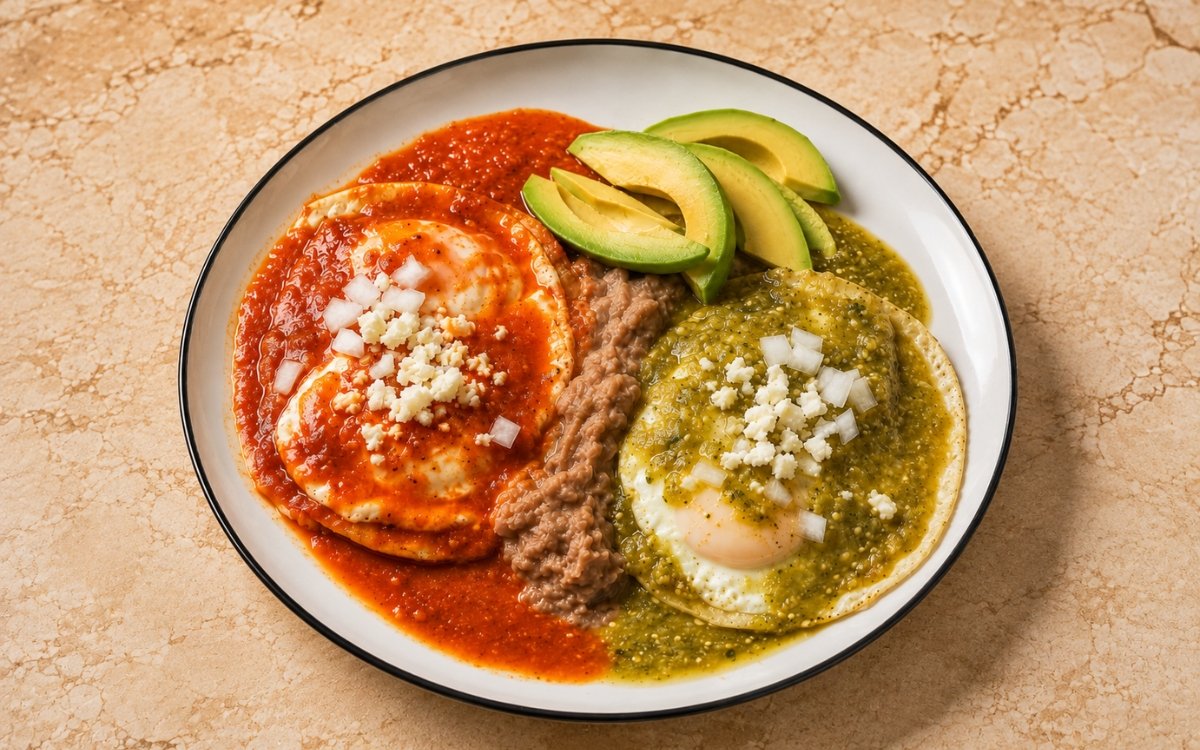
- For each serving, place 2 tortillas on a plate, side by side with a slight overlap. Top each tortilla with 1 fried egg. Spoon warm Salsa Roja generously over one egg and warm Salsa Verde generously over the other, keeping the red and green sides clearly separate. Place a generous stripe or spoonful of warm refried beans between the two eggs. Finish each plate with crumbled queso fresco, a small scattering of diced white onion, and sliced avocado. Positioning the beans directly between the two eggs serves a real, functional purpose beyond presentation — that stripe acts as a genuine visual and physical buffer, reinforcing the clean separation between red and green that gives this dish its name.
Serve
- Serve immediately while the eggs are hot, the yolks are still soft, and the tortillas are warm and tender. This dish's whole appeal depends on a specific, fleeting moment — hot eggs, soft yolks, warm tortillas, and hot salsa all meeting at once — and serving without delay is what actually delivers that moment rather than letting any one component cool or soften out of sync with the others.
Notes
Keeping the two salsas physically and visually separate throughout every stage of this recipe deserves to be understood as the entire organizing principle behind the dish, not simply a presentation choice among several options. "Divorciados" specifically references that deliberate separation — a plate where the red and green salsas were allowed to mix or blend together would lose the dish's actual defining characteristic, regardless of how good either salsa tasted on its own.
The specific, restrained frying treatment given to the tortillas — just enough to soften and lightly blister, stopping well short of tostada-level crispness — reflects real thought about what this particular dish needs from its base. A fully crisp tortilla would shatter under the combined weight of a fried egg, warm salsa, and beans, while an entirely unfried, soft tortilla would offer no real resistance at all. The brief fry specified here finds a genuine middle ground.
Warming each salsa to hot and spoonable, but stopping short of watery, matters more than it might initially seem given how this dish is plated. A salsa that's too thin would run and blur the clean boundary between red and green sides rather than sitting distinctly over its own egg — the specific consistency called for here is what lets each sauce hold its place on the plate.
The recipe's own emphasis on serving immediately, capturing hot eggs, soft yolks, warm tortillas, and hot salsa all together, is worth respecting as a genuine, time-sensitive requirement rather than generic advice. Every earlier stage of preparation — warming the salsas and beans separately, frying the tortillas just enough, frying the eggs to the right doneness — exists specifically to converge at this one serving moment, and any real delay lets that careful timing fall out of sync.