Ingredients
Method
Make the Honey Mustard
- Mix the mayonnaise, mustard, honey, vinegar or lemon juice, salt, and black pepper until smooth. Taste and adjust. It should be creamy, sweet, sharp, and thick enough for dipping. Do not make it runny. Thin sauce feels cheap and does not cling to the nuggets. Keeping this sauce genuinely thick is a deliberate textural choice — a properly clinging dip is what carries flavour onto each bite of nugget rather than simply pooling on the plate beside it.
Mix the Nugget Meat
- Combine the ground chicken, fatty ground pork shoulder, salt, MSG, smoked paprika, garlic powder, onion powder, white pepper, cornstarch, and ice-cold water in a bowl. Mix firmly for 1–2 minutes until the mixture becomes sticky, cohesive, and evenly seasoned. This is important. You are not making loose meatballs — the mixture needs to bind so the nuggets hold their shape and slice cleanly when broken open. Do not overmix until rubbery, but do not leave it crumbly either. The firm mixing here develops just enough of the meat's own protein structure to create a genuine bind, similar to how a sausage forcemeat is worked — the ice-cold water keeps the fat from softening and smearing during that mixing, which helps the final texture stay tender rather than greasy.
Chill the Mixture
- Cover and chill the meat mixture for 30 minutes. Cold meat is easier to shape and holds better during breading. Skipping the chill makes the nuggets sticky, messy, and more likely to deform. Chilling firms the fat throughout the mixture, which is what allows it to be shaped into distinct, hand-formed pieces without smearing or sticking excessively to your hands during the process.
Shape the Nuggets
- With lightly wet or oiled hands, shape the mixture into 28–32 irregular nugget pieces. Keep them about 25–30g each. Do not make perfect balls. Nuggets should look hand-formed and slightly uneven, with flattened sides and irregular edges. That gives better crust. The irregular, flattened shape genuinely produces a better fried result than a perfectly round ball would — those uneven edges and flat sides create more surface area and more corners for the breading to catch and crisp unevenly, which is part of what makes a homemade nugget read as genuinely craggy rather than uniform and processed-looking.
Prepare the Breading Station
- Place the flour in one shallow bowl. In a second bowl, whisk the eggs with water or milk. In a third bowl, combine the lightly crushed panko, fine breadcrumbs, salt, smoked paprika, and white pepper. Lightly crushing the panko is the right move here. Whole panko can look too large and flaky; fully fine crumbs can look boring. The mix gives a craggy but even crust. Combining the two breadcrumb types is a deliberate textural balance — panko alone produces large, sometimes unevenly sized flakes, while fine breadcrumbs alone can crisp into something almost too smooth and uniform; together they produce the specific rough-but-cohesive crust texture this recipe is built around.
Bread the Nuggets
- Coat each nugget lightly in flour, shaking off excess. Dip into the egg mixture, then press into the breadcrumb mixture until fully coated. For a thicker, crunchier crust, dip the breaded nugget back into the egg and then again into the breadcrumb mix. Press the coating on gently but firmly. Bare spots will fry pale and weak. The initial flour layer gives the wet egg something dry and textured to grip immediately, which in turn is what the breadcrumb mixture adheres to — skipping or shortchanging this first layer produces a patchier, less even final crust.
Rest the Breaded Nuggets
- Place the breaded nuggets on a tray and rest for 10–15 minutes while the oil heats. This helps the breading hydrate and stick. Frying immediately after breading can make the coating shed into the oil. This rest lets the egg wash fully bind the breadcrumbs to the meat's surface before the shock of hot oil — nuggets fried immediately after breading are considerably more prone to shedding crumbs into the fryer.
Heat the Oil
- Heat neutral oil to 175°C. Do not guess the oil temperature. Too low gives greasy nuggets. Too high browns the crust before the centre reaches 74°C. This window is a genuine balance point specific to a nugget's small size — hot enough to crisp the exterior at a reasonable pace, but not so hot that it darkens before the ground meat centre has had time to fully cook through.
Fry the Nuggets
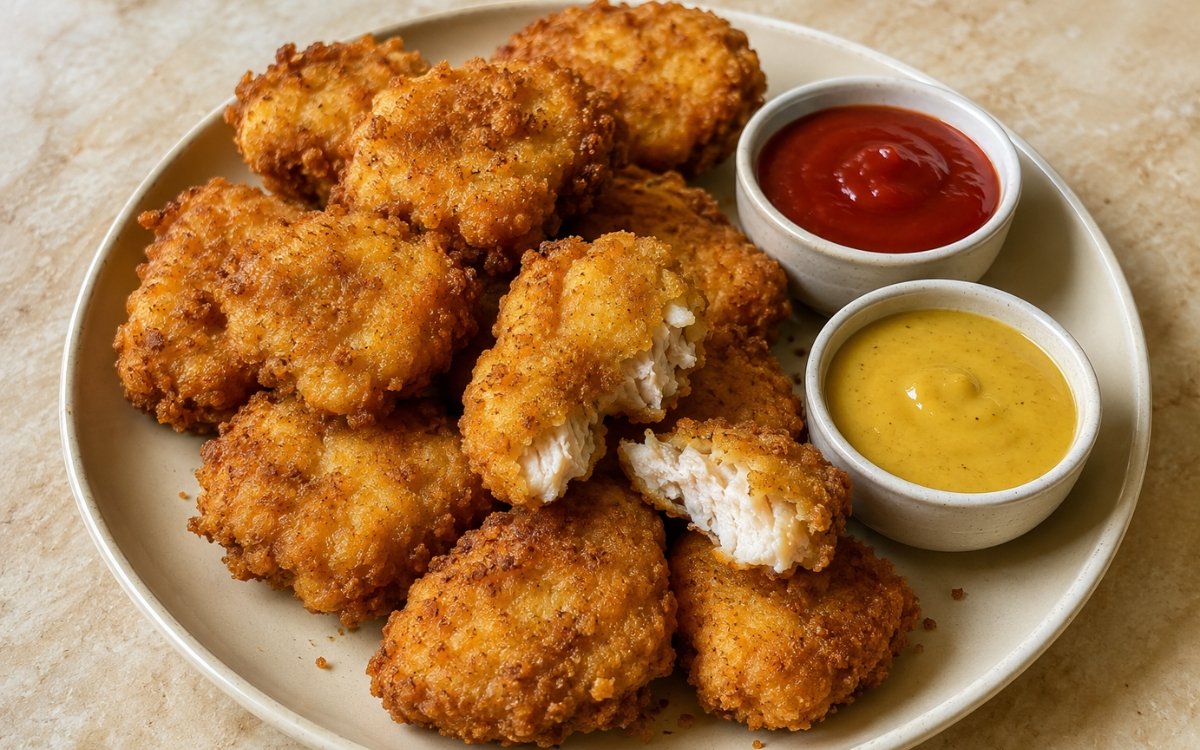
- Fry the nuggets in batches for about 3–4 minutes, turning occasionally, until deep golden-brown, crisp, and cooked through. The internal temperature must reach 74°C / 165°F. Do not overcrowd the pot. Crowding drops the oil temperature and turns the crust heavy instead of crisp. Verifying with a thermometer rather than judging by colour alone matters here specifically because this is a ground-meat mixture combining poultry and pork — both need to reach a genuinely safe internal temperature, and outward browning doesn't reliably indicate that the centre has caught up.
Drain and Serve
- Transfer the nuggets to a wire rack. Salt lightly while hot if needed. Serve immediately with ketchup and honey mustard. A single, uncrowded layer on the rack lets any residual surface oil drip away and lets steam escape rather than becoming trapped against the crisp crust of a neighbouring nugget.
Notes
The 3:1 chicken-to-pork ratio deserves to be understood as the defining structural decision in this recipe rather than a minor ingredient choice. Ground chicken on its own, being quite lean, tends to cook up dry and somewhat bouncy in a small, fast-cooking format like a nugget. Fatty ground pork shoulder folded in at this proportion adds real juiciness and a more tender bite throughout, without contributing enough of its own flavour to read as a pork nugget — the chicken's flavour still dominates, but the texture benefits considerably from the pork's fat content.
Mixing the meat firmly until it becomes genuinely sticky and cohesive, rather than stopping at "combined," is worth treating as a real technique step with a specific target rather than a quick stir. This firm mixing develops just enough protein bind — similar in principle to working a sausage forcemeat — that the shaped nuggets hold together cleanly through breading, resting, and frying, and slice cleanly when broken open rather than crumbling apart.
The combination of panko and fine breadcrumbs in the coating is a deliberate textural balance worth understanding rather than treating as interchangeable with either crumb type alone. Panko's larger, more irregular flakes contribute genuine crunch and visual crag, but used alone can look and feel slightly too jagged. Fine breadcrumbs alone crisp into something smoother and more uniform, closer to a standard fried coating, but can read as visually plain. Together, they produce the specific craggy-but-cohesive crust that distinguishes a well-made homemade nugget from a store-bought one.
Cooking to a verified internal temperature of 74°C, rather than judging doneness by the crust's colour, matters more here than it might for a single, larger cut of meat. This is a ground mixture combining two different proteins, and outward browning on a coated, fried nugget doesn't reliably signal that the centre has reached a safe temperature — a thermometer check, even a quick spot-check on one nugget per batch, is the only reliable way to confirm.