Ingredients
Method
Prepare the Pork Skin
- If the pork skin has thick attached fat underneath, trim it down heavily with a sharp knife so you are left with skin and only a thin layer of fat. Do not try to leave thick fat attached — it will prevent proper drying and puffing later. Cut the skin into bite-size pieces, roughly 4–5cm wide. They will shrink during drying and expand irregularly during frying, so keep the size fairly even for more even cooking. The skin should be mostly clean and flat, not thick and heavy with fat. Too much fat gives chewy, hard pieces instead of light puffed crackling. Fat trapped beneath the skin doesn't render out cleanly the way it would in a longer roast — left in place, it simply weighs the piece down and blocks the steam-driven puffing that's supposed to happen once the dried skin hits hot oil.
Simmer to Tenderize and Start Rendering
- Place the pork skin pieces in a pot and cover with cold water. Add 6g of the salt. Bring to a gentle simmer, not a hard boil, then cook for 45–60 minutes until the skin is tender enough to bend easily but not falling apart. Drain well and let cool just enough to handle. Once slightly cooled, inspect the underside again and scrape or trim away any softened excess fat that remains. This step matters — removing this rendered fat is one of the biggest factors in getting truly puffed chicharrones. After simmering, the skin should feel flexible and gelatinous, not rubbery-stiff. If it is still rigid, simmer a little longer. The gentle simmer here breaks down the skin's collagen into a softer, more gelatinous texture without agitating it hard enough to tear it apart — that pliability is what allows the skin to expand dramatically once fried, rather than staying stiff and resistant.
Dry the Skin Thoroughly
- Pat the skin very dry with paper towels. Arrange the pieces in a single layer on a wire rack set over a tray. Refrigerate uncovered for at least 4 hours, ideally overnight, until the pieces feel dry, leathery, and no longer wet on the surface. If you want to speed the process slightly, you can place the tray in a low oven at about 90–95°C for 1½–2½ hours after the initial pat-drying, then still allow the skins to cool and air-dry before frying. The frying stage depends completely on this drying step being done properly. Wet or damp skin will not puff properly and may splatter violently. The dried skin should feel firmer, slightly stiff, and matte on the outside. Any tackiness or surface moisture means it needs more drying time. Every bit of moisture remaining in the skin has to violently flash to steam the instant it hits the hot oil — a thoroughly dried piece converts that internal moisture into the controlled, dramatic puff this dish depends on, while a still-damp piece produces dangerous, uncontrolled spattering instead.
Fry the Chicharrones
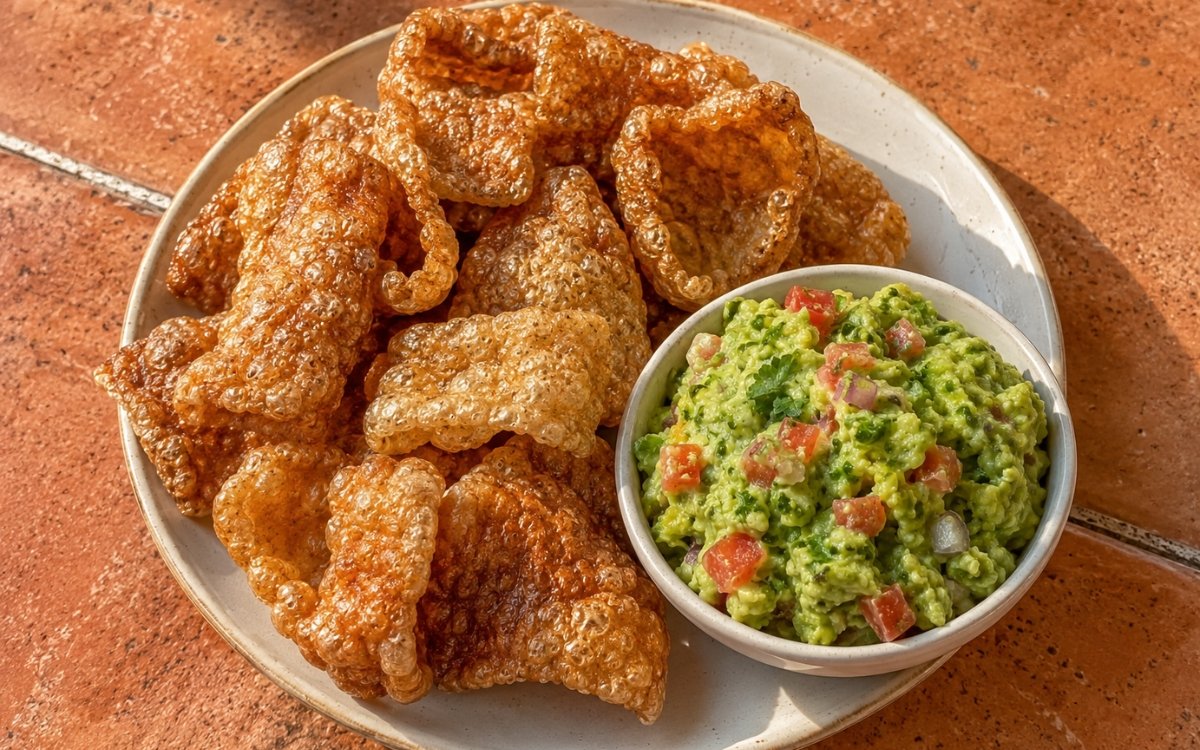
- Heat 5–7cm of neutral oil or lard in a deep heavy pot to 190°C. Fry the dried pork skin in small batches. As soon as the pieces hit the oil, they should begin to blister, expand, and puff dramatically. Fry each batch for about 1–2 minutes, turning as needed, until fully puffed, deeply blistered, and golden. Remove immediately to a wire rack or paper towel-lined tray. While still hot, season with the remaining 6g salt, the black pepper, and garlic powder if using. Properly fried chicharrones will be light, rigid, and hollow-sounding when tapped. If they stay dense and hard, they were either too wet before frying or had too much fat attached. If they darken before puffing, the oil is too hot. Frying only a small batch at a time keeps the oil at its full, held temperature throughout — a crowded pot drops that temperature immediately, and the resulting cooler oil produces exactly the dense, unpuffed pieces this whole process is built to avoid.
Make the Chunky Guacamole
- Halve and pit the avocados. Scoop the flesh into a bowl. Add the lime juice, cumin, a pinch of salt, and black pepper. Mash lightly with a fork, keeping plenty of visible chunks — do not make it fully smooth. Add the red onion, jalapeño, garlic, cilantro, and green Tabasco if using. Fold gently to combine. Add the diced Roma tomatoes last and fold them in carefully so they stay distinct and do not break down too much. Taste and adjust with more salt, pepper, or lime juice if needed. The finished guacamole should be chunky and spoonable, with visible avocado pieces, tomato, onion, and cilantro throughout. It should taste bright, savoury, and fresh, not flat or overly mashed. Adding the tomato last and folding it in gently, rather than mashing it in with the avocado from the start, is what keeps its pieces distinct rather than breaking down into extra liquid that would thin out the whole guacamole.
Serve
- Pile the hot chicharrones generously onto a serving plate or shallow bowl. Spoon the chunky guacamole into a separate bowl or ramekin alongside. Serve immediately while the chicharrones are still fully crisp. Chicharrones lose their signature hollow crispness within a fairly short window once fried, so serving without delay is what preserves that texture at the table.
Notes
Trimming away as much attached fat as possible before the skin ever meets the pot is worth taking seriously as the first and arguably most consequential step in the whole process. Fat left clinging to the underside of the skin doesn't render away cleanly during either the simmer or the fry — it simply sits there, adding weight and moisture that work directly against the dramatic puffing this dish depends on. The closer the skin gets to genuinely clean before simmering, the lighter and more reliably puffed the final chicharrones will be.
The extended drying period is worth understanding as the true dependency the entire recipe hinges on, more so than any single other step. Every bit of moisture still present in the skin when it hits the hot oil has to flash into steam violently and immediately, and if there's too much of it, that flash happens uncontrollably — producing dangerous spattering rather than the controlled, dramatic puff a properly dried piece produces. Rushing or shortening this stage is the single most common reason homemade chicharrones fail to puff.
Frying in genuinely small batches protects the oil's temperature, which in turn protects the puffing reaction each piece needs. Chicharrones expand dramatically the instant they hit properly hot oil, and that expansion depends on the oil staying at its full temperature throughout — even a modest amount of overcrowding drops that temperature enough to produce dense, only partially puffed pieces instead of the light, hollow-sounding result this recipe is built around.
The guacamole's construction — mashing the avocado first with lime, cumin, and seasoning, then folding in the sharper components, and adding the tomato only at the very end — protects the specific chunky texture this version calls for. Adding everything at once and mixing vigorously would break down both the avocado and the tomato considerably faster, producing something closer to a smooth dip than the visibly chunky, distinct-piece guacamole this recipe is meant to be.