Ingredients
Method
Prepare the Salsa Roja
- Toss the Roma tomatoes, onion wedges, and garlic with olive oil and a little salt. Broil or roast on a hot tray until the tomatoes soften and blister and the onion develops browned edges, about 8–12 minutes. Transfer the roasted tomatoes, onion, and garlic to a blender. Add the ground cumin, raw jalapeño, lime juice, cilantro, and salt. Blend until smooth but still slightly textured. The salsa should be spoonable and quite thick, not watery. If it is loose, it will soak the gorditas too quickly and soften the whole pocket. Adding the jalapeño raw at the blending stage rather than roasting it alongside the tomatoes keeps its heat sharper and fresher against the roasted sweetness of everything else.
Make the Gordita Dough
- In a large bowl, mix the masa harina and salt. Add the warm water gradually, mixing with your hand until a soft dough forms. Add the lard or oil if using and knead briefly until smooth. Cover and rest for 20 minutes. The dough should feel soft, hydrated, and pliable, not dry or crumbly. If it cracks badly at the edges when shaped, add a little more warm water. If it sticks heavily to your hands, add a small amount of masa harina. The 20-minute rest lets the masa harina fully hydrate, which is what determines whether the dough presses and shapes cleanly or resists and cracks at the edges.
Shape the Gorditas
- Divide the dough into 12 equal balls, about 90–95g each. Keep the dough covered while working. Press each ball into a thick round about 9–10cm wide and about 1cm thick. They should be clearly thicker than tortillas. Smooth the edges so they do not crack during cooking. This roughly 1cm thickness is deliberately much greater than a standard tortilla's — it's exactly what gives the gordita enough mass to still have a soft, workable interior after cooking, which is what makes splitting it into a pocket possible at all.
Cook the Gorditas
- Heat a comal, cast-iron skillet, or heavy pan over medium heat. Cook the gorditas for about 3–4 minutes on the first side, then 3–4 minutes on the second side, and then another 1–2 minutes per side as needed, until they are cooked through, golden-brown, and lightly charred in places. Some may puff slightly as they finish cooking. That is good. It helps create the interior pocket. Do not cook them over very high heat. The outside will brown too fast while the center stays raw and gummy. The slight puffing that happens toward the end of cooking is a sign that internal steam is building and beginning to separate the dough into distinct layers — this is the same mechanism, on a smaller scale, that gives a properly cooked gordita its pocket even before the deliberate slit is cut.
Split the Gorditas
- While still hot but cool enough to handle, use a small knife to cut a slit into the side of each gordita and gently open it to form a pocket. Do this while they are still warm. Once fully cooled, the gorditas are more likely to crack instead of opening cleanly. This window is genuinely narrow — masa that's still warm flexes and yields cleanly along the cut, while masa that's had time to firm up as it cools resists and tends to crack unpredictably rather than opening into a usable pocket.
Reheat the Chicharrón
- If the chicharrón is already very crisp, simply break it into bite-sized pieces. If it needs refreshing, warm it briefly in a dry skillet or with just a few drops of oil over medium heat for 2–3 minutes until hot and crisp again. Do not cover it or steam it. The whole point here is keeping the pork crackling crisp and distinct. Any trapped steam, even briefly, will soften chicharrón's signature crackling texture almost immediately — this is why the instruction is specific about leaving it uncovered even for a short reheat.
Prepare the Garnishes
- Shred the white cabbage very thinly. Slice the avocado thinly. Chop or pick the cilantro. Cut the limes into wedges. Keep the cabbage dry and light. Wet cabbage will soften the inside of the gordita. Shredding the cabbage genuinely thin rather than into rough shreds matters for how it sits inside the warm pocket — fine shreds wilt gently from residual heat while keeping crunch, while thicker pieces either stay stubbornly raw-tasting or take up too much space in an already tight pocket.
Fill the Gorditas
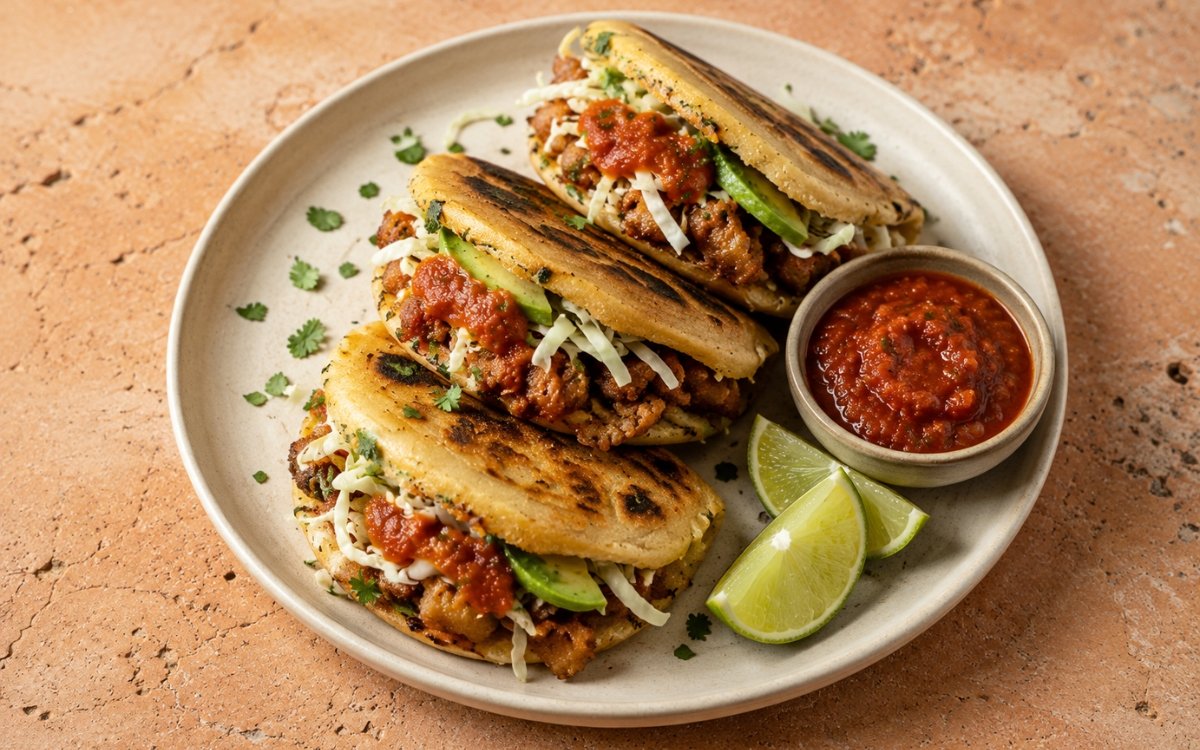
- Open each gordita pocket and add a generous portion of crispy chicharrón. Spoon in a small amount of salsa roja, just enough to coat and season the filling without making it soggy. Top with shredded cabbage, a thin slice or two of avocado, and a little fresh cilantro. The filling should peek out visibly from the opening. Do not overstuff so much that the gordita tears or cannot close slightly around the filling. Using the salsa sparingly here, rather than generously as on an open taco, is a deliberate restraint specific to the enclosed-pocket format — salsa that would work fine spooned over an open tortilla becomes a liability once trapped against the masa on all sides.
Serve
- Serve 3 gorditas per serving with lime wedges on the side and extra salsa roja for spooning over or dipping. Serve immediately while the masa is warm, the chicharrón is still crisp, and the cabbage stays fresh. The contrast between hot, soft masa and crackling chicharrón is at its sharpest right at assembly, so serving without delay is what preserves the specific textural range this dish is built around.
Notes
The gordita's thickness is the single detail that separates it structurally from a tortilla, and it's worth being precise about rather than approximating. At roughly 1cm, the pressed dough retains enough mass to stay soft and pliable through its full cook, which is what allows it to be split into a genuine pocket afterward. A thinner disc of the same dough would cook through completely and behave like a tortilla, with no soft centre left to open into a pocket at all.
Timing the split to happen while the gordita is still warm is one of the least flexible steps in the whole recipe. Masa firms up measurably as it cools, and once that happens, a knife cut through the side tends to crack the gordita unpredictably rather than opening it cleanly along a controlled line. This is a step worth doing immediately after the gorditas come off the heat, before moving on to any other part of assembly.
Keeping the chicharrón uncovered during reheating, and using only a modest amount of salsa inside the finished gordita, both address the same underlying concern from different angles: protecting the crisp-soft contrast that defines this dish. Chicharrón loses its crackling texture within moments of any trapped steam, and excess salsa liquid works against that same texture from a different direction, softening both the chicharrón and the surrounding masa if used too generously inside the enclosed pocket.
Cooking the gorditas over medium rather than high heat addresses their unusual thickness directly. A thinner tortilla can tolerate higher heat because it cooks through quickly regardless, but a gordita's greater mass needs more time for heat to reach the centre — high heat browns and can burn the exterior well before the interior has finished cooking, leaving a raw, gummy centre beneath a dark crust.