Ingredients
Method
Cook the Jasmine Rice
- Rinse the 300g of jasmine rice under cold running water 2–3 times, swirling with your hand between each rinse, until the water runs noticeably clearer. After the final rinse, drain through a fine-mesh sieve until no water drips — complete drainage matters, because the cooking water ratio is calibrated to the dry-drained rice weight. Pour into a medium saucepan and add 450ml of cold water and a pinch of salt. Bring to a full rolling boil over high heat — watch it rather than leaving it, as the boil arrives quickly. The instant the boil is confirmed, reduce the heat to the absolute lowest possible setting. Cover tightly. Cook for exactly 15 minutes without lifting the lid at any point during cooking or resting — any lid-lifting releases the steam that is cooking the rice above the water line. After 15 minutes, turn the heat off completely. Allow the covered saucepan to rest, still lidded, for 10 minutes. Do not lift the lid during this rest period either — the residual steam completes the cooking of any remaining moisture and evenly hydrates the upper layers of the rice. After the full 10-minute rest, remove the lid and fluff with a fork.
Marinate the Chicken
- Cut the 700g of chicken thighs into 3–4cm bite-sized cubes. Chicken thighs are the specifically correct cut for General Tso's — their fat content keeps each piece moist and juicy through the high-heat frying and the subsequent sauce tossing, where lean breast meat would tighten and dry. In a large bowl, combine the 10g of grated ginger, 3 minced garlic cloves, 30ml of soy sauce, 30ml of Shaoxing wine, and 1 tsp of fine sea salt. Add the chicken cubes and toss to coat every piece. Cover and allow to marinate for 15–30 minutes at room temperature. The marinade's Shaoxing wine begins mildly tenderising the surface proteins; the soy provides flavour penetration; the ginger and garlic contribute aromatic character that is present throughout the chicken's interior rather than only on the sauce-coated surface.
Dredge the Chicken
- In a wide, shallow bowl, whisk together the 60g of cornstarch and 60g of all-purpose flour until combined. The 1:1 ratio is the specific balance for General Tso's chicken — pure cornstarch produces a very thin, very crisp but fragile crust; pure flour produces a thicker, bread-like coating that absorbs the sauce instead of being coated by it. Together they produce a crust that is light enough to shatter on the first bite, thick enough to hold the sauce coating without dissolving, and specifically with the slight chew at the interior layer that makes the finished chicken texturally interesting. Remove the chicken pieces from the marinade one by one, allowing excess marinade to drip briefly, and toss each piece in the dredge mixture — pressing gently to ensure all surfaces are coated. Shake off any thick excess powder. Place the dredged pieces on a plate or wire rack and allow to rest for 5 minutes — the brief rest allows the cornstarch and flour to absorb the marinade's surface moisture and adhere more completely, reducing the amount of crust that falls off during frying.
Shallow Frying Method
- For the accessible weeknight approach: pour neutral oil into a large, heavy-bottomed skillet or wok to a depth of approximately 2.5–3cm. Heat to 175–180°C over medium-high heat. Working in batches of 8–10 pieces — never overcrowding, as dropped temperature produces oil-absorbing rather than crisping — carefully lower the dredged chicken into the oil. Fry for 3–4 minutes on the first side without moving, until the crust is deeply golden and set. Turn each piece and fry for 2–3 minutes on the second side. The crust should be a deep amber-gold on both sides. Transfer to a wire rack — not paper towels, which trap steam and soften the bottom crust. Shallow frying produces a slightly more uneven crust on the curved sides between the flat faces, but this is acceptable and the technique requires significantly less oil.
Deep Frying Method
- For the restaurant-quality result where every surface of every cube is simultaneously crisped: fill a deep pot or wok with 1.5–2 litres of neutral oil. Heat to 175–180°C — verified with a thermometer. Working in batches of 8–10 pieces, lower the dredged chicken into the oil using a spider strainer or slotted spoon. Fry for 3–4 minutes total, stirring occasionally to ensure all surfaces contact the hot oil, until the entire surface of each cube is uniformly deep golden. The complete submersion produces an even, sealed crust on every face simultaneously — producing the specific texture that General Tso's chicken has at its best in restaurant versions. Transfer to a wire rack. For an extra-crispy result, allow the first-fried batch to rest for 2 minutes and then return to 190°C oil for 60–90 seconds — the double-fry drives additional moisture from the crust and produces a specifically more shattered texture.
Build the General Tso's Sauce
- In a small bowl, combine all the sauce components together before beginning to cook — the sauce builds quickly in the wok and pre-combining ensures no component is missed in the rapid sequence: 120ml of chicken stock, 60ml of soy sauce, 30ml of Shaoxing wine, 30ml of rice vinegar, 70g of brown sugar, 15g of tomato paste, 15g of hoisin sauce, and 2 tsp of sesame oil. Stir until the tomato paste is fully incorporated and the mixture is uniform. Heat 1 tbsp of neutral oil in a wok over medium heat. Add the broken dried Chinese chilies and stir-fry for approximately 15 seconds — the oil-blooming of the dried chilies releases their fat-soluble capsaicin and aromatic compounds into the surrounding oil in a way that dry spice addition cannot achieve. At 15 seconds they should be fragrant and slightly darkened without burning — burnt dried chilies produce bitterness throughout the sauce. Add the 4 minced garlic cloves and 15g of minced ginger simultaneously. Stir-fry for 20–30 seconds, pressing the aromatics against the wok surface, until fragrant. Pour the combined sauce mixture into the wok. Stir to incorporate the aromatics. Bring to a simmer and cook for 2–3 minutes, stirring occasionally, until the brown sugar has dissolved completely and the sauce has reduced slightly and darkened from its initial raw-sauce colour to a deeper, glossy mahogany. In a small bowl, whisk together the 12g of cornstarch and 30ml of cold water until the slurry is completely smooth with no lumps. While stirring the simmering sauce continuously, pour the slurry in a steady stream into the sauce. Cook, stirring continuously, for 30–60 seconds until the sauce becomes visibly glossy and thick enough to coat the back of a spoon — the cornstarch gelatinising within this window and providing the specific sticky, coating consistency of General Tso's sauce.
Toss the Chicken in the Sauce and Serve
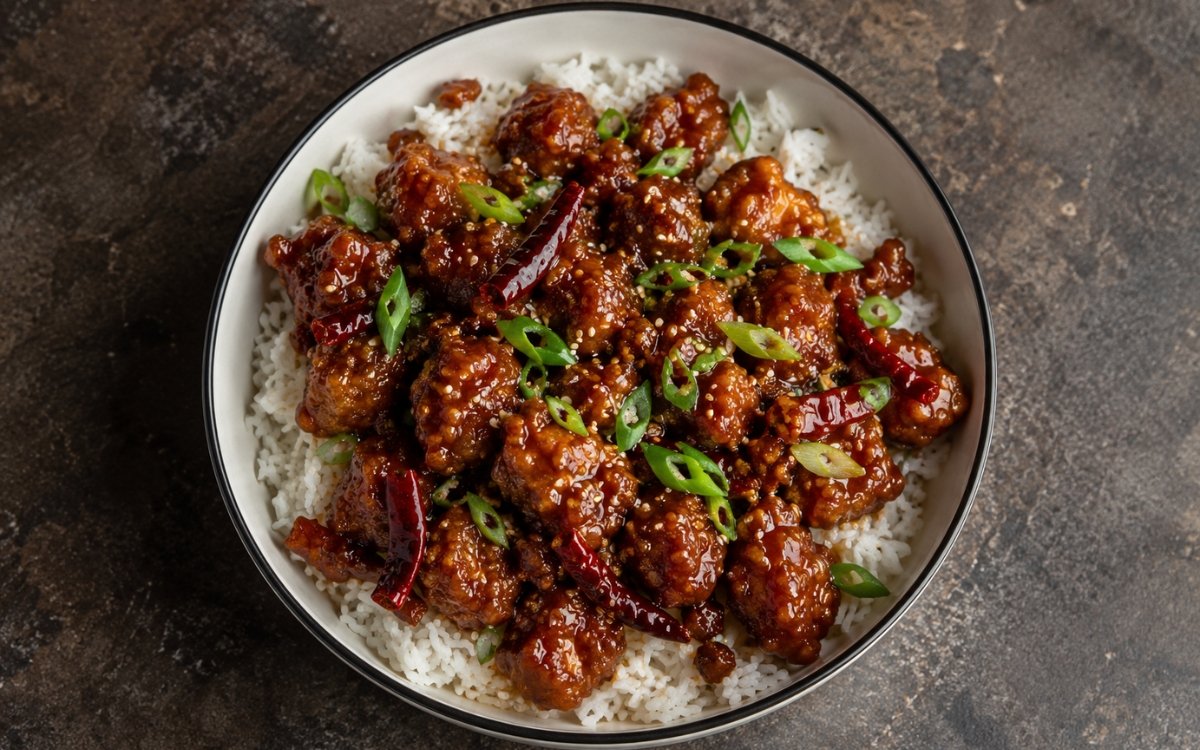
- Add all the fried chicken pieces to the wok with the sauce. Toss continuously with a wok spatula for 1–2 minutes, turning every piece through the sauce until every surface is fully and evenly coated in the glossy, sticky sauce. Work quickly — extended tossing after the sauce has thickened begins softening the crust progressively. The correctly finished chicken should show a complete, glossy sauce coating on every surface while retaining audible crunch when a piece is bitten. Divide the jasmine rice among four wide bowls. Top each bowl with the General Tso's chicken, spooning any additional sauce from the wok over each portion. Garnish generously with sliced scallions and toasted sesame seeds. Serve immediately.
Notes
The dried Chinese red chilies — small, thin, intensely red dried chilies available at Asian grocery stores — are an aromatic and heat-providing component of the General Tso's sauce rather than an eating component. Their fat-soluble capsaicin and aromatic compounds bloom into the oil during the 15-second stir-fry, distributing their character through the entire sauce base. The chilies themselves remain in the finished dish as a visual element and a source of occasional direct heat for those who bite into them — they are typically not eaten in restaurant versions but serve this visual and aromatic function.
Shaoxing wine appears at two stages in this recipe — in the marinade and in the sauce — and its contribution at each stage is distinct. In the marinade it mildly tenderises the chicken's surface proteins and provides an aromatic fermented grain depth that soy sauce alone does not. In the sauce it contributes the same fermented depth to the sauce's complex background flavour alongside the hoisin. Together these two applications produce the specifically Chinese-restaurant depth that makes General Tso's sauce more compelling than a simple sweet-soy preparation.