Ingredients
Method
Build the Mango Syrup at the Lowest Effective Simmer
- Combine the 400–450g of roughly chopped mango flesh, 65g of white sugar, 240ml of water, ⅛ tsp of fine sea salt, and the strip of lime zest in a medium saucepan. Place over medium-low heat rather than the medium heat of the cranberry and blueberry preparations — mango's volatile aromatic character, while more heat-tolerant than pineapple's, is specifically more delicate than cranberry's and benefits from the slightly lower extraction temperature that medium-low provides. Bring to a very gentle simmer and cook for 6–8 minutes, stirring occasionally and lightly mashing the mango pieces as they soften — pressing against the pan's surface to release their juice and begin breaking down the flesh. The mango should be noticeably soft and partially broken down by the 6-minute mark; by 8 minutes it should be fully collapsed with the surrounding liquid vivid, golden, and intensely fragrant. The same extraction principle applies: the volume should remain approximately the same as added, the syrup should be fluid rather than thick, and the aroma should be specifically of fresh mango — warm, tropical, and vivid — rather than caramelised or flat. Remove the lime zest strip and discard it at the end of the cooking period.
Add Ginger Off Heat (Exactly 2 Minutes)
- Remove the saucepan from the heat. Immediately stir in the ¼ tsp of finely grated fresh ginger. Allow to steep for exactly 2 minutes. This is the briefest botanical infusion in this entire collection, and the 2-minute limit is the most specifically critical timing in this preparation. Fresh ginger at room temperature has a sharp, raw, aromatic character from its volatile gingerols and zingiberene. In warm post-simmer liquid at approximately 80–90°C, these volatile compounds transfer within minutes — 2 minutes extracts the most volatile, most specifically aromatic fraction into the surrounding warm mango syrup at a concentration where it is below detection as a separate ginger character but provides a barely-perceptible warming dimension that makes the tropical mango flavour taste more vivid and more three-dimensional. At 5 minutes in the same warm liquid the ginger character begins to become detectable; at 10 minutes it is clearly present as ginger rather than as background warmth. The ¼ tsp quantity combined with the 2-minute steep is the specifically calibrated approach for ginger as aromatic amplifier rather than flavour contributor. After 2 minutes, proceed immediately to blending — the continuing temperature of the warm syrup will continue the ginger extraction if left standing, so the brief blend-and-strain step that follows naturally ends the infusion period.
Blend and Strain
- Transfer the warm mango mixture to a blender. Blend briefly at medium speed — 20–30 seconds — until mostly smooth. The mango's soft flesh after 6–8 minutes of gentle simmering blends almost immediately into a vivid, golden purée. Strain through a fine-mesh sieve into a clean bowl or measuring jug, pressing firmly on the blended mango solids. Mango's fibrous matrix holds a meaningful proportion of its juice — firm pressing is required for the maximum syrup yield. Press until the fibrous solids feel dry. Discard the solids. Allow to cool completely.
Build the Lemonade with Dual Citrus
- In a large pitcher, combine 180ml of the cooled mango syrup, 240ml of fresh lemon juice, 1 tbsp of fresh lime juice, and 750ml of ice-cold water. Stir thoroughly. The dual citrus addition — predominantly lemon for the primary bright acid and a small amount of lime for the secondary tropical-citrus character — produces a specifically more interesting acid profile than lemon alone. Lime's sharper, slightly more tropical citric-malic acid combination specifically complements mango's own tropical character, contributing a secondary acid register that is tonally consistent with the mango's direction. Taste and assess carefully. The mango should be the clearly dominant flavour; the citrus brightness from both lemon and lime sharpening it into something specifically refreshing rather than sweet. Adjust: more mango syrup for stronger fruit character; more lemon up to 300ml for brightness; more lime juice up to 2 tbsp for additional tropical sharpness; more cold water up to 1 litre for lighter concentration; optional simple syrup only if the combined acidity is more aggressive than pleasant.
Chill and Serve
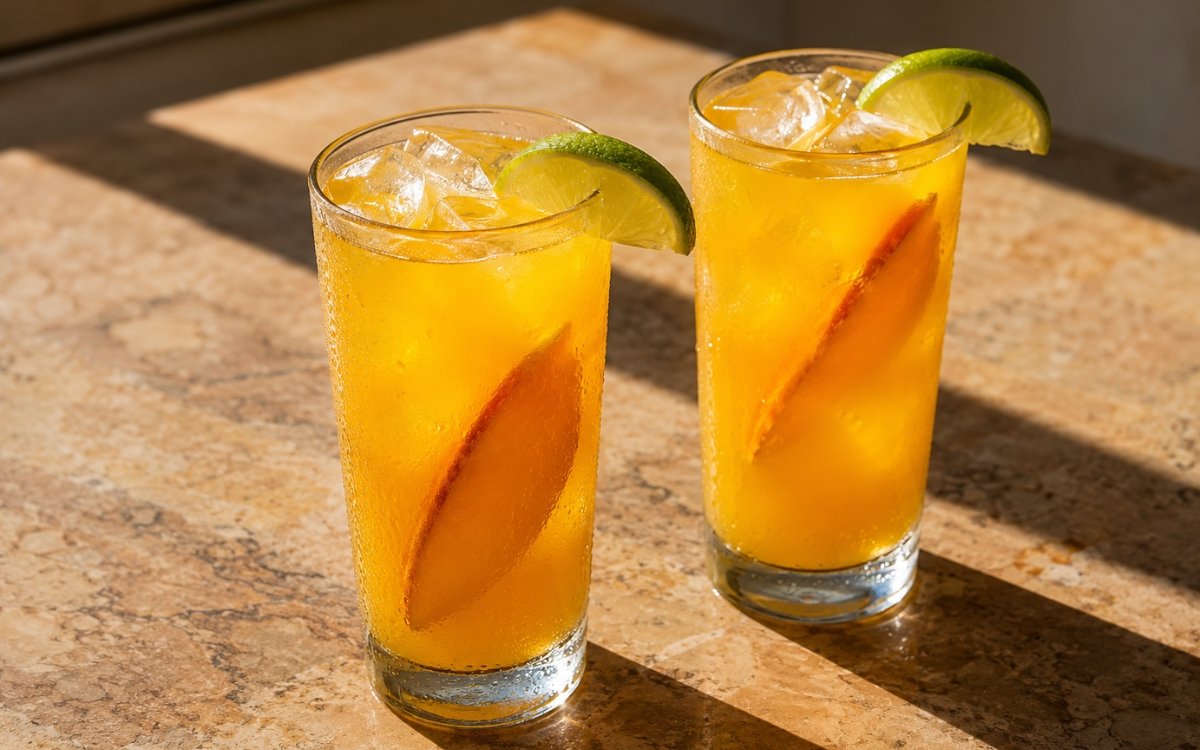
- Refrigerate for 1–2 hours until completely cold and integrated. Stir before serving — mango juice contains natural large-molecule compounds that settle progressively, similar to the settling in the watermelon and pineapple lemonades. Fill glasses with ice. Pour the chilled mango lemonade over the ice. Garnish with a lemon slice and slices of fresh mango. Serve immediately.
Notes
Mango variety affects the finished lemonade significantly in the same way it affects every mango preparation in this collection. Alphonso — small, intensely aromatic, deeply golden — produces the most vivid, most specifically tropical result. Ataulfo (honey mango) produces a comparably excellent result with slightly more acidity. Tommy Atkins — the large, commercially dominant variety with milder flavour — requires the full 450g quantity and produces a good but less intensely flavoured result. The sugar quantity should be adjusted downward by 10g for Alphonso or Ataulfo and maintained at 70g for Tommy Atkins.
The lime zest in the saucepan rather than lemon zest is a tonally specific decision. Lemon zest's primary aromatic compounds are more assertively citrusy in a bright, clean direction; lime zest's primary compounds include a higher proportion of the specifically tropical, slightly floral notes that are tonally aligned with mango's own aromatic direction. The integration of lime zest into the warm mango syrup produces a specifically more unified tropical-citrus base than lemon zest would.