Ingredients
Method
Prepare the Pan
- Use a solid 20cm / 8-inch round cake pan with high sides. Do not use a springform pan. Caramel and custard will leak through it, and that would be a stupid way to ruin an otherwise simple dessert. Place the cake pan near the stove before making the caramel. Once caramel is ready, it sets fast. A solid, seamless pan is the only real option here — even a well-sealed springform has enough of a seam for hot caramel and thin custard to find their way through during the long bake.
Make the Caramel
- Add the sugar, water, and pinch of salt to a small saucepan. Cook over medium heat until the sugar dissolves, then let it boil without stirring. Swirl the pan gently if needed, but do not stir once the syrup is boiling. Cook until the caramel turns deep amber, about 8–12 minutes. It should smell rich and toasted, not burnt. Immediately pour the caramel into the 8-inch cake pan and tilt the pan carefully so the caramel coats the bottom evenly and runs slightly up the sides. Set aside to harden. Do not take the caramel too dark. Burnt caramel tastes bitter and will dominate the custard. Stirring boiling sugar syrup encourages stray sugar crystals to seed the whole batch, which is what causes grainy, crystallised caramel rather than a smooth, glassy one — a gentle swirl of the pan moves the syrup without introducing that risk.
Prepare the Custard
- Preheat the oven to 160°C. In a large bowl, whisk the eggs and egg yolks gently until combined. Do not whip air into them. Add the sweetened condensed milk, evaporated milk, whole milk, vanilla extract, fine sea salt, cinnamon, cloves, and nutmeg. Whisk gently until smooth and fully combined. The spices are intentionally restrained. They should deepen the flavour, not make the flan taste like pumpkin pie. Whisking gently rather than vigorously keeps air bubbles out of the custard from the very start — those trapped bubbles have nowhere productive to go once baked, and they're what turn a silky custard into one riddled with small holes.
Strain the Custard
- Pour the custard through a fine sieve into a clean jug or bowl. This removes egg threads, spice clumps, and any uneven bits. This step is not optional if you want a smooth flan. Skipping it gives you a rougher custard with little cooked egg specks. Even carefully whisked eggs leave behind some stringy, partially set threads (chalazae) that never fully break down into the liquid — straining catches exactly this kind of texture flaw before it has a chance to bake in and become visible in the finished slice.
Fill the Pan
- Pour the strained custard over the hardened caramel in the cake pan. Tap the pan lightly on the counter to release large bubbles. If there is foam on the surface, skim it off with a spoon. Foam bakes into a pitted top instead of a clean smooth surface. This is a second layer of protection against surface imperfections, on top of the straining — any bubbles or foam that survived straining and pouring are addressed here, right before the custard goes into the oven where any remaining flaws would set permanently.
Set Up the Water Bath
- Place the filled cake pan inside a larger roasting pan or baking dish. Pour hot water into the outer dish until it reaches halfway up the sides of the cake pan. Cover the flan loosely with foil. The foil protects the surface from drying and prevents over-browning. The water bath's entire purpose is moderating and evening out the heat reaching the custard — surrounding the cake pan with hot water caps the maximum temperature the custard's edges can reach at around the boiling point of water, protecting against the rubbery, overcooked edges that direct oven heat would produce.
Bake the Flan
- Bake at 160°C for 55–70 minutes, until the edges are set and the centre still has a gentle wobble when the pan is nudged. The internal temperature should be about 80–82°C in the centre. Do not bake until completely firm in the oven. It will finish setting as it cools. If the centre sloshes like liquid, it needs more time. If the whole flan is stiff and cracked, it is overbaked. Pulling the flan while the centre still visibly wobbles is a genuinely counterintuitive instruction worth trusting — residual heat continues cooking the custard for a period after it leaves the oven, and a flan that looks fully set inside the oven will be considerably overbaked by the time it's finished carrying over.
Cool Slowly
- Remove the cake pan from the water bath and let it cool at room temperature for 1 hour. Do not unmould it warm. Warm flan breaks easily and the custard texture will look loose. A custard that's still warm hasn't yet reached the firmer, more structured state it needs for clean handling — attempting to unmould at this stage risks the whole flan breaking apart rather than releasing cleanly as one piece.
Chill the Flan
- Cover and refrigerate for at least 6 hours, preferably overnight. The flan must be fully cold before unmoulding. This chilling time is the main turning point. Flan needs time to set dense, smooth, and sliceable. The custard's proteins continue firming and settling into their final structure throughout this extended chilling period — this is not simply about temperature, but about giving the custard's texture time to fully develop into something dense enough to slice cleanly rather than something that spreads or collapses under a knife.
Unmould the Flan
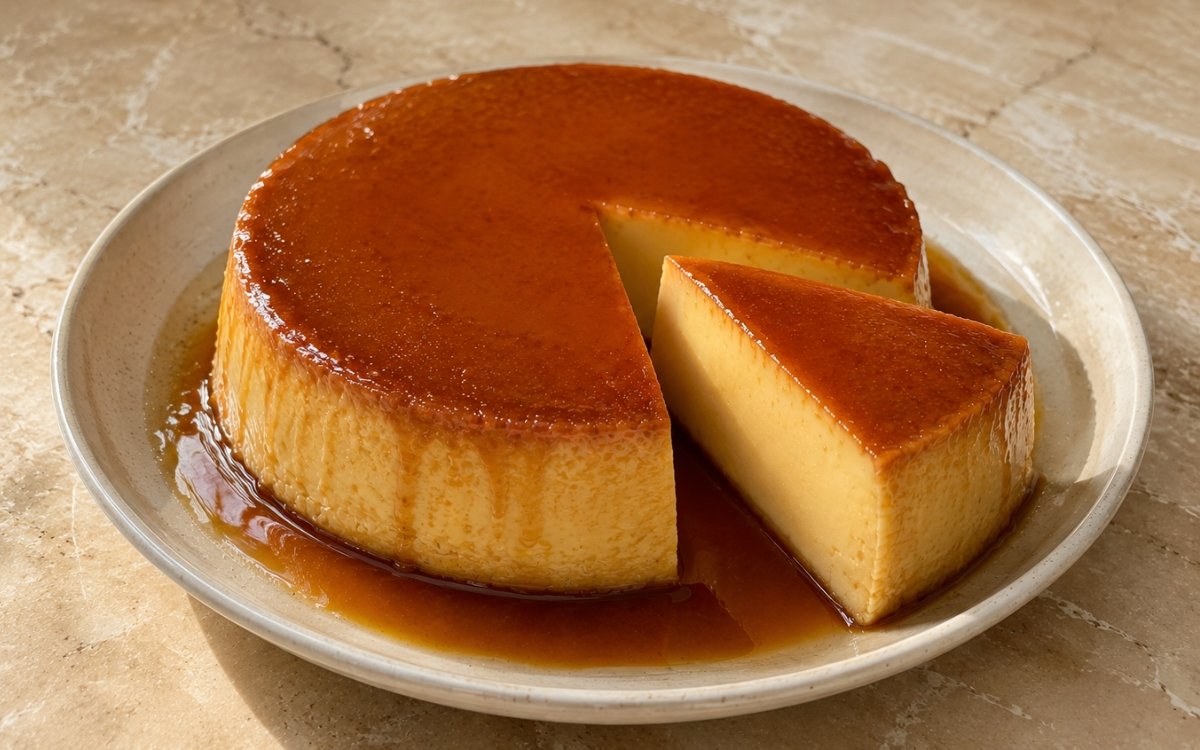
- Run a thin knife carefully around the edge of the pan. Dip the bottom of the pan briefly in warm water for 20–30 seconds to loosen the caramel. Place a rimmed serving plate over the pan, then invert confidently in one motion. Let the flan release naturally. The caramel should run down the sides and pool around the base. Do not shake it violently. If it does not release, warm the bottom for another few seconds and try again. The brief warm water dip gently melts just the outermost layer of hardened caramel where it contacts the pan, loosening its grip without melting the caramel throughout — too long in the water risks losing the caramel's structure entirely before it even reaches the plate.
Slice and Serve
- Cut into 8 slices. Pull one slice slightly forward to show the smooth custard interior and allow caramel to pool around it. Serve cold. Presenting one slice pulled forward, rather than a fully intact round, deliberately reveals the flan's defining visual detail — the clean, unbroken custard texture and the caramel pooling around the cut edge.
Notes
The relationship between the caramel and the custard is worth understanding as a slow transformation that happens entirely during baking and chilling, not something achieved at the caramel-making stage. The hardened caramel poured into the pan starts out glassy and brittle, but over the course of baking and then the extended chilling period, moisture from the custard gradually dissolves the caramel's surface back into a glossy, pourable sauce — which is exactly what allows it to run down the sides and pool around the base once the flan is unmoulded, rather than staying stuck as a hard, brittle disc.
Restraint with the warm spices — cinnamon, cloves, and nutmeg, each measured in eighths of a teaspoon — is a deliberate choice rather than an oversight. These spices are present specifically to add a subtle background warmth and depth to the custard, not to make the flan taste overtly spiced. Adding more than the specified small amounts risks pushing the flavour toward something closer to pumpkin pie, which works against the clean, milky custard flavour a proper flan is built around.
The water bath and the extended, patient chilling period both address the same underlying vulnerability from different angles: custard is a genuinely delicate structure that's easy to overcook or handle prematurely. The water bath protects it during the active cooking stage by moderating heat, while the long chill afterward protects it during the structural-setting stage by giving the custard's proteins time to fully firm without any external stress. Skipping or shortening either stage compromises the final texture in a way that's difficult to fix afterward.
Unmoulding while the flan is still warm is one of the more tempting shortcuts to take, given how long the full process already runs, and it's also one of the most consequential mistakes to make. A flan that hasn't had its full chilling time doesn't yet have the density and structural integrity to survive being inverted and released from the pan cleanly — the risk of it breaking apart rather than sliding out as one intact piece rises sharply the less time it's had to fully chill.