Ingredients
Method
Cook the Cilantro-Lime Jasmine Rice
- For the complete technique — including the rinsing method, the resting period, and the cilantro-lime finish — follow the full Cilantro-Lime Jasmine Rice recipe. Summary: rinse the 300g of jasmine rice under cold running water until completely clear. Combine with 450ml of water and 3g of salt in a medium saucepan. Bring to a full rolling boil, reduce immediately to the lowest heat, cover tightly, and simmer for 15 minutes without lifting the lid. Remove from heat and rest covered for 5 minutes — do not open the lid during this period. After the full rest, uncover and fluff with a fork. While the rice is still warm, stir in the 30ml of lime juice, 15g of chopped fresh cilantro, and 15ml of olive oil or butter — both are absorbed more effectively by warm grains than cold. The rice should taste specifically of lime and cilantro throughout, providing an actively flavoured base that contributes to the bowl's coastal Mexican character rather than being a neutral carrier.
Make the Cabbage Slaw
- While the rice cooks, prepare the slaw. Combine the 300g of finely shredded purple cabbage, 100g of thinly sliced radishes, and 80g of julienned red onion in a large bowl. In a separate small bowl, whisk together the 15ml of lime juice, 20ml of olive oil, 15ml of honey, and 2g of salt until fully emulsified — the honey dissolves into the lime juice rather than sitting in pools, and the oil distributes evenly through the dressing. Pour the dressing over the vegetables and toss thoroughly to coat every shred and slice. Refrigerate immediately. The cabbage slaw benefits from a minimum of 15 minutes of marinating time before serving — the lime juice begins a very light pickling process that softens the cabbage's rawness slightly and mellows the red onion's sharp bite, producing a more cohesive, more balanced slaw than one served immediately after dressing. The purple cabbage is specified rather than green for its specific slightly bitter, more robust character that holds up through the marinating period without wilting excessively, and for its vivid colour that provides the most visual contrast in the assembled bowl.
Make the Chipotle Crema
- In a small bowl, combine the 240g of sour cream, 10ml of adobo sauce from canned chipotle peppers in adobo, 15ml of fresh lime juice, the minced garlic clove, and 2g of salt. Whisk vigorously until completely smooth and uniform — no visible adobo streaks remaining, no garlic clumps, a uniform pale orange-pink cream. The adobo sauce is the specific ingredient that makes this crema distinctly chipotle rather than simply spiced sour cream — the adobo sauce is the thick, slightly sweet, deeply smoky and spiced red sauce in which the chipotle peppers are canned, carrying all the chipotle's complexity without the pepper's direct heat and texture. At 10ml it produces a moderately smoky, warmly spiced crema without aggressiveness — increase to 15ml for a more prominently chipotle flavour if preferred. Taste the finished crema — it should be simultaneously smoky from the chipotle, bright from the lime, garlicky, and well-salted. Refrigerate until assembly.
Make the Pico de Gallo
- For the complete technique — including the correct dice size, the salting and resting method, and the balance — follow the full Pico de Gallo recipe. Summary: finely dice the 4 Roma tomatoes, ½ white onion, and 1 jalapeño into uniform, approximately 5mm pieces. Combine in a bowl with the 30g of roughly chopped cilantro, 30ml of lime juice, and 3g of salt. Toss and allow to rest for at least 10 minutes — the resting period draws moisture from the tomatoes and onion and mellows the raw sharpness into a cohesive, balanced salsa. Taste and adjust with additional lime or salt.
Make the Guacamole
- For the complete technique — including the correct avocado preparation, the mashing method, and the balance — follow the full Classic Guacamole recipe. Make this step last among the cold preparations to minimise oxidation time before serving. Summary: halve the 3 ripe avocados, remove the stones, and scoop the flesh into a bowl. Add the 30ml of lime juice immediately — the acid slows the enzymatic browning from the moment of contact. Add the minced garlic, finely diced onion, diced jalapeño, chopped cilantro, and 3g of salt. Mash to a partially chunky consistency with some avocado pieces remaining — the correct texture for a bowl component that provides creamy pockets rather than a smooth spread. Taste and adjust. Press plastic wrap directly against the surface if not serving immediately.
Season and Cook the Fish
- Pat the 680g of fish fillets completely dry on all surfaces with paper towels — thorough drying is the most important preparation step for a properly crisped, caramelised fish surface. Any surface moisture converts to steam on contact with the hot oil, preventing the Maillard crust that produces both the visual golden colour and the textural contrast between the crispy exterior and the flaking interior. In a small bowl, combine the 8g of cumin, 6g of smoked paprika, 4g of garlic powder, 4g of salt, and 3g of black pepper and stir to a uniform spice blend. Season both sides of each fillet generously, pressing the spice blend gently against the fish surface to help it adhere. Heat a large cast iron skillet or heavy-bottomed non-stick skillet over medium-high heat. Add the 20ml of olive oil and allow to heat until shimmering — at shimmering the oil is at the correct temperature for a proper sear without burning the spices. Add the fish fillets with space between each — work in two batches if needed to prevent crowding. Place skin-side down if the fillets have skin. Cook completely undisturbed for 4–5 minutes — the spice crust caramelises against the hot oil and pan surface during this sustained contact, producing the deeply golden, slightly charred exterior that is the visual and flavour signature of properly cooked taco fish. Any movement before the crust forms tears the developing surface. Flip gently using a thin spatula once the fish releases naturally from the surface. Cook the second side for 3–4 minutes until the fish flakes easily when pressed with a fork and reads 63°C internal temperature. Remove from heat and allow to rest for 2 minutes, then break into large, irregular chunks — large enough to provide textural identity in the assembled bowl rather than fine flakes that disappear into the other components.
Warm the Black Beans and Assemble
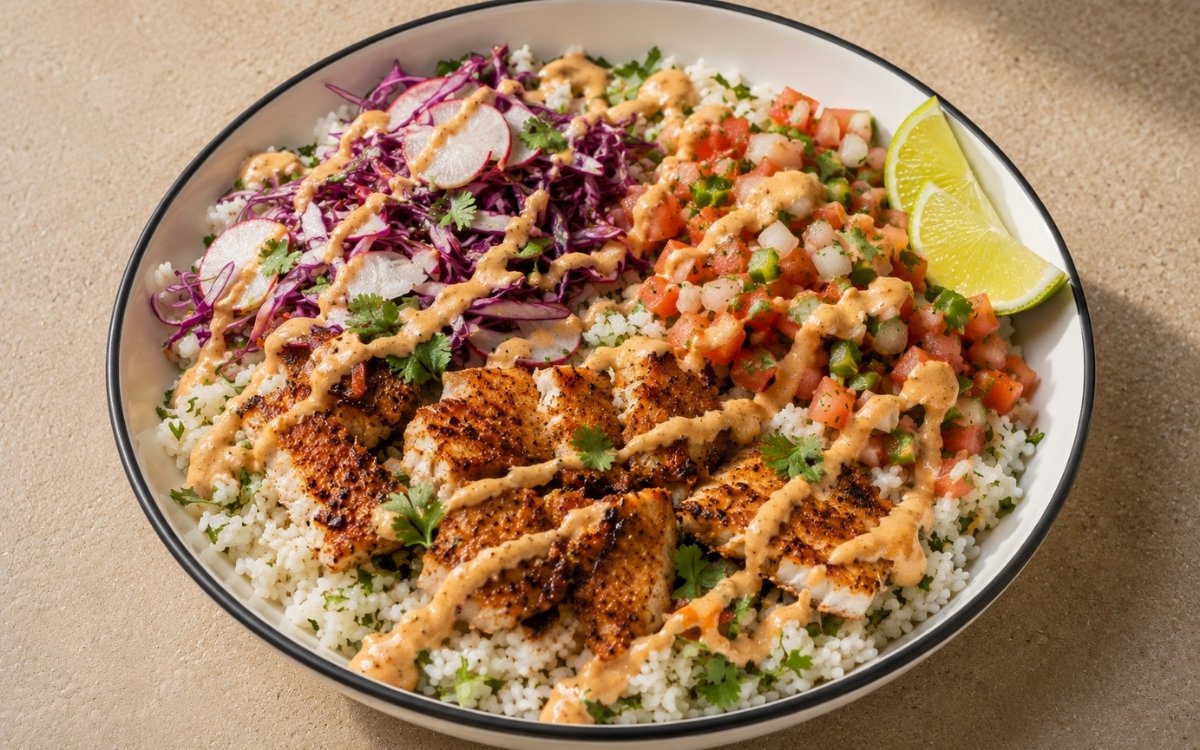
- Warm the 240g of drained and rinsed black beans in a small saucepan over medium heat with a splash of water for 2–3 minutes until heated through. Season with a pinch of salt. Assemble all four bowls in rapid succession — the fish is at its best warm and the guacamole begins to oxidise once exposed. Divide the cilantro-lime rice as the base of each bowl. Working around the rice, place each component in its own distinct section: the flaked fish pieces in the largest section, the cabbage slaw alongside, the pico de gallo in its own area, the guacamole in the remaining section, and the warm black beans distributed evenly. Drizzle the chipotle crema generously over each bowl — it should reach every component, extending from the fish across the rice to the edges of the bowl. Scatter fresh cilantro leaves over each bowl. Place lime wedges alongside for squeezing at the table. Serve immediately.
Notes
The chipotle crema is the single component that most defines this bowl's coastal Mexican character and distinguishes it from a generic spiced fish preparation. Chipotle peppers in adobo — smoked, dried jalapeños rehydrated and canned in a spiced tomato-vinegar sauce — produce an adobo sauce with a specifically complex, smoky-sweet, lightly spiced character that neither plain chili powder nor cayenne can replicate. The adobo sauce rather than the chipotle pepper itself is used in this crema because the sauce carries the chipotle's full aromatic and flavour complexity in a liquid form that blends instantly and uniformly into the sour cream, whereas chopped chipotle pepper produces uneven heat and texture. A can of chipotle peppers in adobo — available at most supermarkets in the Mexican foods section — provides both the peppers for other recipes and the sauce for this crema. The remaining peppers and sauce keep refrigerated in a sealed container for up to 2 weeks and are used in the Chili Lime Chicken Rice Bowl marinade and numerous other preparations.
The purple cabbage slaw prepared with lime, olive oil, and honey rather than a mayonnaise base is the specifically Mexican-coastal approach — lighter, more acidic, and with the slight pickling character from the lime juice that provides the fresh crunch contrast the fish and creamy components require. The 15-minute minimum marinating period in the refrigerator is the technique that converts the raw vegetable mixture into a cohesive slaw.