Ingredients
Method
Brew and Cool the Espresso
- Prepare 120ml of fresh espresso using high-quality beans and properly dialed grind size. Allow the espresso to cool to room temperature or slightly warm — never hot. Cooling preserves carbonation later and prevents the drink from tasting flat or overly bitter. For faster cooling, transfer the espresso to a shallow container or stir gently to release heat. A shallow container gives the espresso considerably more surface area exposed to the air than a deep, narrow cup would, which is what allows heat to dissipate quickly without needing to wait for it to cool passively over a longer stretch of time.
Prepare the Glasses or Pitcher
- Fill a large pitcher or individual glasses generously with ice. Cold dilution is essential here — espresso tonic relies on temperature contrast and rapid chilling to achieve its clean, refreshing profile. Using insufficient ice results in a warm, aggressive drink with muted aromatics. Generous ice does more than simply chill the drink; it also provides the immediate, sustained cold that keeps the tonic's carbonation intact once it's poured, since warmer liquid loses dissolved carbon dioxide considerably faster than properly cold liquid does.
Add the Tonic First
- Pour the fully chilled tonic water into the ice-filled pitcher or glasses. Adding tonic first preserves carbonation structure and ensures proper dilution control. High-quality tonic should appear lively and effervescent with tight bubbles. Building the tonic's own carbonated structure in the glass before anything else is added means it has a genuine, undisturbed baseline to work from — introducing the espresso at this early stage instead would risk disrupting that structure before it's even had a chance to settle.
Layer the Espresso
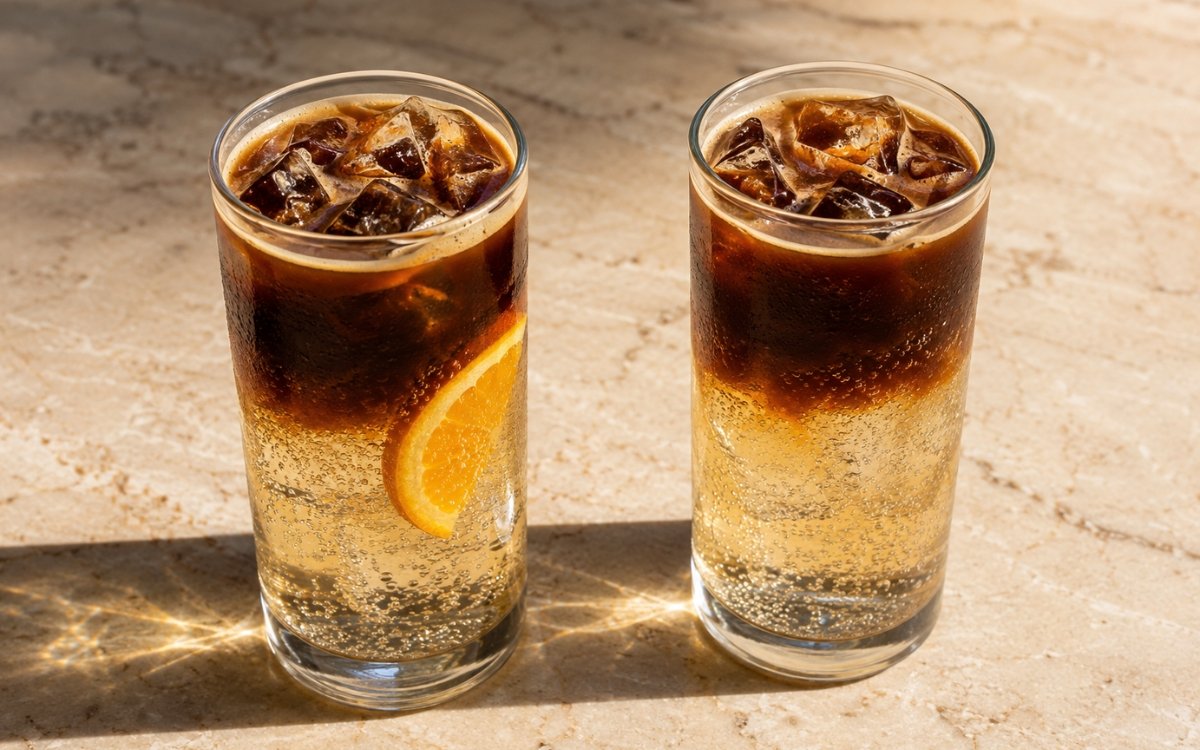
- Slowly pour the cooled espresso over the back of a spoon or down the inside wall of the glass so it gently floats and partially layers over the tonic. This technique creates visual contrast and prevents immediate collapse of carbonation. A spoon or the glass's own inside wall breaks the espresso's fall into a slow, gentle trickle rather than a direct drop — that gentler entry is what lets it settle and float as a visibly distinct layer rather than crashing through the tonic and disturbing its carbonation on contact.
Light Integration and Serve
- Give one very gentle stir only if desired — just enough to slightly combine the liquids while maintaining bubble structure. Garnish with orange peel or a slice and serve immediately while sharply cold and fully sparkling. This is a genuinely light touch, not a full mixing stir — the goal is only to soften the sharp line between the two layers slightly, while leaving the tonic's carbonation as intact as possible for serving.
Notes
Cooling the espresso before it ever meets the tonic deserves to be understood as the foundational technical requirement this entire drink depends on. Hot liquid poured directly onto cold, carbonated tonic causes that dissolved carbon dioxide to release rapidly and violently, essentially flattening the drink's effervescence on contact. The brief cooling step — whether achieved through a shallow container or gentle stirring — protects the tonic's sparkle by ensuring the espresso arrives at a temperature that won't shock it.
The specific order of assembly — tonic first, into the ice-filled glass, with espresso added only afterward — is worth treating as a deliberate sequence rather than an arbitrary preference. Building the tonic's carbonated structure first, undisturbed, gives it a genuine baseline to hold before anything else is introduced. Reversing that order and adding espresso to an empty glass first would offer no such protection, and the tonic poured on top afterward would have far less opportunity to establish and maintain its own lively fizz.
The technique of layering the espresso in slowly, over a spoon or down the glass wall, reflects the same principle used for visually layered drinks throughout this collection, adapted here specifically to protect carbonation rather than simply create a colour gradient. A direct, forceful pour would disturb the tonic's bubbles considerably more than a slow, gentle trickle along a surface — the visual float this technique produces is a genuine byproduct of protecting the drink's structure, not simply a presentation trick.
The explicit instruction against over-stirring is worth respecting as a real constraint on how this drink is finished, not a minor stylistic note. Vigorous stirring, even after the espresso has already been gently layered in, works directly against everything the earlier steps protected — it's specifically flagged in this recipe as the difference between a properly structured spritz-style drink and something that collapses into diluted iced coffee instead.