Ingredients
Method
Prepare the Corn Tortillas
- Prepare the Homemade Corn Tortilla dough according to its separate recipe. Mix the masa harina, salt, and warm water until the dough is soft, hydrated, and no dry masa remains. Rest covered for 20–30 minutes. Divide into 8 equal balls of about 67–68g each. Press each tortilla to about 20cm / 8 inches diameter. Cook on a dry hot skillet or comal until lightly charred, flexible, and cooked through. Stack immediately under a towel so the tortillas steam and stay pliable. Do not let them dry out, or they will crack when rolled. The larger 20cm diameter here, compared to a small taco tortilla, is specific to this format — enchiladas need enough surface area to wrap fully around a generous filling and still overlap at the seam.
Toast and Soften the Chiles
- Toast the guajillo, ancho, and chile de árbol in a dry skillet over medium heat for 10–15 seconds per side, just until fragrant and flexible. Do not let them smoke or blacken; burned chiles will make the sauce bitter. Transfer the toasted chiles to a bowl, cover with hot water, and soak for 15 minutes until softened. Drain before blending. The brief dry toast blooms each chile's aromatic oils before rehydration, which is a meaningfully different result than simply soaking raw dried chiles straight from the bag — the toasted version carries more roasted depth into the final blended sauce.
Make the Red Enchilada Sauce
- Heat 30ml neutral oil in a saucepan over medium heat. Add the chopped onion and cook for 4–5 minutes until softened and lightly golden. Add the garlic and cook for 30 seconds. Add the tomato paste, cumin, oregano, smoked paprika, and coriander, then cook for 1 minute until the paste darkens slightly. Transfer everything to a blender with the softened chiles, stock, apple cider vinegar, brown sugar, and salt. Blend until completely smooth. Strain through a fine sieve into a clean saucepan if the sauce has visible chile skin or grit. Simmer the sauce for 8–10 minutes over medium-low heat until slightly thickened, glossy, and deep red-orange. Whisk in the butter at the end for shine. The sauce should coat the back of a spoon but still pour easily. If it becomes too thick, loosen with a splash of stock. Whisking in cold butter at the very end, off the heat's most aggressive point, is what gives the sauce its final glossy sheen — this is the same finishing technique used in French pan sauces, and it's a distinct step from the simmer itself, which is doing the actual thickening work.
Cook the Spiced Ground Beef
- Heat 15ml neutral oil in a large skillet over medium-high heat. Add the ground beef and cook for 5–6 minutes, breaking it into small crumbles, until browned and no longer pink. If the pan has excessive fat, spoon off some but leave enough to keep the filling juicy. Add the diced onion and cook for 3–4 minutes until softened. Add the garlic and cook for 30 seconds. Stir in the tomato paste, cumin, smoked paprika, chilli powder, oregano, salt, and black pepper. Cook for 1 minute to bloom the spices. Add 80ml water or beef stock and simmer for 3–4 minutes until the beef is moist but not wet. The filling should be juicy enough to hold together but not saucy enough to leak through the tortillas. Browning the beef before adding the aromatics, rather than all at once, keeps the meat from steaming in its own released liquid — a hot, dry pan first is what produces genuine browned flavour rather than grey, boiled-tasting crumbles.
Make the Refried Black Beans
- Heat the oil or lard in a small skillet over medium heat. Add the diced onion and cook for 3–4 minutes until soft. Add the garlic and cumin and cook for 30 seconds. Add the drained black beans, salt, and 80ml water or stock. Mash with a potato masher or fork until creamy but still slightly textured. Cook for 4–5 minutes, stirring often, until thick and spreadable. Add more water if the beans become too stiff. Stir in butter if using. The beans should be creamy enough to spread inside the tortillas without tearing them. Mashing rather than blending is a deliberate texture choice — a potato masher leaves some bean skins and small chunks intact, giving the filling a bit of body and interest rather than the uniform smoothness a blender would produce.
Prepare the Tortillas for Rolling
- If the tortillas have cooled and feel stiff, warm them one at a time on a hot skillet for 10–15 seconds per side, or lightly brush with oil and warm briefly until flexible. This step matters. Cold or dry corn tortillas will split when rolled. Corn tortillas firm up and lose flexibility as they cool because the starches in the masa retrograde — this brief rewarming step reverses that just enough to make the tortilla pliable again without cooking it further.
Assemble the Enchiladas
- Spread a thin layer of red enchilada sauce across the bottom of a baking dish. Working with one tortilla at a time, spread a spoonful of refried black beans down the centre, then add a portion of spiced ground beef. Roll tightly but gently and place seam-side down in the dish. Repeat with all 8 tortillas. Pour the remaining red sauce over the enchiladas, covering them completely. The tortillas should be coated edge to edge, with some sauce pooling around them. Placing each enchilada seam-side down is what keeps it rolled through baking — the weight of the tortilla and the pooling sauce both help hold the seam shut without needing a toothpick or additional binding.
Heat the Enchiladas
- Place the dish over gentle heat if using a stovetop-safe clay dish, or bake at 190°C for 12–15 minutes until the sauce is hot, glossy, and bubbling lightly at the edges. Do not overbake. The goal is hot, saucy enchiladas, not dried-out tortillas. This is a heating and melding stage rather than a true bake — the tortillas and fillings are already fully cooked, so the oven time exists purely to bring the sauce to temperature and let it soak slightly into the tortilla's surface without drying anything out.
Garnish and Serve
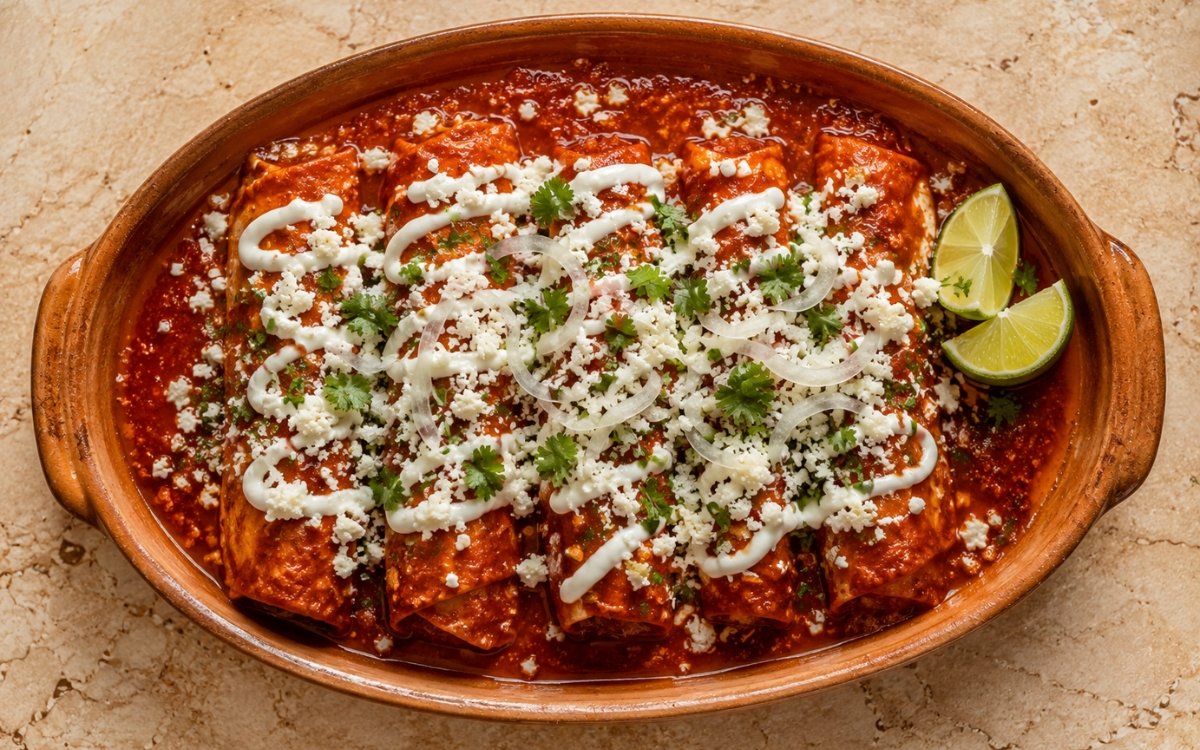
- Scatter crumbled queso fresco generously over the hot enchiladas. Drizzle crema in thick zigzags across the top. Add thin white onion rings and fresh cilantro leaves. Serve 2 enchiladas per person with lime wedges if using. Serve immediately while the sauce is glossy and hot, the cheese is still fresh-looking, and the onion and cilantro remain crisp. Adding every garnish after the enchiladas come out of the heat, rather than before, keeps the queso fresco from melting into the sauce and the crema from breaking or thinning out — all four garnishes are meant to sit visually and texturally distinct on top of the hot dish.
Notes
The red enchilada sauce follows the same layered-building principle used throughout this collection for chile-based sauces: toast, soak, sweat, briefly fry the tomato paste, blend, then simmer with a final butter finish. Skipping any one of those steps — particularly the toasting or the tomato paste frying — produces a sauce that tastes flatter and more one-dimensionally spicy rather than genuinely roasted and rounded. The butter whisked in at the very end is a small addition by volume but a meaningful one for mouthfeel, giving the sauce a glossy richness that a purely water-and-chile base wouldn't have on its own.
Keeping both fillings on the drier side of moist is a structural decision as much as a flavour one. Ground beef simmered down until juicy but not wet, and black beans mashed until spreadable but not runny, are both filling profiles built specifically to survive rolling and baking without leaking through the tortilla or turning the dish soupy. A wetter version of either filling might taste fine on its own, but it compromises the integrity of the rolled tortilla once it's sitting in sauce in the oven.
Warming the tortillas immediately before rolling is one of the easiest steps to skip and one of the most consequential to skip. Corn tortillas that have cooled past a certain point lose the flexibility that makes them rollable, and forcing a cold, stiff tortilla around a filling reliably cracks it, which then leaks filling and sauce through the crack during baking. The brief 10–15 second warm-up on each side restores that pliability cheaply, right before it's needed.
The garnishing sequence — queso fresco, crema, onion, cilantro, all added after the dish comes out hot from the oven — exists to preserve a visual and textural contrast that's central to how enchiladas rojas are meant to look and eat. Adding any of these garnishes before baking would either melt them into the sauce or dull their fresh, bright appearance, undercutting the specific colour story of vivid red sauce against white cheese and cream that gives the dish its identity.