Ingredients
Method
Slice and Salt the Eggplant
- Trim the eggplants and slice lengthwise or into rounds about 8–10mm thick. Lay the slices in a single layer or in stacked layers on trays, salting lightly on both sides. Let sit for 30–45 minutes. Pat very dry with paper towels. This step helps remove excess surface moisture so the breading adheres better and the eggplant fries instead of steaming. Do not skip drying well — wet eggplant leads to soggy coating and oily frying. That salting stage draws out real, measurable moisture through osmosis, and the thorough pat-dry that follows removes it before it ever has the chance to interfere with breading adhesion or proper frying.
Make the Sauce
- Heat the olive oil in a saucepan over medium heat. Add the onion and cook for 6–8 minutes until softened but not browned. Add the garlic and cook for 30 seconds. Add the tomatoes, salt, pepper and optional chili flakes. Simmer gently for 20–25 minutes, stirring occasionally, until slightly thickened. Add the basil for the final few minutes. Taste and adjust seasoning. The sauce should be well seasoned but not overly thick. The sauce should be thick enough to coat a spoon lightly, but not reduced into a paste. If it is too thin, the bake becomes watery. If too thick, the layers can dry out.
Bread the Eggplant
- Prepare 3 shallow bowls: flour, eggs beaten with the milk or water, and breadcrumbs mixed with the 60g Parmesan and black pepper. Dredge each eggplant slice first in flour, then egg, then breadcrumb mixture. Press lightly so the crumbs adhere. Place on a tray while you finish the rest. Bread only once and keep the coating light and even. A thick heavy crust separates from the eggplant and makes the bake bulky rather than layered. That deliberately light, single coating protects each slice's own real structural integration with its crust — a heavier, doubled breading would instead sit as a separate, bulkier layer prone to pulling away once baked.
Fry the Eggplant
- Heat about 1cm of neutral oil in a wide skillet over medium heat. Fry the eggplant in batches for about 2–3 minutes per side, until golden brown and crisp. Transfer to a rack or paper towel-lined tray. Fry until evenly golden, not pale. Pale slices soften too much in the oven and lose structure. Do not overcrowd the pan or the oil temperature will drop and the eggplant will absorb oil. The slices should be flexible and tender inside, but with a set golden crust outside. That deep golden colour shows the crust has set — pale slices haven't developed that same set crust, and they soften further once the oven's own additional heat is applied during baking.
Assemble
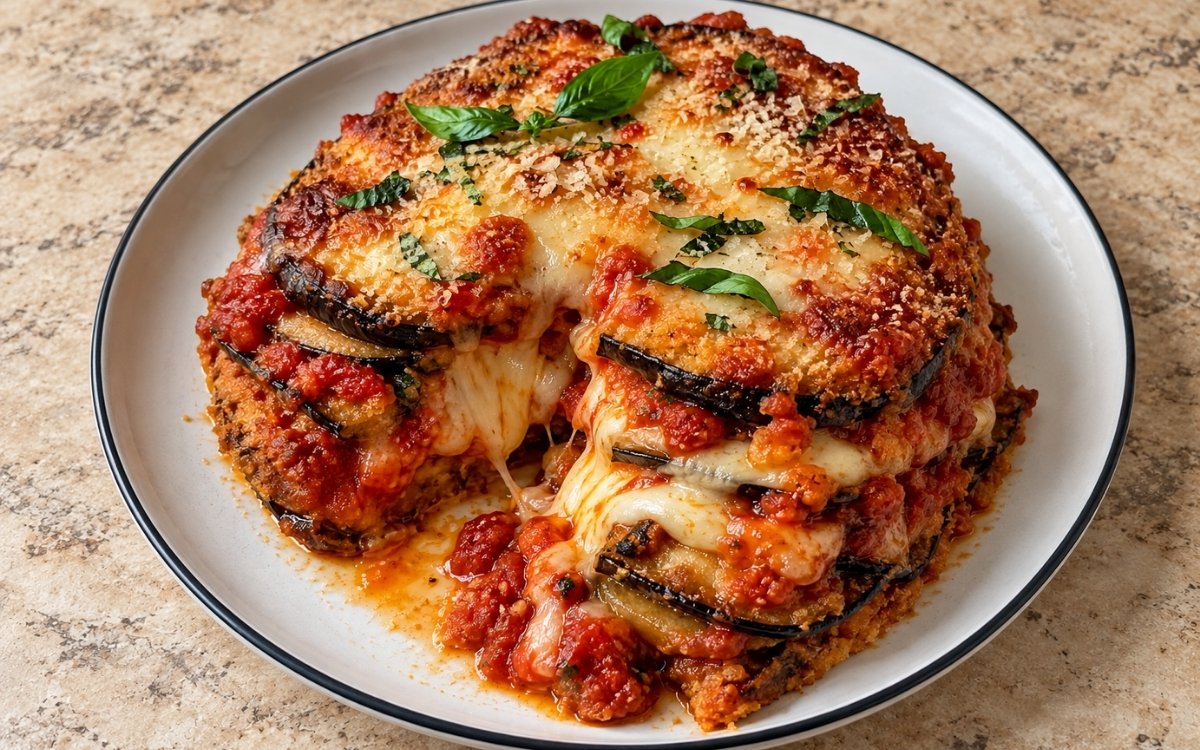
- Preheat the oven to 200°C / 400°F. Use a medium-to-large baking dish, about 23 x 33cm / 9 x 13 in. Spread a thin layer of sauce on the bottom. Add a layer of fried eggplant, overlapping slightly. Spoon over a light layer of sauce, then scatter some mozzarella, Parmesan and basil. Repeat the layers until everything is used, finishing with sauce, mozzarella and Parmesan on top. Usually you will have 3 layers, depending on your dish and slice size. Do not drown each layer in sauce. Use enough for coverage, but keep it restrained so the eggplant remains defined and the final dish slices cleanly. That deliberate restraint with sauce at every layer, rather than a heavy hand throughout, keeps each eggplant slice distinct and defined rather than dissolving into one saucy mass.
Bake
- Bake for 25–30 minutes, until bubbling around the edges and browned on top. If needed, broil for 1–2 minutes at the end for deeper color, watching carefully. Let rest for 15–20 minutes before cutting. Resting is essential. If cut immediately, the layers slide apart and the sauce runs. After resting, the structure sets and the slices hold together. That rest lets the whole casserole's internal structure firm up considerably, protecting every layered slice from collapsing into a loose, sliding mass the moment a knife touches it too soon.
Notes
Salt and thoroughly dry the eggplant slices before breading. Skip this and the breading turns soggy and oil-heavy instead of crisp and adherent. That salting draws out real, measurable moisture through osmosis, and the thorough drying that follows prevents that residual moisture from interfering with either the breading's own adhesion or the eggplant's actual ability to fry rather than steam.
Fry until golden rather than pulling the eggplant while it's still pale, because the slices keep cooking in the oven. Pale slices simply haven't developed the same set, structured crust that properly golden ones have, which is directly why they soften considerably more and lose real structure once they spend additional time baking in the oven.
Keep the sauce restrained at every layer rather than drowning the eggplant in it. A dish that slices cleanly, with distinct eggplant layers rather than a mushy casserole, depends on that restraint throughout assembly.
Let the baked dish rest for the full 15 to 20 minutes before cutting; this is a structural step, not just patience. Cutting too early lets the still-loose layers slide apart and the sauce run, undoing much of the careful, layered structure built throughout the rest of the recipe.