Ingredients
Method
Make the Italian Breadcrumbs
- Preheat the oven to 135°C. Spread the 12 slices of white bread in a single layer across one or two baking sheets. Bake for 15 minutes until the bread is completely dry and very lightly toasted — there should be no give or softness when pressed. The goal is complete moisture removal rather than browning; white bread baked to this internal dryness produces a finer, more neutral-flavoured crumb than bread that is browned, which would add bitterness to the coating. Remove and allow to cool completely. Partially cooled bread introduces steam into the food processor and produces a damp crumb rather than a dry, fine one. Once fully cool, break the dried slices into rough pieces and add to a food processor. Pulse in batches until reduced to fine, uniform crumbs. On the final processing batch, add the 8g of salt, 4g of dried basil, 4g of dried oregano, 6g of black pepper, and 6g of garlic powder to the processor before pulsing — adding the herbs at this stage distributes them through every crumb uniformly rather than stirring them into the finished crumb where they tend to settle unevenly. Process until fully combined. Transfer all breadcrumbs to a wide bowl.
Make the Dipping Sauce
- In a medium bowl, whisk together the 240g of mayonnaise, 120g of ketchup, 25g of sriracha, 10g of Dijon mustard, 3 finely grated garlic cloves, 6g of mushroom powder, and 8g of Worcestershire sauce until completely smooth and uniform. The mushroom powder — oyster or porcini — is the invisible flavour amplifier that deepens the sauce's savoury character significantly without any detectable mushroom flavour; its concentrated glutamate content amplifies the sriracha's heat, the Worcestershire's complexity, and the ketchup's sweetness simultaneously. Cover and refrigerate. The sauce improves with 15–20 minutes of chilling as the flavours meld.
Cut the Mozzarella
- Slice the 680g of cold low-moisture whole-milk mozzarella blocks into uniform batons approximately 12mm (½ inch) thick. Consistent sizing ensures every stick cooks at the same rate. Low-moisture whole-milk mozzarella is the non-negotiable specification for this recipe — fresh mozzarella's high water content produces steam during frying that ruptures the crust regardless of how many times the stick is coated; low-moisture mozzarella's reduced water content melts without steaming, and whole-milk produces the specific rich, creamy flavour and full stretch that part-skim cannot match. If the kitchen is warm, place the cut batons on a tray and freeze for 10–15 minutes before breading. Very cold mozzarella maintains its shape during the breading process and resists premature leaking when it first contacts the hot oil.
Set Up the Breading Station
- Arrange three wide, shallow bowls in sequence: First bowl — the 225g of all-purpose flour. Second bowl — the 5 large eggs, beaten until completely uniform. Third bowl — the seasoned Italian breadcrumbs.
Double-Coat the Mozzarella
- Work through the full three-stage sequence twice for each baton — this is the double coat that prevents leaking. First coat: Dip each cold mozzarella baton into the flour, turning to coat all surfaces, then shake off excess vigorously. Dip into the beaten egg, turning to coat, then allow excess to drip off. Press firmly into the seasoned breadcrumbs, coating all surfaces completely and pressing gently to compact the crumbs against the egg-coated surface. Second coat: Immediately dip the once-breaded baton back into the egg — the egg re-moistens the first breadcrumb layer and creates the adhesive surface for the second coat. Allow excess to drip off. Press firmly into the breadcrumbs again for a complete second layer. Place on a tray. A single coat leaves micro-gaps in the crust that allow the expanding, liquefying cheese to find and exit through; a double coat fills every gap and creates the sealed, continuous barrier that holds the molten centre contained. Once all sticks are double-coated, refrigerate the tray for 10 minutes — or freeze for 5 minutes — before frying.
Heat the Oil and Fry
- Fill a large, heavy-bottomed pot with 3–4 litres of vegetable oil. Heat to 175°C — use a thermometer throughout; oil temperature cannot be reliably estimated visually and an incorrect temperature is the most common cause of either soggy coatings or cheese leakage. Maintain a cooling rack over a baking sheet alongside the pot. Fry in small batches — 3–4 sticks maximum per batch, depending on pot diameter. Overcrowding drops the oil temperature below the critical 170°C threshold where the coating begins absorbing oil rather than crisping immediately on contact. Lower each stick carefully into the oil. Fry for 2–3 minutes, turning occasionally, until the crust is a deep, even golden-brown across all surfaces. The correct frying window is narrow — undercooked means a pale, soft crust; overcooked means the crust has been at temperature long enough for the cheese to fully liquefy and seek a gap in the coating. Transfer immediately to the wire rack. Season each stick lightly with salt while still hot — the heat and residual surface oil hold the salt in place. Allow the oil to return to 175°C between each batch before adding the next.
Serve
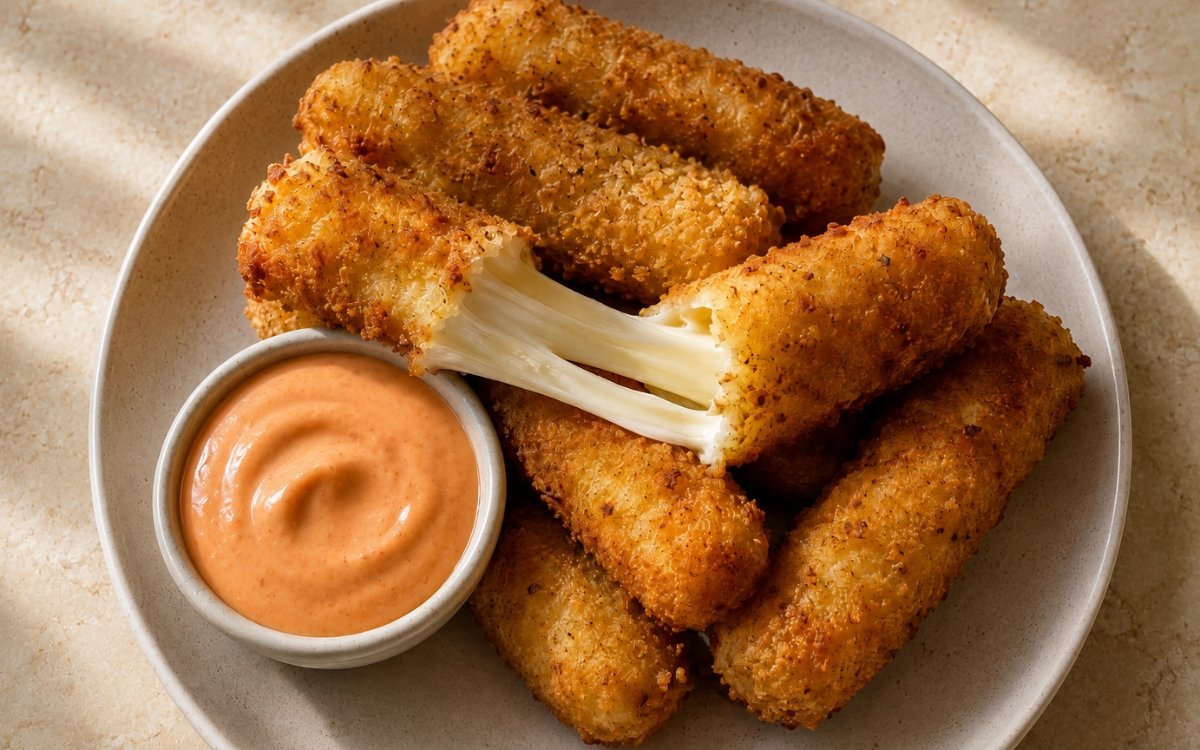
- Serve immediately with the chilled dipping sauce alongside. Mozzarella sticks are at their optimal state in the first 2–3 minutes after frying — the crust is at peak crispness and the cheese is at its maximum stretch. The longer they sit, the more the interior cheese cools and firms, reducing the dramatic molten pull.
Notes
The homemade Italian breadcrumbs are the specific quality decision that makes these mozzarella sticks distinguishable from panko or store-bought breadcrumb versions. White bread baked to complete dryness and ground fine produces a crumb with a specific light, almost powdery texture that packs closely against the egg surface during pressing — creating a more uniformly sealed, more continuous crust than the irregular panko flake. The Italian herb seasoning ground into the final processing pass distributes evenly through every particle of crumb, so the herbs are present in every bite of crust rather than distributed unevenly through a hand-mixed batch.
The double-coat is the structural requirement that makes consistently non-leaking mozzarella sticks achievable at home. The physics of the problem: mozzarella's melting point is crossed within the first 30–40 seconds of frying, at which point the cheese begins expanding and liquefying. A single breadcrumb coat has micro-gaps — visible under magnification, but invisible to the naked eye — through which the expanding liquid cheese finds a path outward. The double coat doubles the coat's density and effectively eliminates these micro-gaps, sealing the cheese inside for the full 2–3 minute fry time. The second egg dip between coats is the adhesive layer that bonds the two breadcrumb layers together into a unified, dense coating rather than two independent layers that could separate.