Ingredients
Method
Make the Lemon Breadcrumbs
- Heat the 30ml of olive oil in a large skillet over medium heat until shimmering. Add the 80g of torn sourdough crumbs — coarse, irregular pieces rather than fine, uniform crumbs, which produce a more interesting, more texturally dramatic topping with better crunch retention. Cook, stirring constantly, for 4–5 minutes until the crumbs are deeply golden and crispy throughout — not just coloured on the surface but crunchy all the way through. The olive oil saturates each piece and the water in the bread evaporates during this cooking period, leaving behind a toasted, crispy crumb that holds its crunch at serving rather than softening immediately on contact with the warm pasta. Add the lemon zest and a pinch of salt in the final 30 seconds of toasting, tossing quickly to coat — the zest's aromatic oils bloom briefly in the hot oil and adhere to the toasted crumbs, producing a crumb that smells and tastes of both toasted bread and fragrant lemon. Transfer to a bowl and set aside. Wipe the skillet clean.
Cook the Pasta
- Bring a large pot of heavily salted water to a full rolling boil. Add the rigatoni and cook until exactly 2 minutes shy of the package's al dente time — the pasta finishes cooking in the sauce. Before draining, reserve 200ml of the starchy pasta water in a heatproof jug. Drain without rinsing.
Caramelise the Zucchini
- This is the most technically important step in the recipe and the one where patience produces the most dramatic quality difference. Heat the 50ml of olive oil in the wiped skillet over medium-high heat until shimmering. Add the diced zucchini in a single layer — work in two batches if the skillet cannot accommodate all 600g without crowding, because crowded zucchini releases its moisture and steams rather than searing, producing pale, soft, waterlogged pieces instead of the deeply golden caramelised cubes that contribute the sauce's character. With a single layer and space between pieces, the zucchini's surface moisture evaporates immediately and the direct pan contact produces caramelisation. Leave undisturbed for 3 minutes — no stirring, no moving. The bottom surface of each piece must have uninterrupted contact with the hot pan for long enough to develop genuine golden colour. After 3 minutes, toss or stir once and cook for another 2–3 minutes until the zucchini is tender throughout and golden on most surfaces. Season with salt and black pepper. Remove approximately half the zucchini — approximately 300g — and transfer it to a blender. Leave the remaining half in the skillet. The strategic split is the architectural decision that defines this dish: the blended half becomes the smooth, vibrant green sauce; the intact half provides the textural, slightly charred zucchini pieces that are visible in the finished dish and provide a contrast between creamy sauce and distinct vegetable.
Build the Anchovy-Garlic Aromatic Base
- Reduce the heat to medium-low. Add the remaining 40ml of olive oil to the skillet with the intact zucchini pieces. Add the thinly sliced garlic, the 2 minced anchovy fillets, and the red pepper flakes. Cook for 1–2 minutes, stirring constantly, until the garlic is fragrant and very lightly golden. The anchovies — the same invisible-but-essential umami foundation technique as in puttanesca — melt almost completely into the olive oil within 60–90 seconds of minced contact with the hot fat, distributing their glutamate-rich savoury depth through the oil without leaving any identifiable anchovy presence. Their role is to add the deep savoury foundation that prevents the zucchini sauce from tasting one-dimensionally sweet and vegetable-mild. At their small quantity — 2 fillets — they are completely undetectable as anchovy in the finished dish. The garlic and red pepper flakes bloom their aromatic and heat compounds into the anchovy-infused oil simultaneously.
Blend the Sauce
- To the blender containing the reserved half of the caramelised zucchini, add 150ml of the reserved pasta water, the 80ml of heavy cream, and 30g (half the total) of the finely grated Parmigiano-Reggiano. Blend on high speed for 45–60 seconds until completely smooth — a vivid, uniform green cream with no visible zucchini pieces remaining. The blended sauce should look and behave like a pourable cream sauce — smooth, slightly thick, and vibrantly green from the cooked zucchini's chlorophyll. The caramelised zucchini pieces used here produce a more complex, more deeply flavoured sauce than raw or simply sautéed zucchini would — the Maillard reaction compounds from the caramelisation distribute through the blended sauce, adding a slightly sweet, concentrated depth to every tablespoon. The pasta water's starch and the cream's fat combine during blending to produce the sauce's emulsified, slightly creamy body. Pour the blended sauce into the skillet with the intact zucchini pieces and the anchovy-garlic base. Add the 45g of butter and stir until completely melted and incorporated — the butter adds richness and contributes to the sauce's smooth, coating quality.
Finish the Pasta in the Sauce
- Add the drained, underdone rigatoni and the 45ml of fresh lemon juice to the skillet. Increase the heat to medium. Toss continuously with tongs for 2–3 minutes, turning the rigatoni through the green sauce and ensuring the sauce coats every external surface and penetrates into each tube's hollow interior. The lemon juice added at this stage — rather than during the sauce building — preserves its brightest volatile aromatic compounds by not subjecting them to extended heat, producing a more vivid, more fragrant lemon character than lemon added earlier would provide. The pasta's surface starch continues to release into the sauce during this tossing, thickening and enriching it. Add splashes of the remaining pasta water if needed — the sauce should be loose enough to flow slightly when the pan is tilted, not tightly coating or dry. Remove from heat and stir in the torn basil, torn mint, and the remaining 30g of Parmigiano-Reggiano. Taste and adjust with additional salt, black pepper, or lemon juice.
Serve with Burrata
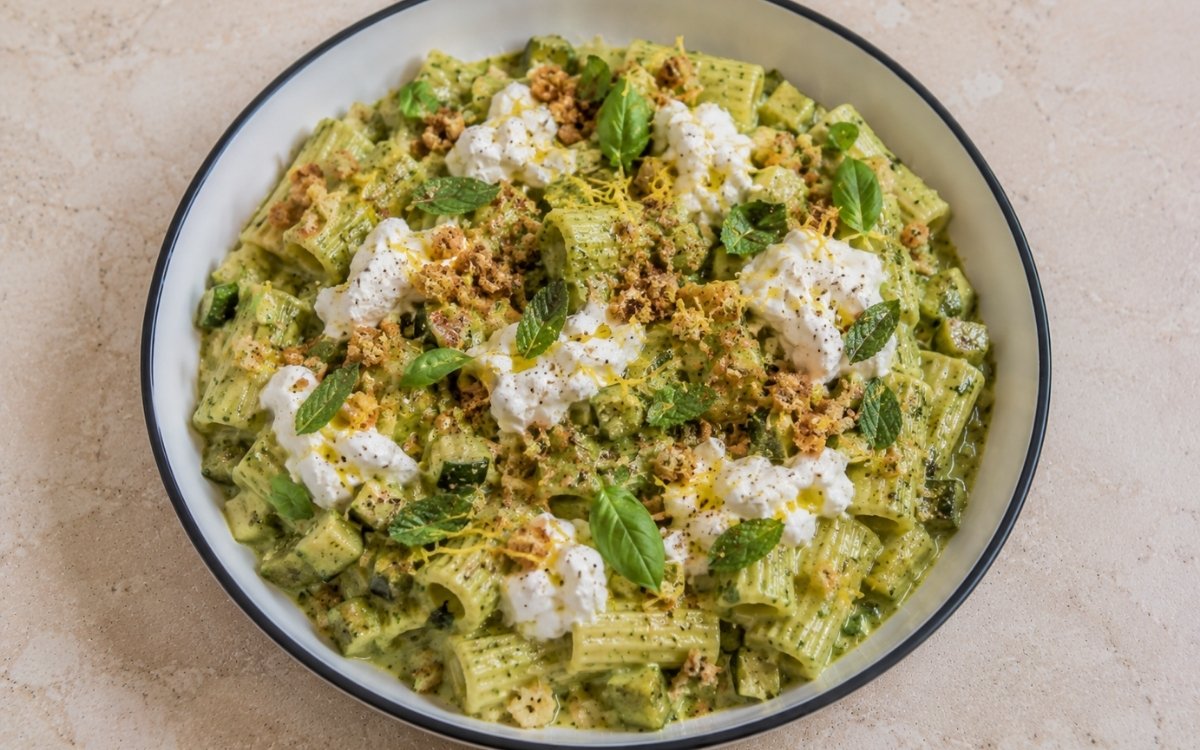
- Divide among four warm shallow bowls immediately — the green colour of the zucchini sauce begins to fade slightly as the chlorophyll continues to be exposed to heat after cooking, and the dish is most visually vibrant in the first few minutes of plating. Over each bowl, distribute torn pieces of the 200g burrata — tear it directly from the ball just before serving, allowing the liquid cream interior to flow as each piece is placed. The contrast between the warm, vibrant-green pasta and the cool, creamy white burrata pieces is the visual and thermal signature of the dish — cool dairy against warm pasta is the specific eating experience this composition is designed to produce. Scatter a generous amount of the lemon breadcrumbs over each bowl — the crumbs must go on at the last possible moment before serving to preserve their crunch against the warm, moist pasta. Drizzle a small amount of extra-virgin olive oil over each bowl. Finish with freshly ground black pepper.
Notes
The zucchini-splitting technique — half blended into the sauce, half kept whole — is the single most important structural decision in this recipe and worth examining in detail. Blending all the zucchini produces a sauce that is completely smooth and uniformly green but has no textural contrast and can feel monotonous despite its flavour. Keeping all the zucchini whole produces a pasta where the sauce is only lightly thickened by the pasta water and cream without the body that blended zucchini adds — the sauce does not coat the pasta with sufficient richness. The split produces the best of both: a smooth, creamy, coating sauce base from the blended half, and identifiable zucchini pieces providing textural interest, visual variety, and a concentrated caramelised zucchini flavour presence throughout the dish.
Burrata must be torn immediately before serving and placed on the pasta — never cooked into the sauce, never added when the pasta is still in the pan, and never prepared more than a minute before the bowl is carried to the table. Burrata's specific quality is the contrast between its outer mozzarella shell and its liquid cream and stracciatella interior. Placed on warm pasta, the exterior mozzarella softens while the interior cream melts into the pasta sauce — producing a pooling of cool, fresh dairy that combines with the warm green sauce at the edges of each piece into something more compelling than either the sauce or the burrata alone. Cooked burrata loses this contrast entirely.
The lemon breadcrumbs are a technique borrowed from the Southern Italian pangrattato tradition — toasted bread as a textural and flavour finishing element. The sourdough's slight sourness and open crumb structure produces breadcrumbs with more character and more varied texture than white sandwich bread. The lemon zest added in the final 30 seconds of toasting adheres to the hot, oil-slicked crumbs and its aromatic oils bloom and fix to the surface, producing a crumb that provides both lemon aroma and crunch simultaneously.