Ingredients
Method
Toast the Hazelnuts
- Place the 60g of roughly chopped hazelnuts in a dry skillet over medium heat. Toast for 4–5 minutes, tossing or stirring frequently throughout — hazelnuts have a high oil content that makes them move from fragrant and golden to burnt and bitter quickly without the constant attention that less oily nuts require. The target is a deep, even golden-brown across the surface of each piece, with the kitchen clearly smelling of toasted nut. Transfer immediately to a plate as soon as this colour is reached — they continue to toast on any residual heat of the pan if left. Set aside for the topping. Toasted hazelnuts provide a specific deeply nutty, slightly bitter aromatic character that is completely different from raw hazelnuts and is the specific textural and flavour contrast that makes this pasta composition work — their crunch against the smooth, creamy sauce, and their earthy bitterness against the pumpkin's sweetness, are both essential.
Cook the Pasta
- Bring a large pot of water with the 40g of salt to a full rolling boil. The water should taste aggressively salted — 40g for a standard pasta pot is a generous quantity that ensures the rigatoni is properly seasoned throughout. Add the rigatoni and cook until exactly 2 minutes shy of the package's al dente time. The pasta finishes cooking in the sauce during the final tossing step — pulling it significantly underdone means it arrives in the sauce with sufficient cooking time remaining to absorb the pumpkin cream's character directly into its structure. Before draining, reserve 240ml of the starchy pasta water in a heatproof jug and keep it warm throughout. Drain without rinsing.
Render the Pancetta
- In a large, deep skillet over medium heat, add the diced pancetta without any additional oil — pancetta contains sufficient fat for self-rendering. Cook for 6–8 minutes, stirring occasionally, until the cubes are deeply golden and crispy on most surfaces and the fat has rendered completely into the pan. The rendered pancetta fat is the cooking medium for the sage and the garlic — it carries the cured pork's savory, slightly smoky depth through both aromatics and into the sauce base. Use a slotted spoon to transfer the crispy pancetta to a paper-towel-lined plate, leaving all the rendered fat in the pan. Do not drain the fat — every drop is flavour.
Fry the Sage Leaves
- Add the 60g of butter to the rendered pancetta fat in the pan over medium heat. Allow the butter to melt completely into the fat and begin to foam — the foam indicates the water in the butter is evaporating and the milk solids are approaching the temperature at which they will begin to brown. Add the 15 fresh sage leaves to the foaming butter-pancetta fat. The leaves will sizzle immediately and dramatically — this is correct and expected. Fry for 45–60 seconds, turning the leaves once with tongs or a fork at the 20-second mark. Watch continuously and do not leave the pan unattended during this step. The target is crispy, aromatic, still-bright-green leaves — the moment any leaf begins to darken beyond bright green toward olive or brown, remove all leaves immediately. Over-fried sage tastes bitter and its characteristic camphor-and-floral aromatic character is replaced by a harsh, charred note. Properly fried sage is one of the most specific and irreplaceable aromatic elements in Italian cooking — it loses its volatile aromatic compounds gradually as it cooks and transitions from fragrant to bitter in under 30 seconds past the correct point. Transfer the fried sage leaves to the plate with the pancetta. The butter and fat remaining in the pan — now infused with sage's aromatic oils — is the foundation of the sauce.
Build the Pumpkin Cream Sauce
- Reduce the heat to medium-low. Add the minced garlic to the sage-infused butter-pancetta fat and cook for 30 seconds, stirring continuously — at this reduced heat level, the garlic becomes fragrant and sweet rather than sharp, and the 30-second window is all it needs before the pumpkin goes in. Add the 450g of pumpkin purée and stir it into the aromatic fat and garlic, pressing and folding to combine. Cook for 2–3 minutes, stirring frequently — this brief direct-heat cooking of the purée before the liquid is added deepens its flavour through a mild caramelisation of its natural sugars, concentrates it slightly, and drives off some of the residual moisture that would otherwise dilute the finished sauce. Pour in the 200ml of heavy cream and 120ml of whole milk, whisking continuously until the mixture is completely smooth and uniform. The combination of cream and milk rather than cream alone is calibrated for this specific sauce — cream alone produces a richer, heavier result where the pumpkin's delicate sweetness can be masked by the dairy fat; the milk lightens the cream's richness and produces a sauce where the pumpkin's character remains the primary flavour. Season with the 2g of nutmeg, 1g of cayenne, a generous pinch of salt, and several grinds of black pepper. The nutmeg is the classic spice pairing for pumpkin and squash in Italian cooking — at this quantity it adds the specific warm, slightly floral-sweet background note that amplifies pumpkin's inherent character without announcing itself as nutmeg. The cayenne's background heat prevents the cream and pumpkin's sweetness from making the sauce feel cloying. Bring to a gentle simmer and cook for 3–4 minutes, stirring occasionally, until the sauce has thickened slightly and the flavours have integrated.
Finish the Pasta in the Sauce
- Add the partially cooked rigatoni directly to the pumpkin cream sauce in the skillet along with 180ml of the reserved pasta water. Increase the heat to medium-high. Toss and stir continuously for 2–3 minutes — turning the rigatoni through the sauce, ensuring it coats every external surface and penetrates into the hollow centres of each tube. The pasta's surface starch releases into the pumpkin cream during this tossing, thickening and enriching the sauce further and producing the emulsified, clinging coating that distinguishes pasta finished in a sauce from pasta simply plated alongside one. The sauce should cling to the pasta with a thick, slightly glossy coating after 2–3 minutes of tossing — not watery, not dry, but specifically coating. If it tightens beyond the correct consistency, add the remaining 60ml of reserved pasta water in small increments while continuing to toss.
Add Parmigiano and Serve
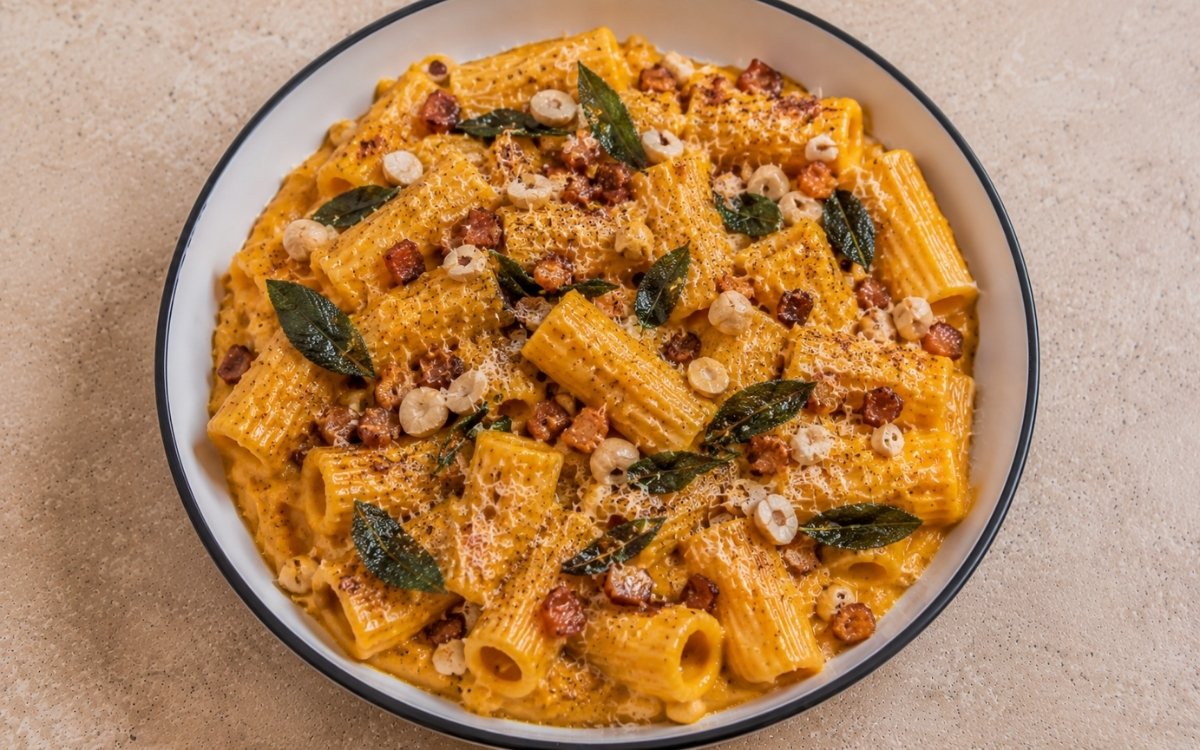
- Remove the pan from the heat. Add the 80g of finely grated Parmigiano-Reggiano and stir to incorporate — the residual heat of the pasta and sauce melts the cheese smoothly without it seizing, adding a deep savoury, umami-rich layer that rounds the sweetness of the pumpkin and the cream's richness into a fully balanced, complete sauce. Divide among four warm bowls immediately. Place the toppings over each bowl — the crispy pancetta pieces first, then the fried sage leaves distributed across the surface, then the toasted hazelnuts scattered generously. Drizzle the 15ml of extra-virgin olive oil in a thin stream over each bowl. Finish with additional finely grated Parmigiano and a confident crack of black pepper. Serve without delay.
Notes
Homemade pumpkin or squash purée is the better choice over canned for this recipe for two specific reasons. First, kabocha squash and butternut squash roasted whole or halved at 200°C until completely tender produce a purée with a more concentrated, more complex, more naturally sweet flavour than canned pumpkin — which is often made from Dickinson pumpkin, a variety with a less vibrant flavour than kabocha or butternut. Second, homemade purée has lower moisture content than canned — roasting drives off significant water content, producing a denser purée that thickens the sauce more effectively. To make homemade purée: halve a kabocha squash or butternut squash, remove seeds, drizzle with olive oil, and roast cut-side down at 200°C for 40–50 minutes until completely tender. Scoop the flesh and blend until completely smooth. Canned pumpkin is an entirely acceptable shortcut — simply choose plain pumpkin purée rather than pumpkin pie filling, which contains added spices and sugar that would conflict with this recipe's specific seasoning.
The fried sage technique is one of the most useful and most underused in Italian cooking. Sage leaves fried for 45–60 seconds in hot butter or oil become brittle, concentrated versions of their raw selves — their volatile aromatic compounds, which in raw sage are assertive and slightly medicinal at room temperature, transform into a more complex, camphor-sweet, deeply aromatic character when briefly exposed to high heat. The result crumbles pleasantly when bitten and releases a burst of concentrated sage aroma. The same technique works with thyme and rosemary. The fried leaves can be prepared up to 30 minutes before serving and set aside — they remain crispy at room temperature for this period.