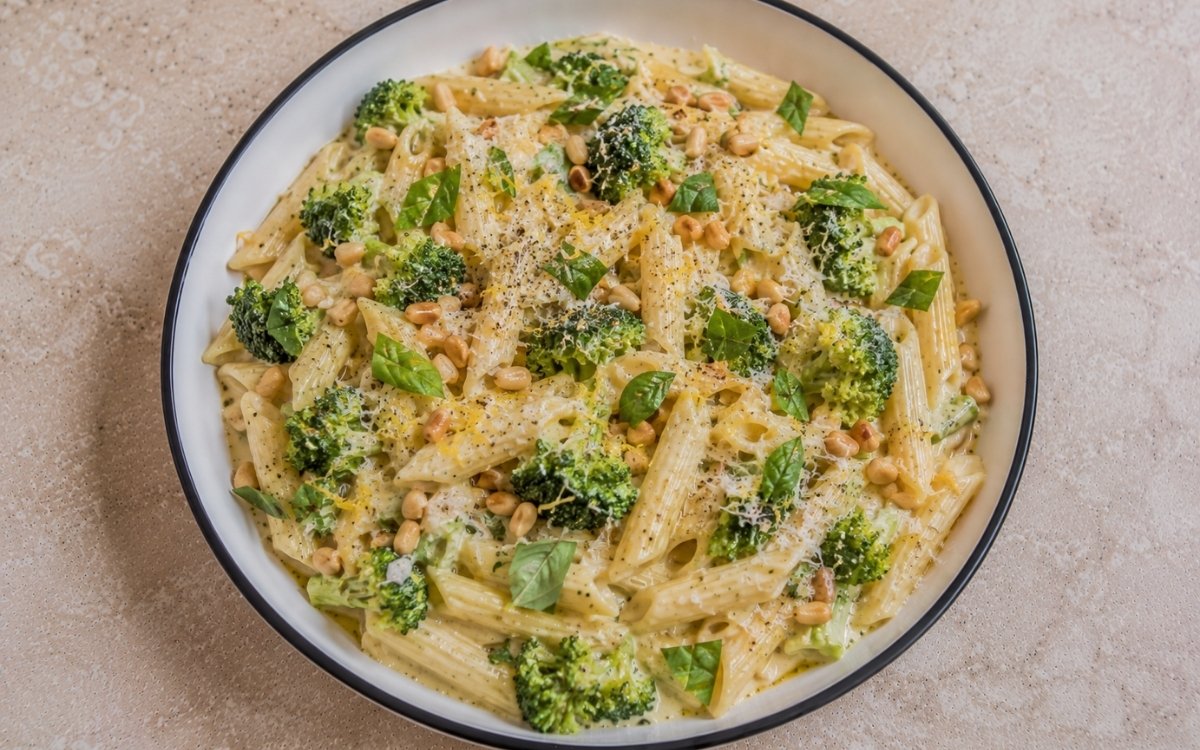
Ingredients
Method
Toast the Pine Nuts
- Place the 60g of pine nuts in a dry skillet over medium heat without any oil. Toast for 3–4 minutes, stirring or shaking the pan every 30–45 seconds throughout. Pine nuts' exceptionally high polyunsaturated fat content makes them the most volatile nut to toast — the window between pale and raw, correctly golden, and burnt-and-bitter is measured in seconds rather than minutes. Watch continuously from the 2-minute mark. Remove immediately when they reach an even light golden colour and transfer to a plate — the residual heat of a skillet left on the burner can carry them past the correct point even after the heat is off. Set aside for the finish.
Cook the Pasta and Broccoli Together in the Same Water
- Bring a large pot of water to a full rolling boil and add the 6g of salt. Add the pasta and cook for 5 minutes — the pasta will be undercooked at this point, which is correct. After 5 minutes, add the 500g of broccoli florets directly to the same pot alongside the cooking pasta. Continue cooking for a further 5–6 minutes until the pasta has reached al dente and the broccoli is tender but still bright green. The decision to cook the pasta and broccoli in the same water is not a time-saving shortcut alone — it is a deliberate flavour decision. During the 5–6 minutes the broccoli cooks in the water, it releases its earthy, slightly sweet, distinctively green vegetable compounds into the surrounding starchy pasta water. These compounds flavour the water that will subsequently become the sauce's emulsifying liquid, adding a subtle background broccoli depth to the sauce itself rather than simply to the broccoli pieces. Before draining, reserve 180ml of this broccoli-infused, starchy cooking water in a heatproof jug and keep it warm — this water is the emulsification medium for the entire sauce. Drain the pasta and broccoli together without rinsing.
Make the Mascarpone-Lemon Sauce Base
- While the pasta and broccoli cook, prepare the cream sauce in a medium bowl. This can be done entirely at room temperature — no heat required. Combine the 180g of mascarpone, 120ml of heavy cream, and 80g of finely grated Parmigiano-Reggiano in the bowl. Add the zest of both lemons and the juice of 1½ lemons. Whisk vigorously until the mixture is completely smooth and uniform — the cream loosens the mascarpone into a pourable consistency, the Parmigiano distributes through the dairy, and the lemon zest's aromatic oils and the juice's acid distribute evenly throughout. The double lemon application — zest and juice together from 2 lemons for zest and 1½ for juice — is the technique that produces a lemon character that is simultaneously aromatic and acidic rather than simply sour. The zest's volatile oils cannot be extracted by heat-free mixing alone as effectively as in a heated application, but whisking with the cream distributes them sufficiently to be present in every bite of the finished dish. Season with the remaining 2g of salt and several grinds of black pepper. Set aside at room temperature — cold mascarpone sauce added to the warm pan can cause temperature shock that produces grainy separation rather than smooth integration.
Build the Aromatic Garlic-Butter Base
- In the same large pot used for the pasta — wiped dry with paper towels — heat the 45ml of olive oil and 60g of butter together over medium heat. The combination of butter and olive oil produces the ideal aromatic base for this sauce: the butter provides the sweet dairy richness and the foam that signals the correct temperature for garlic; the olive oil moderates the butter's temperature, prevents burning, and contributes its own fruity character to the background. When the butter has melted completely and begins to foam, add the thinly sliced garlic and the red pepper flakes simultaneously. Cook for 1–2 minutes, stirring constantly. At medium heat in foaming butter and oil, thin garlic slices move quickly — constant stirring ensures even heat distribution and prevents any pieces from sitting stationary long enough to brown. The target is fragrant, just-beginning-to-colour garlic — sweet, aromatic, and present without any bitterness from browning. The red pepper flakes bloom their fat-soluble capsaicin into the surrounding butter and oil during these 1–2 minutes, providing the background warmth that runs through every bite of the finished dish.
Create the Silky Emulsified Sauce
- Reduce the heat to low. Add the mascarpone-lemon mixture to the pot with the garlic butter. Stir immediately to combine — the garlic-butter fat and the mascarpone's fat and protein begin to integrate at this stage. Add 120ml of the reserved pasta-and-broccoli cooking water and whisk vigorously. The starchy, slightly broccoli-infused cooking water emulsifies with the mascarpone, cream, and butter in the pot — the water's dissolved starch molecules bridge between the fat-based dairy and the water itself, producing a unified, cohesive sauce rather than separated oil and dairy. The emulsified sauce should coat the back of a spoon clearly within 60 seconds of vigorous whisking over low heat. Add the drained pasta and broccoli to the pot and toss gently but thoroughly for 1–2 minutes over low heat — turning the pasta and broccoli through the sauce to coat every surface. The pasta's surface starch continues to release during this tossing, progressively thickening the sauce further and improving its cling. If the sauce tightens beyond the correct glossy, flowing consistency, add the remaining 60ml of pasta water in 30ml increments while continuing to toss.
Finish and Serve
- Remove from the heat completely. Fold in the torn basil leaves and half of the toasted pine nuts — gently, so the basil is distributed without being crushed and the pine nuts maintain their crunch rather than being broken by vigorous stirring. Taste carefully and adjust — the mascarpone and Parmigiano provide significant richness and salt, but the dish may need additional lemon juice if the cream's richness is masking the citrus brightness. A small additional squeeze of lemon juice at this stage can be the difference between a very good pasta and a genuinely memorable one. Divide among four warm shallow bowls immediately. Scatter the remaining pine nuts over each bowl — the crunch contrast against the smooth cream sauce is most effective when the pine nuts are still at room temperature and their texture is at its best. Add a generous additional grating of Parmigiano-Reggiano. Finish with a small drizzle of the best extra-virgin olive oil available.
Notes
The pasta-and-broccoli cooked together technique is worth understanding beyond its efficiency benefit. When broccoli cooks in water, it releases glucosinolate breakdown products, chlorophyll fragments, and a range of volatile sulphur compounds that give broccoli its characteristic earthy, slightly pungent sweetness. These compounds dissolve into the surrounding water and, when that water is subsequently used to emulsify the cream sauce, they add a subtle background broccoli character to the sauce itself — making the sauce taste of the dish rather than simply being the medium the dish sits in. This is the same principle as the broccoli cooking water being preferable to plain water as a sauce component in any pasta where broccoli is a central ingredient.
Mascarpone's specific role in this sauce — rather than all cream, or ricotta, or cream cheese — is its combination of very high fat content and very low acidity. Its fat produces the coating, luxurious texture. Its near-neutral acidity means the sauce tastes clean and bright from the lemon rather than the dairy contributing a competing sourness. Cream cheese would add a slight tanginess that conflicts with the lemon's intended role as the dominant acid. Ricotta would produce a grainier texture at the mascarpone's quantity. Mascarpone specifically produces the neutral, silky, richly coating base that allows the lemon to be the defining flavour of the sauce.