Ingredients
Method
Start the Potatoes in Cold Water
- Peel the russet potatoes and cut them into roughly uniform 5cm chunks — uniformity matters here because uneven pieces cook at different rates, leaving some overcooked and waterlogged while others remain underdone. Place the chunks in a large pot and cover with cold water by approximately 3cm. Add the 15g of salt directly to the cold water and stir briefly. Starting the potatoes in cold rather than boiling water is a deliberate and important technique decision. When potatoes are placed in already-boiling water, the outside surface of each chunk cooks rapidly and begins to break down before the interior has softened — this produces an uneven texture where the outer layer becomes mushy and waterlogged while the centre is still hard. Cold water allows the entire chunk to heat gradually and evenly from the outside in, producing uniform tenderness throughout with a firmer outer surface that does not fall apart during cooking. The salted water seasons the potato flesh throughout during cooking rather than only on the surface.
Boil to Proper Tenderness
- Bring the pot to a full rolling boil over high heat. Once boiling, reduce to medium heat and simmer steadily for 15–18 minutes. The cooking is complete when a fork or skewer slides through the thickest piece of potato with absolutely no resistance — the fork should penetrate with the same ease as pushing through soft butter. This complete tenderness is the threshold that must be reached before mashing begins. Undercooked potato starch does not break down into the smooth, creamy texture mashed potatoes require — it produces grainy, slightly mealy patches in the finished mash that no amount of butter or cream can mask. If in doubt, cook for an additional 2 minutes and test again. While the potatoes cook, proceed with the dairy preparation so everything is ready simultaneously.
Warm the Dairy
- Combine the whole milk and heavy cream in a small saucepan and heat over low heat for 3–4 minutes, stirring occasionally, until warm to the touch but not simmering or boiling. The dairy must be warm — ideally 60–70°C — when it contacts the mashed potato. This is not a step that can be skipped or approximated with room-temperature dairy without consequence. Cold milk or cold cream added to hot mashed potato causes two specific problems. First, the temperature shock causes the gelatinised starch granules in the mashed potato to retrogradre — to partially re-crystallise from their fluid, smooth state back toward a denser, firmer structure — which produces gluey, sticky, slightly pasty mash rather than the light, fluffy texture you are working toward. Second, cold dairy immediately lowers the temperature of the mash, making it harder to work with and requiring more aggressive stirring that further develops the gluten and produces a tougher, denser result. Keep the dairy warm on the lowest heat setting until needed.
Drain and Dry Thoroughly
- Drain the cooked potatoes through a colander, shaking it firmly to remove all standing water from the surfaces of the chunks. Immediately return the drained potatoes to the hot, empty pot. Place the pot over low heat and let the potatoes sit in the dry pot for 1–2 minutes, shaking the pot occasionally. Steam will visibly rise from the potato pieces during this time — that steam is excess water evaporating from the surface and interior of the potato flesh. This drying step is what separates mashed potatoes with light, fluffy texture from watery, thin, flat-tasting ones. Potato flesh absorbs a significant amount of cooking water during boiling, and unless this water is driven out by heat before dairy is added, the finished mash is diluted — both in flavour and texture. The hot pot provides the gentle heat needed for evaporation without cooking the potatoes further.
Mash Until Completely Smooth
- Remove the pot from heat. Using a potato ricer or potato masher, work through all the dried potato chunks until no lumps remain. A ricer produces the finest, most uniform result — the potato is forced through small holes under pressure, breaking the starch structure very cleanly without working it excessively. Pass through the ricer twice if you want the absolute smoothest texture possible. A standard potato masher requires more physical effort and produces a slightly more rustic texture with occasional small pieces remaining — this is not a fault, simply a different result that many cooks prefer. The critical rule applies to both tools: do not use a food processor, stand mixer, or electric hand mixer for mashing. These machines work the potato far beyond the breaking point of the starch structure, aggressively developing the starch cells and producing glue rather than mash. The texture becomes dense, sticky, and elastic — a consequence of over-processing that cannot be reversed.
Add the Butter
- Add the room-temperature butter to the hot mashed potato and stir with a wooden spoon or flexible spatula using folding strokes — not aggressive beating — until the butter is completely melted and distributed throughout. Butter is added before the dairy for a specific and well-established reason in French mash technique: fat introduced before liquid coats the individual starch granules in a thin film that physically limits their ability to absorb the subsequent water-based dairy. This fat barrier is what allows the cream and milk to produce richness and lightness rather than causing the starch to bloat with liquid and turn dense. Adding butter after the dairy reverses this protective sequence and produces a heavier, denser mash. The butter should be at room temperature — cold butter melts unevenly and requires more mixing, which risks over-working the starch.
Add the Warm Dairy Gradually
- Pour the warmed milk-cream mixture into the buttered mash in a thin, gradual stream while stirring gently and continuously. Do not add all the dairy at once — gradual addition allows you to monitor the consistency as it develops and stop at the exact moment the mash reaches your preferred texture. Some batches of potatoes absorb more dairy than others depending on the specific variety, size, and how thoroughly they were dried. Adding gradually gives you full control over the final consistency — whether you prefer a thick, sturdy mash that holds its shape on the plate, or a looser, more pourable mash that flows naturally. Stir until everything is uniformly incorporated and the mash looks smooth, glossy, and homogeneous with no streaks of butter or cream visible.
Season and Serve
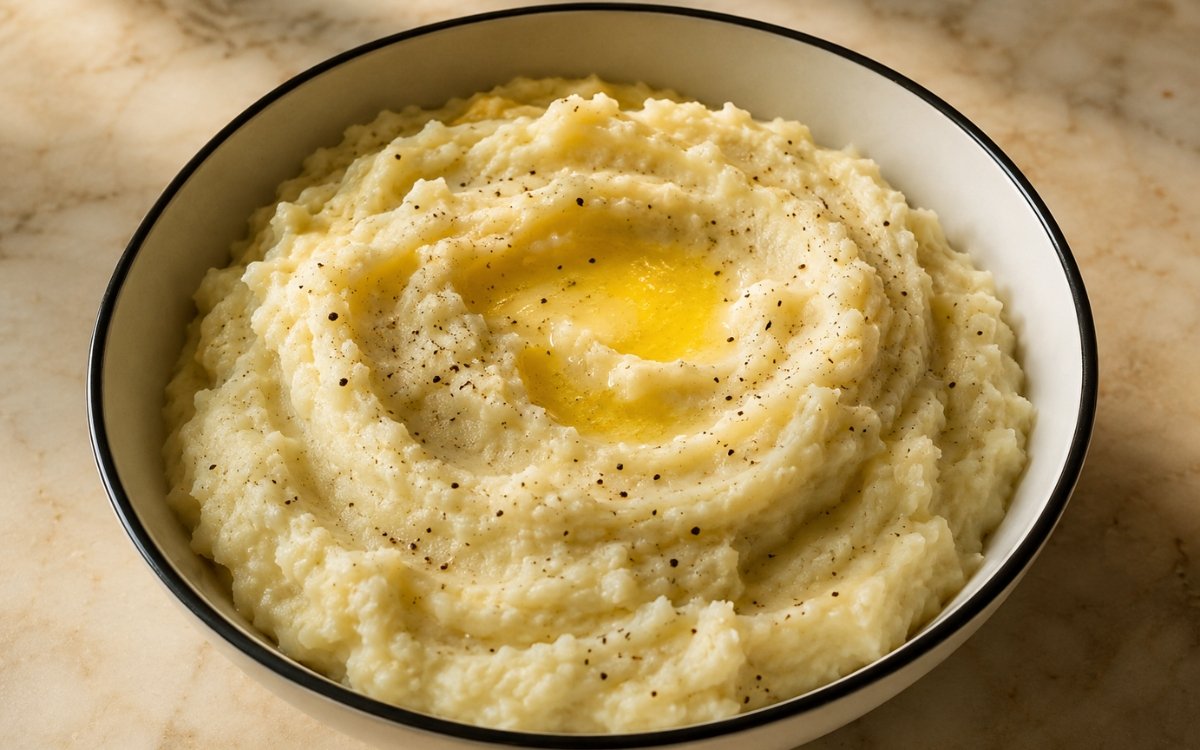
- Add the salt and freshly ground black pepper and stir to distribute evenly throughout. Taste carefully — the seasoning should feel complete, with the potato's natural earthy flavour clearly present alongside the butter and cream richness. If it tastes flat, add more salt in small increments — flat mashed potato is almost always a seasoning problem rather than a technique problem. If the mash has cooled slightly below your preferred serving temperature, return the pot to very low heat and stir gently for 1–2 minutes. Serve immediately in a warm bowl or straight onto warm plates, with a small additional knob of butter placed in a well pressed into the surface of the mash if desired — it will melt into a visible pool of butter at the table, which is both aesthetically classic and delicious.
Notes
Russet potatoes are specified because their starch composition is specifically suited to the mash method. Russets are high-starch, low-moisture potatoes — their starch cells are large, separate easily when cooked, and produce the light, fluffy, cloud-like texture that defines classic mashed potatoes. Yukon Gold potatoes are medium-starch, higher-moisture potatoes that produce a creamier, denser, naturally buttery-tasting mash — still excellent, but different in character and slightly heavier in texture. The choice between them is a matter of preference: russets for the lightest, fluffiest result; Yukon Golds for a more luxurious, denser mash.
The rule against electric mixers is the most important technical note in this recipe and is frequently violated by home cooks who associate power tools with better results in the kitchen. In the specific case of mashed potatoes, the opposite is true. Potato starch granules, when cooked, swell with water and become fragile. A masher or ricer breaks the cells open gently by compressive force, releasing the internal starch in a way that produces separate, fluffy particles. An electric mixer applies rapid, repetitive shear force that literally tears the starch cells apart and releases their internal contents in a way that causes them to entangle and form long, sticky chains — exactly the mechanism that produces glue. The more powerful and longer the mixing, the worse the result.
For the most luxurious possible mashed potatoes, replace the whole milk entirely with additional heavy cream and increase the butter to 90g. The result is closer to the French pommes purée — an extraordinarily rich, smooth preparation that is more akin to a potato sauce than a traditional mash.