Ingredients
Method
Soak the Chickpeas Overnight
- Place the dried chickpeas in a large bowl and cover with cold water by at least 5–6cm — the chickpeas will absorb a significant amount of water and swell considerably, roughly doubling in size. Add ½ tsp of baking soda to the soaking water and stir briefly to dissolve. The baking soda in the soaking water begins the softening process before cooking even starts. It raises the pH of the water slightly, which weakens the pectin in the chickpea skins and begins to soften the cell walls — producing chickpeas that will cook more quickly and more completely than those soaked in plain water. Allow to soak for 8 hours at room temperature, or overnight. After soaking, drain the chickpeas thoroughly through a colander and discard the soaking water — it contains released starches, oligosaccharides, and the dissolved baking soda. Do not use it for cooking.
Cook the Chickpeas with Baking Soda
- Transfer the drained, soaked chickpeas to a large pot. Cover with fresh cold water by approximately 5cm and add the remaining ½ tsp of baking soda. Bring to a boil over medium-high heat. As the water approaches and reaches a boil, a greyish foam will accumulate on the surface — this is coagulated proteins and dissolved starches. Skim it off with a large spoon as it forms, in the same way you would skim a stock. Once the boil is established and the foam has been removed, reduce to medium-low heat, cover with a lid, and cook for approximately 30 minutes. Begin checking at the 25-minute mark by removing a single chickpea from the pot and pressing it firmly between your fingers or with the back of a fork. The chickpea should crush completely and immediately under minimal pressure — if it offers any resistance, it needs more cooking. The baking soda in the cooking water continues the skin-softening work begun during the soaking and produces chickpeas that are cooked throughout to a uniformly soft, creamy consistency rather than soft at the edges with a firm, grainy centre. This complete softness is the foundation of genuinely smooth hummus — any residual firmness in the chickpeas will produce a grainy, slightly rough texture in the finished hummus regardless of how long the food processor runs. Drain the cooked chickpeas. Reserve a small amount of the cooking liquid if desired — it can be used to thin the hummus in place of or alongside the ice water.
Process the Warm Chickpeas First
- Transfer the drained chickpeas to the food processor while they are still warm — this is an important timing decision. Warm chickpeas process significantly more smoothly than cold ones. The heat keeps the starch in a gelatinised, fluid state that blends into a uniform mass easily. Cold chickpeas have starch that has partially retrogradrated back toward a firmer, more crystalline structure that resists smooth processing and produces a grainier result at the same processing time. Begin processing immediately, stopping every 30–45 seconds to scrape down the sides and bottom of the bowl with a spatula — any chickpea mass stuck to the sides is not being processed and will remain as coarser pieces in the finished hummus. Process for 2–3 minutes until the chickpeas have broken down into a thick, fairly smooth paste. The paste will look dry and stiff at this stage — this is correct. The tahini, lemon, and water are added progressively in subsequent steps and the consistency will transform significantly.
Add the Tahini, Lemon, Garlic, and Spices
- With the food processor running, add the tahini paste in a steady stream — not all at once. Adding tahini while the machine runs incorporates it more evenly than adding it to a stationary paste. Add the lemon juice, lemon zest, smashed garlic cloves, ground cumin, a conservative starting amount of fine sea salt, and a small amount of freshly ground black pepper. The garlic is smashed rather than minced for this application — smashing opens the clove and allows its aromatic compounds to release into the hummus during processing, but the smashed pieces process more evenly than large whole cloves and less intensely than pre-minced garlic, which can produce sharp, raw garlic pockets in the finished hummus. Process everything together for 2–3 minutes, scraping down the sides frequently. At this stage the hummus will look thick and slightly grainy — this is normal before the ice water is added.
Add Ice-Cold Water Gradually
- With the food processor running, begin adding the ice-cold water one tablespoon at a time, allowing each addition to fully incorporate before adding the next. Cold water — specifically ice-cold — is the technique detail that separates commercial-quality smooth hummus from good home hummus. When cold water is added to the blended chickpea-tahini mass while the processor runs, it creates a temporary emulsification effect: the fat molecules in the tahini are dispersed by the mechanical action of the blade and the cold water stabilises this dispersion, producing a lighter, creamier, more aerated texture. Warm water does not produce the same effect — the fat re-aggregates more quickly and the result is denser and heavier. Continue adding water and processing until you reach your preferred consistency. At approximately 50ml the hummus will be thick and dense — a paste that holds a shape firmly on a plate. At 100ml it will be smooth and creamy with a texture that flows slowly from a spoon. At more than 100ml it becomes noticeably thinner and lighter in flavour — the dilution with water reduces the flavour intensity proportionally. There is no single correct answer — choose the consistency that suits your intended use.
Taste and Calibrate
- Stop the processor and taste the hummus thoroughly. This step is the most important and most frequently rushed step in the recipe. Evaluate four specific dimensions: if the hummus tastes flat and one-dimensional, it needs salt — add in small increments and process briefly to distribute, tasting after each addition until the flavours of the tahini and chickpea sharpen and come forward. If it tastes heavy, rich, and slightly dull, it needs more lemon juice — acid is the brightening element that makes hummus taste alive rather than dense. If it tastes bland despite salt and lemon, it needs more cumin and black pepper — earthy warmth and mild heat that provide the background complexity that prevents hummus from tasting like a plain paste. If it tastes too strongly of raw garlic, the garlic pieces may not have fully processed — continue running the machine for 60 more seconds. Continue adjusting in small increments and tasting after each until the hummus tastes balanced, complex, and genuinely good.
Serve
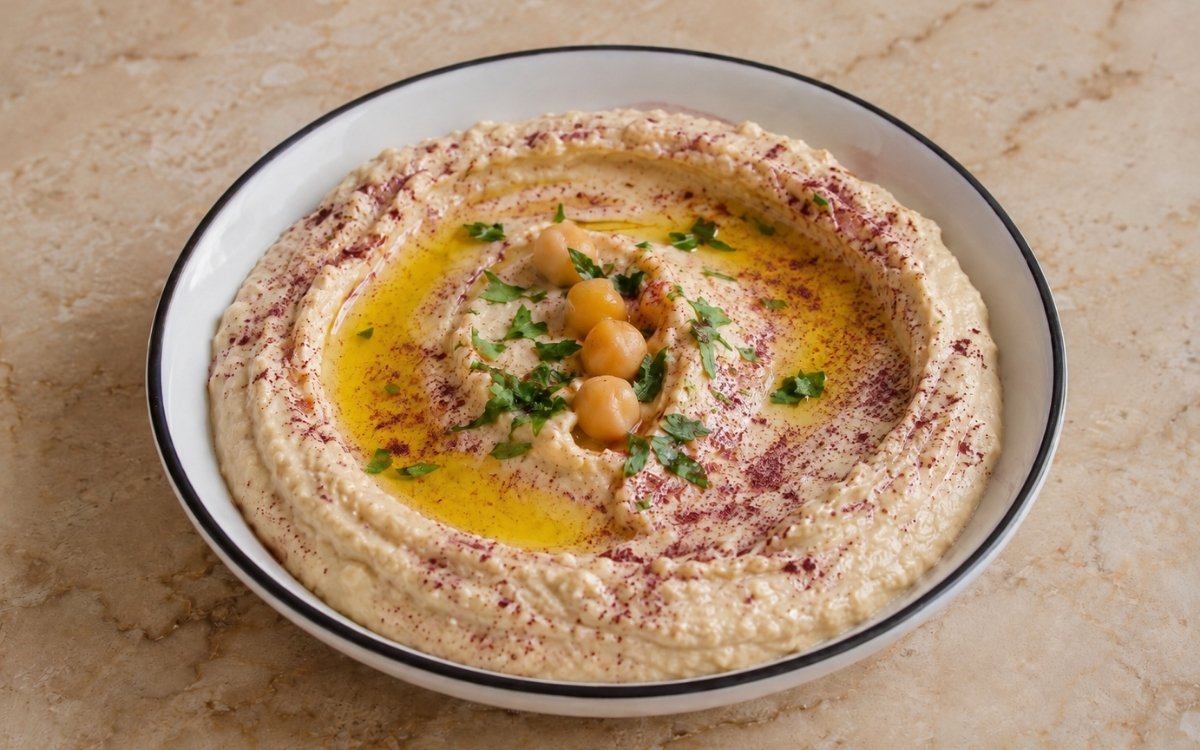
- Transfer the finished hummus to a wide, shallow serving bowl. Use the back of a spoon to create a swooping circular well in the surface — starting from the centre and sweeping outward in a single smooth motion. This well collects the olive oil and garnishes and is the visual presentation style of authentic hummus. Drizzle a generous amount of extra-virgin olive oil into the well and across the surface. Scatter za'atar seasoning or sumac generously — sumac provides a fruity, tangy garnish note that brightens the surface and introduces a visual pop of deep red; za'atar provides earthy, herby complexity. Sprinkle the chopped fresh parsley across the top. Serve immediately with warm Homemade Lavash or fresh pita bread — both provide the right combination of warmth, softness, and neutral flavour to complement the hummus without competing with it.
Notes
Dried chickpeas versus canned is the most significant quality decision in this recipe, and the difference in the finished hummus is immediately and obviously apparent. Dried chickpeas soaked and cooked with baking soda produce a hummus with a creamier, more coherent texture and a richer, more developed chickpea flavour than canned chickpeas provide. Canned chickpeas are pre-cooked, and the heat-processing and canning liquid affect both the chickpea's internal starch structure and the skin's integrity — they produce a slightly grainier result and a flatter flavour. If using canned chickpeas as a convenience shortcut, drain and rinse them thoroughly, then heat in a small amount of water with ¼ tsp of baking soda over low heat for 15–20 minutes before draining and processing while warm — this improves the texture substantially over simply draining cold canned chickpeas and processing directly.
The double baking soda method — ½ tsp in the soaking water and ½ tsp in the cooking water — is the technique most responsible for the ultra-smooth texture this recipe achieves. Baking soda's alkalinity weakens the pectin matrix in the chickpea skins and cell walls progressively through the soaking and cooking stages, producing chickpeas that are so completely softened that their skins blend invisibly into the final hummus rather than creating the flecked, slightly gritty texture that intact skins produce. Some recipes call for hand-peeling the chickpeas after cooking to remove the skins — an effective but extremely tedious process for 225g of chickpeas. The baking soda method achieves a comparable or superior result without any manual skin removal.
This classic hummus is the technical foundation for the four flavoured variations in the hummus collection. Each variation uses this base recipe's chickpea preparation and processing technique, adding its specific flavour element at the stage where it can be most effectively incorporated. Understanding the base recipe's technique thoroughly makes every subsequent flavoured variation straightforward — the only change is what goes in alongside the tahini and lemon.