Ingredients
Method
Build the Custard
- In a medium bowl, combine the 3 whole eggs and 3 egg yolks. The egg yolk addition beyond the standard whole-egg custard is the specific enrichment decision that produces French toast with a noticeably deeper golden colour during cooking — yolks contain concentrated carotenoid pigments and a higher fat content that both contribute to the colour development on the cooked surface — and a richer, more custardy interior texture than whole eggs alone. Whisk together until completely uniform with no visible yolk streaks. Add the 3g of cinnamon, 3g of salt, 25g of sugar, and the pinch of freshly grated nutmeg. Whisk until the sugar has dissolved into the egg mixture. The nutmeg is specified freshly grated rather than pre-ground — freshly grated nutmeg's volatile aromatic oils are present at full intensity, providing the specific warm, slightly floral spice note that pre-ground nutmeg has largely lost through oxidation during storage. A small pinch is correct — nutmeg at higher quantities becomes medicinal rather than warmly aromatic. Add the 80ml of heavy cream and 180ml of whole milk. Whisk until fully combined. The cream-and-milk combination rather than all milk or all cream is calibrated for the correct custard consistency — all cream produces a custard too thick to penetrate the brioche in the brief soaking time; all milk produces a less rich, less custardy result. The current ratio produces a pourable, smooth custard that absorbs into brioche cleanly within a few seconds per side.
Prepare the Soaking Dish
- Pour the custard into a shallow baking dish — a 23cm (9-inch) baking dish or a similar wide, flat-bottomed vessel that allows two brioche slices to lie flat side by side without stacking. The width matters: slices that must be placed diagonally or overlapped in the custard soak unevenly, with the overlapping areas absorbing significantly less custard than the exposed surfaces.
Cut and Prepare the Brioche
- Slice the brioche to a consistent 2cm thickness if not already sliced. The thickness is the balance point between a slice thin enough to cook through completely in the 3 minutes per side without burning the exterior, and thick enough to maintain an interior that is custardy and yielding rather than cooked all the way through to a uniform firm texture. At 2cm, the exterior develops the correct deeply golden crust while the centre remains slightly soft and custardy — the contrast between crust and interior that makes properly cooked French toast specifically satisfying.
Heat the Pan and Soak the First Slices
- Set a large non-stick skillet over medium heat. Add a generous amount of unsalted butter — enough to coat the entire pan bottom in a visible layer once melted. Allow the butter to melt and foam. The correct temperature for cooking French toast is when the butter is foaming and sizzling gently but has not yet begun to brown — the foam indicates the water in the butter is still evaporating and the temperature is at the correct level for even, controlled browning of the custard-soaked bread over the full 3-minute period without burning. While the pan heats, place two brioche slices into the custard. Allow them to soak for a few seconds per side — 10–15 seconds per side is the correct window for brioche specifically. Brioche's butter-enriched, egg-enriched crumb structure absorbs the custard relatively quickly; the brief soak is sufficient for the custard to penetrate the outer 5–6mm of each slice. Longer soaking — 30 seconds or more per side — over-saturates the brioche, producing a bread that is uniformly wet throughout with no structural integrity remaining, which cooks into the soft, uniformly dense result that is the French toast failure mode. The correctly soaked slice feels weighted and slightly softened at its surfaces but maintains its structure when lifted.
Cook the French Toast
- Transfer the two soaked slices to the butter-coated pan. Cook undisturbed for 3 minutes. Do not press down on the slices or move them during this period — the crust develops through sustained contact between the custard-coated bread surface and the hot butter, and any movement before the crust has set disrupts the even colour development. After 3 minutes, the underside should be deeply golden-brown — the sugar in the custard contributing to the Maillard reaction and producing the characteristic caramelised sweetness of properly cooked French toast. Flip each slice carefully and cook the second side for 3 minutes. The interior is cooked through when the custard has fully set — pressing gently on the centre of a cooked slice should feel firm and spring back slightly rather than yielding wetly. Transfer to a baking sheet and keep warm in a 95°C oven while the remaining batches are cooked.
Cook the Remaining Slices
- Add additional butter to the pan as needed — each batch requires a fresh butter coating to maintain the correct cooking surface and flavour. The pan temperature may have increased during the first batch and the second batch may cook slightly faster; monitor the colour actively and adjust heat downward slightly if the butter begins to brown rather than foam. Repeat the soak-and-cook sequence for the remaining 6 slices.
Serve
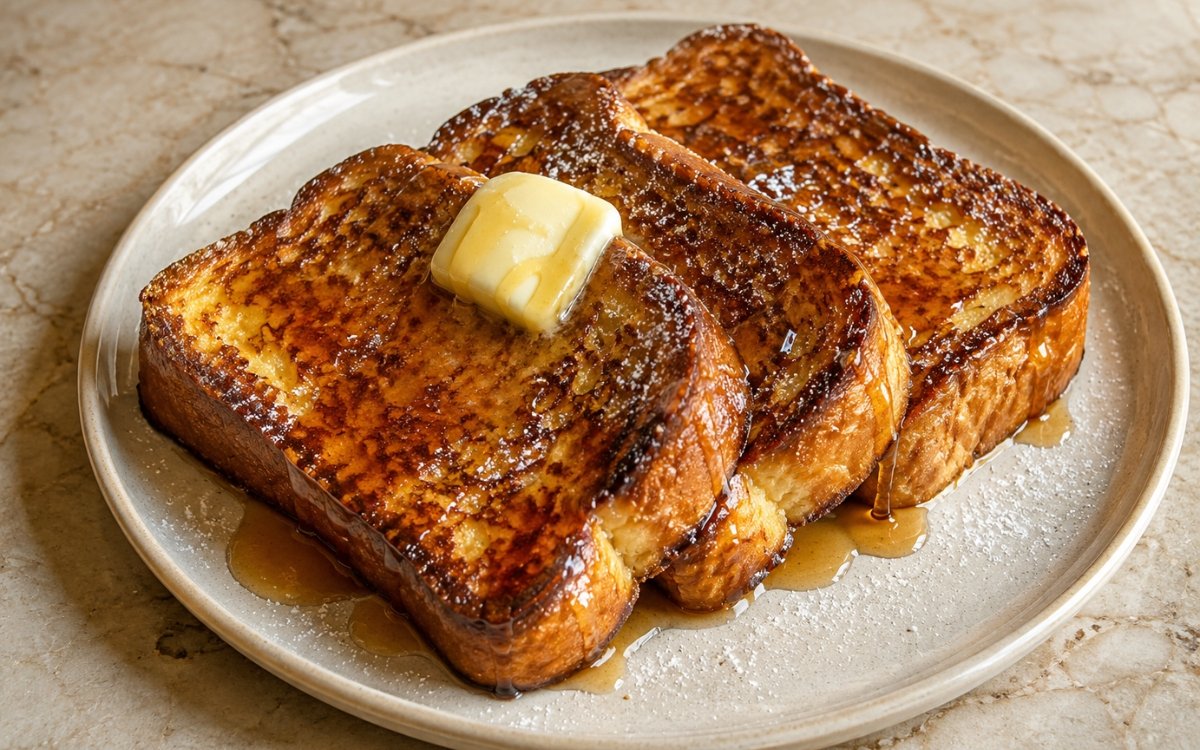
- Plate the warm French toast. Place a small pat of cold unsalted butter on the top slice — it softens immediately from the bread's heat, producing the glossy, rich finish that specifically distinguishes properly finished French toast from a plain stack. Drizzle maple syrup generously over each serving. Serve immediately.
Notes
The three-yolk addition beyond the three whole eggs is the single most impactful custard composition decision in this recipe. Egg yolks contain lecithin — a natural emulsifier — at higher concentrations than whites, producing a custard with a richer, smoother mouthfeel. Their high fat content increases the custard's richness directly. And their carotenoid pigment concentration produces the specific deep amber colour on the cooked exterior that makes French toast visually compelling rather than pale and flat. At the ratio used here, the custard is noticeably richer and more flavourful than a whole-egg-only version without being overwhelmingly eggy.
Brioche is the specific bread for this recipe for structural and flavour reasons simultaneously. Brioche's high butter and egg content gives it a specific richness that makes the finished French toast taste specifically indulgent rather than simply eggy. Its crumb structure — slightly denser and more cohesive than standard sandwich bread from the added fats — absorbs the custard at the correct rate for the brief soaking time: quickly enough for good penetration, slowly enough that the brief soak does not over-saturate. Challah operates on the same principle and is a direct substitute; thick Texas toast works but produces a less rich, less custardy result.