Ingredients
Method
Make the Poolish (12–24 Hours Ahead)
- The poolish is the foundation of this recipe and the reason a homemade baguette can have flavour that rivals a professional bakery. In a medium bowl, combine the 115g of bread flour, 115g of room-temperature water, and the tiny pinch of yeast — 0.1–0.2g is approximately what fits on the tip of a small knife. The quantity of yeast in the poolish is deliberately minuscule. A larger quantity would ferment the poolish too rapidly, burning through the available sugars before the slow, complex fermentation byproducts that provide flavour — organic acids, esters, and other aromatic compounds — have time to develop. The tiny amount of yeast is precisely what produces a 12–24 hour fermentation window at room temperature rather than a 2-hour one. Stir the poolish vigorously until completely uniform — no dry flour should remain. At 100% hydration (equal weights of flour and water), the poolish will look like a thick, wet batter rather than a dough. This is correct. Cover tightly with plastic wrap and leave at room temperature for 12–24 hours. The poolish is ready when its surface shows a dome of fine bubbles, it has a pleasantly sour, slightly alcoholic, yeasty smell, and when you move the bowl it has a loose, almost liquid quality with visible gas bubbles throughout. A poolish that has gone too long will have a sunken, concave top and a more sharply sour smell — still usable but at the very edge of viability.
Mix the Final Dough
- In a large bowl or stand mixer bowl, combine the remaining 225g bread flour, 115g water, 7g salt, and the remaining yeast. Add the entire poolish. Mix together until a rough, shaggy dough forms with no dry flour remaining — by hand for 1–2 minutes of initial mixing, or briefly on the lowest speed of a stand mixer fitted with the dough hook. The salt is added at this stage rather than with the poolish for a specific reason: direct contact between salt and yeast inhibits yeast activity. By adding salt only at the final dough stage after the yeast has already been incorporated into the poolish, you allow the yeast to activate fully in the poolish during the fermentation period without any salt interference.
Knead to Full Gluten Development
- Knead the dough by hand on a lightly floured surface for 8–10 minutes, or in a stand mixer on medium-low speed for 8 minutes, or on the dough cycle of a bread machine. The baguette dough at 68% hydration is moderately sticky — wetter than pasta dough but firmer than ciabatta or pizza dough. It will stick to your hands and the counter during the first few minutes of kneading, and this is normal. Resist the urge to add excessive flour to manage the stickiness — additional flour changes the hydration ratio and produces a denser, less open crumb. Work through the stickiness by using a bench scraper to periodically fold the dough back onto itself. The dough is ready when it is smooth, elastic, and extensible — it should stretch easily when pulled without tearing immediately. Lightly oil a medium-large bowl with a very small amount of olive oil or cooking spray — use as little as possible, as the soft, high-hydration dough will absorb surface fat and an excess will alter the recipe's balance. Transfer the kneaded dough to the bowl, turn it once to coat in the thin oil film. Punch the centre of the dough gently once with your fist, then fold the edges of the dough toward the centre — lift the edge, pull it to the centre, press, rotate the bowl a quarter turn, and repeat around the entire circumference. This fold-and-turn stretches and organises the gluten network without the aggressive compression of continued kneading. Cover with a clean kitchen towel or plastic wrap.
First Rise
- Allow the covered dough to rise at room temperature for 45–60 minutes until it has visibly increased in volume and feels lighter and more airy when gently pressed. The dough does not need to double — baguette dough at this hydration rises more moderately than enriched breads. While the dough rises, prepare your equipment: if using a baking stone, place it on the middle rack. Place a cast iron pan or heavy oven-safe pan on the floor of the oven or the lowest rack. Begin heating 480ml (2 cups) of water to boiling close to when the oven preheat is complete — you want it ready to pour at the moment the baguettes go in.
Divide and Pre-Shape
- Turn the risen dough out onto a work surface lightly dusted with just enough flour to prevent immediate sticking. Divide into two equal pieces — weigh them if possible for consistent results. Each piece should weigh approximately 175g. Shape each piece loosely into a rough rectangle by gently pressing and stretching without degassing it aggressively — the gas bubbles developed during the first rise contribute to the open crumb structure and should be preserved as much as possible at this stage. Cover both pieces with a damp cloth and allow to rest for 10–15 minutes. This bench rest is important: the gluten tensioned by the initial shaping relaxes during this period, making the subsequent final shaping into the baguette form significantly easier and reducing the likelihood of the dough tearing or resisting as you roll it.
Final Shape
- Working with one piece at a time, gently flatten the dough piece into a rough rectangle approximately 20cm long. Fold the far edge of the rectangle toward you by about one-third, pressing the folded edge down firmly with the heel of your hand to seal it to the dough below. Now fold the near edge away from you by about one-third, pressing to seal. You now have a longer, narrower piece. Rotate it 180 degrees and repeat the process: fold the far edge toward you and seal, then fold the near edge away and seal. At this point the dough should have elongated noticeably and begun to tighten. Roll the shaped log seam-side down and, with both hands cupped over the dough, apply gentle, even downward pressure while rolling back and forth and simultaneously working your hands apart toward the ends. This rolling motion extends the log from the centre outward, producing even elongation without thinning the centre more than the ends. Continue rolling until the baguette reaches approximately 40cm (16 inches) in length. Taper the last few centimetres at each end by applying slightly more pressure and rolling with just your fingertips to produce the characteristic pointed ends of a classic baguette.
Second Rise
- Transfer the shaped baguettes seam-side down onto either a parchment-lined baking sheet lightly greased with cooking spray, or into the folds of a heavily floured cotton kitchen towel (a couche), using the towel's fabric to create supporting walls between the baguettes that hold their shape during proofing. If using a kitchen towel, fold the fabric between and around the baguettes to provide lateral support. Cover loosely with lightly greased plastic wrap and allow to proof for 45–60 minutes at room temperature until the baguettes look visibly lighter, slightly puffy, and less dense than when freshly shaped. They will not double in size — an increase of approximately 50% is typical and correct.
Preheat and Score
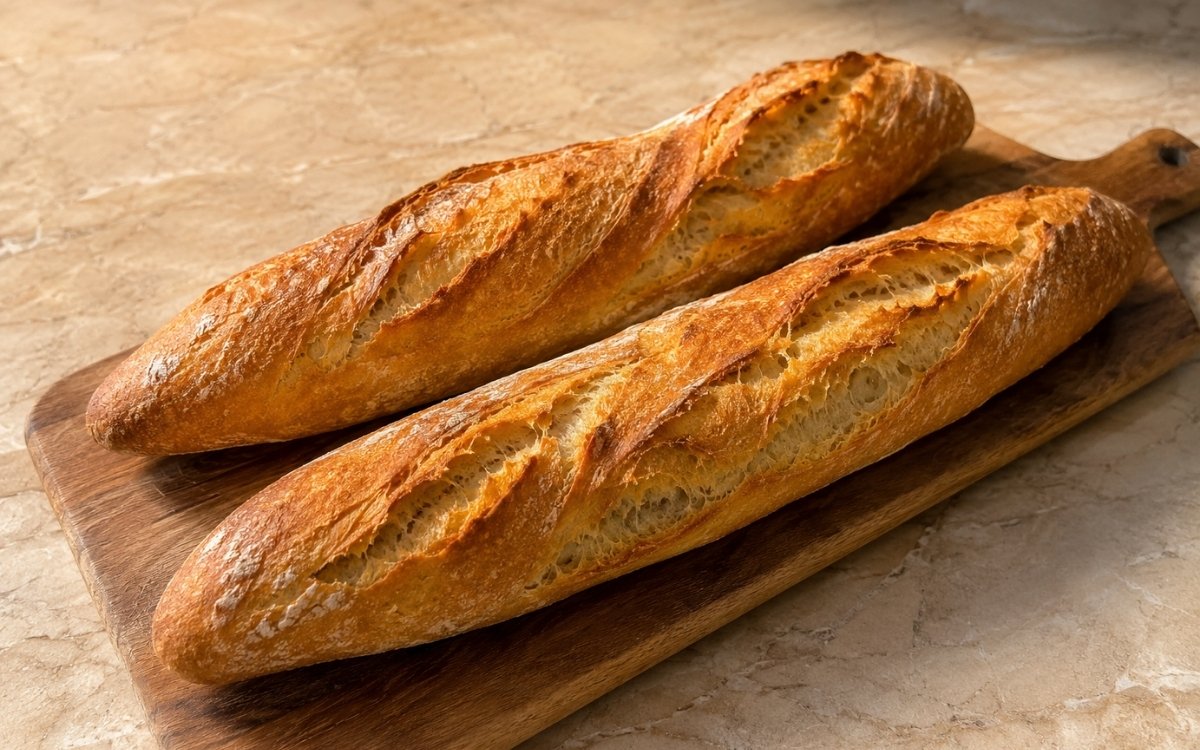
- Preheat the oven to 230°C (450°F) for a minimum of 45 minutes before baking if using a baking stone — the stone requires sustained heat to reach temperature fully and a stone that has not been preheated long enough transfers insufficient heat to the baguette base. If baking on a sheet pan, 20 minutes of preheat is sufficient. If the baguettes proofed on a kitchen towel, gently roll them seam-side down onto a sheet of parchment paper and transfer to a peel or inverted baking sheet for loading into the oven. Immediately before loading the oven, score each baguette with 3–5 diagonal cuts along the length of the loaf using a sharp razor blade (lame) or serrated knife. The cuts should be made at approximately 45 degrees to the baguette's surface rather than straight down, approximately 1cm deep, overlapping slightly, and covering most of the baguette's length. The scoring is structurally essential — it creates deliberate weak points in the crust surface through which the baguette can expand during oven spring. An unscored baguette will burst randomly at its weakest point, producing an irregular, uncontrolled expansion rather than the uniform, blade-like opening that runs along each score and is the visual signature of a properly made baguette.
Steam Bake
- Load the baguettes into the preheated oven as quickly as possible — on parchment directly onto the hot stone if using one, or on the parchment-lined baking sheet. Immediately and carefully pour the boiling water into the cast iron pan on the lower rack and close the oven door quickly to trap the resulting steam. The steam is critical for the first 10 minutes of baking. It keeps the baguette's surface moist and flexible during the initial oven spring, allowing the bread to expand fully before the crust sets. Without steam, the crust sets too quickly in the dry oven heat and constrains the expansion, producing a smaller, denser baguette with a thicker, tougher crust. With steam, the crust remains extensible during oven spring, then dries out in the second half of baking to produce the thin, crackling, deeply coloured crust that is the defining physical quality of an authentic baguette. Bake for 24–28 minutes until the baguettes are a very deep golden brown — not pale gold or medium brown, but genuinely dark amber with deep colour at the score openings and no pale patches remaining.
Cool Completely Before Serving
- Transfer the baked baguettes to a wire rack immediately and allow to cool completely before slicing or serving. The cooling period is not merely a safety precaution against burning — it is a functional part of the baking process. During the first 20–30 minutes after the baguette leaves the oven, significant moisture migration is still occurring within the crumb as the interior steam equalises and the crust transitions from soft to crackling. Cutting a hot baguette traps steam in the crumb and produces a gummy, compressed interior texture. A baguette cooled fully on a wire rack will crackle audibly when the crust cools and contracts — this sound is the reliable indicator that the crust has set properly.
Notes
The poolish pre-ferment is what separates a flavourful baguette from a serviceable one. In the absence of a poolish, a direct-method baguette made with the full quantity of yeast and allowed to rise for 1–2 hours at room temperature contains primarily CO2 from rapid yeast fermentation and very little of the complex organic acid and ester compounds that give artisan bread its depth. The poolish's 12–24 hour fermentation at room temperature produces lactic and acetic acids from bacterial activity alongside the yeast's CO2 production, and these acids contribute the subtle tang and complexity that characterises good French bread. The tiny amount of yeast in the poolish — a pinch, not a measured quantity — is the calibration that produces the correct 12–24 hour window. More yeast produces a shorter, less complex fermentation; less or no yeast would not produce a viable poolish in a reasonable timeframe.
Steam in the oven is the element that most home bakers overlook or approximate inadequately. The boiling water poured into a heavy cast iron pan at the moment of loading the bread generates a rapid, dense burst of steam that fills the oven environment immediately. The cast iron retains heat well and sustains steam generation from the water for the critical first 8–10 minutes. Alternatives — a spray bottle through the door, ice cubes instead of boiling water — produce less consistent steam and less predictable results. The investment in a heavy cast iron pan for this purpose is worthwhile for anyone who bakes bread regularly.
Bread flour rather than all-purpose flour is non-negotiable for baguette structure. The higher protein content produces the strong, extensible gluten network that allows the baguette to stretch during oven spring without tearing, and it produces the semi-open, irregular crumb structure with clear alveoles (air pockets) rather than the tight, uniform crumb of lower-protein flour baguettes.