Ingredients
Method
Toast and Crack the Black Pepper
- Bring 4 litres of water to a full rolling boil in a large pot and add the 20g of coarse sea salt — the water should taste like the sea, noticeably salty but not overwhelmingly so. Do not over-salt the way you would for carbonara, where the sauce's other components can absorb additional salt — cacio e pepe's delicate cheese sauce is easily overpowered by an aggressively salted pasta water. While the water heats, place the whole black peppercorns in a large stainless steel or carbon steel skillet over medium heat. Toast for 2–3 minutes, stirring occasionally, until the peppercorns are intensely fragrant and have taken on a slightly darker, drier appearance. You should be able to smell the released aromatic oils clearly — the pepper's heat compounds and volatile aromatic terpenes are activated by the dry heat in a way that is not achievable with pre-ground pepper. Remove from the heat and transfer to a mortar and pestle or spice grinder. Crush to a deliberately varied texture — the target is a mix of fine pepper powder, medium fragments, and a small number of larger chunks. This varied texture is not a compromise — it is the intended result. The fine powder distributes through the sauce and infuses it with pervasive heat; the medium fragments provide punctuated heat and crunch; the larger pieces provide occasional intense pepper encounters that make individual bites more interesting. Uniform fine grinding produces a flat, one-dimensional pepper presence. Return the crushed pepper to the pan.
Cook the Pasta and Build the Pepper Base
- Add the pasta to the boiling salted water and cook for exactly 2 minutes less than the package directions indicate. The pasta must be pulled significantly before al dente because it will finish cooking in the skillet with the pepper water during the sauce-making step — under-done pasta entering the sauce step produces correctly textured pasta in the finished dish; al dente pasta entering the sauce step produces over-cooked, slightly soft pasta by the time the sauce is ready. While the pasta cooks, return the skillet with the crushed toasted pepper to medium heat and add 180ml of the pasta cooking water — taken from the pot while it is still cooking, at its most starchy after several minutes of pasta cooking. Bring to a gentle simmer, stirring to loosen the pepper from the pan surface. The pepper will bloom in the hot starchy water, releasing its oils and creating a spiced, aromatic base liquid that will become the foundation of the sauce. Allow to simmer gently for 1–2 minutes while the pasta finishes its water cooking.
Make the Cheese Paste
- While the pasta cooks and the pepper base simmers, prepare the cheese paste in a large mixing bowl — large enough to eventually toss the pasta in if needed. Combine the 200g of finely grated Pecorino Romano and 50g of finely grated Parmigiano-Reggiano. Add 60ml of hot pasta water from the pot — ladle it directly from the boiling water — and immediately begin whisking vigorously with a fork until the mixture forms a completely smooth, thick, lump-free paste with a consistency similar to thick cream cheese. This paste-making step is the single technique decision that most determines whether the finished cacio e pepe is smooth and silky or grainy and clumped. When cheese is added directly to hot liquid without this pre-paste preparation, the cheese proteins heat unevenly and the fat separates from the protein before they can form a unified emulsion — producing the notorious cacio e pepe clumping that frustrates home cooks. The paste pre-emulsifies the cheese proteins and fat together in a controlled environment at a temperature where they remain pliable, meaning when the paste subsequently contacts the warm pasta, the emulsification is already partially established and the proteins melt smoothly rather than seizing. The paste should show no lumps and no dry patches — if lumps remain, add 10ml more hot water and whisk again. The Pecorino Romano is the primary cheese — its sharp, assertive, salty, slightly grassy flavour is the defining character of the dish. The Parmigiano-Reggiano is present specifically to moderate the Pecorino's sharpness and improve the sauce's creaminess and meltability — Pecorino alone produces a more intensely flavoured but slightly less smooth sauce than the blend.
Transfer Pasta to the Pepper Base
- When the pasta has cooked for 2 minutes less than its package time, use tongs to transfer it directly from the boiling water to the skillet with the simmering pepper water — do not drain. The transfer with tongs rather than draining preserves the maximum starch content on the pasta's surface and adds a small amount of pasta water to the skillet, maintaining the starchy cooking environment that the sauce depends on for emulsification. Toss the pasta in the pepper water over medium heat for 30 seconds — the pasta absorbs the spiced pepper water and continues cooking in this starchy, pepper-infused liquid. At this point the pasta should have reached just-al dente texture as it was underdone when it left the boiling water and the 30 seconds in the pepper base has completed the cooking. Remove the skillet from the heat completely.
Add the Butter
- Immediately add the 30g of cubed, chilled butter to the pasta off the heat. Toss vigorously for 20 seconds until the butter is completely melted and emulsified into the pepper water and pasta starch. The butter's role in cacio e pepe is specific and structural rather than purely flavour-adding — its fat content, when emulsified into the starchy pepper water, creates an intermediate medium that subsequently helps the cheese paste incorporate without seizing. The chilled butter is specified because cold butter emulsifies more effectively into warm liquid than room-temperature butter — the cold fat disperses into smaller droplets as it melts, producing a finer, more stable emulsion. The pan must be off heat during this step and must remain off heat through the cheese addition — butter added over direct heat breaks immediately into oil and milk solids rather than emulsifying.
Incorporate the Cheese Paste
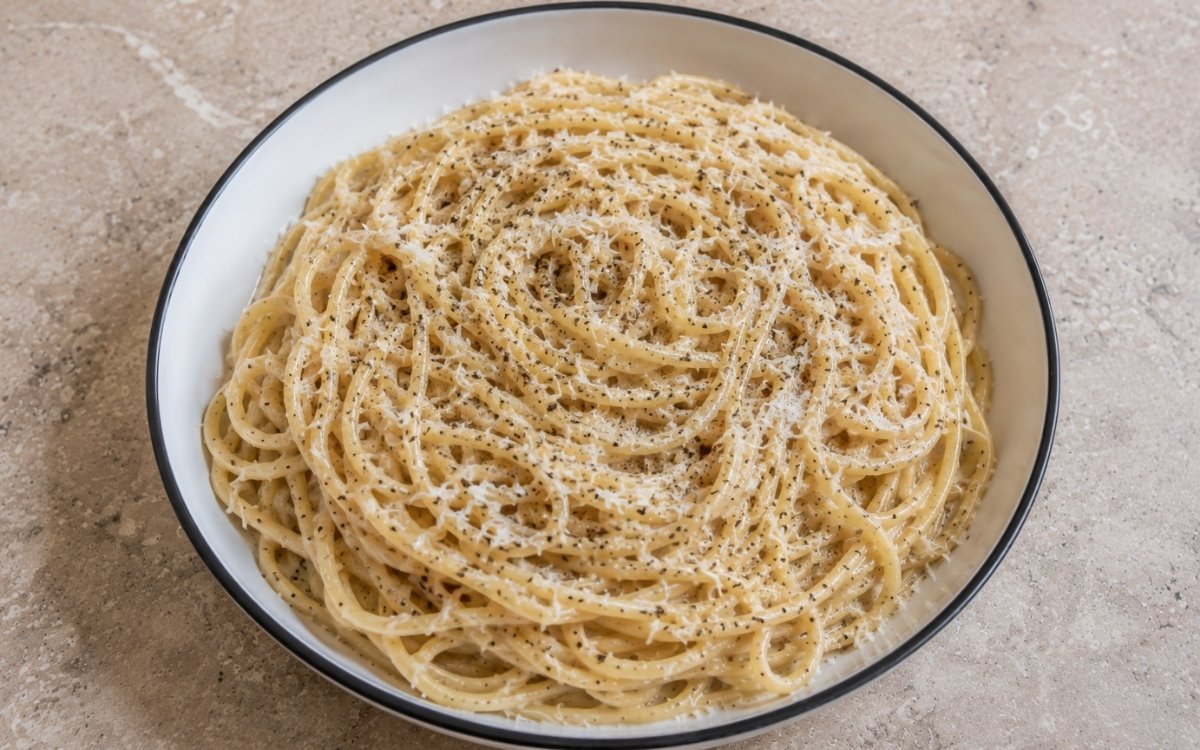
- Immediately after the butter is emulsified, add the cheese paste to the pasta. Begin tossing with rapid, continuous circular motions — lift the pasta from the bottom of the skillet and turn it over the top repeatedly, keeping every part of the pasta in constant motion. This is the moment where the dish succeeds or fails, and it is controlled entirely by motion and temperature. The pasta and pan must be warm enough for the cheese proteins to remain pliable and melt smoothly — too cool and they set before emulsifying. The pan must be off heat so the proteins do not reach the temperature at which they seize and clump — too hot is the more common failure mode. The constant tossing motion does three things simultaneously: it distributes the cheese paste evenly across every strand; it prevents any single point of contact between the cheese and the pan surface from becoming hot enough to clump; and it mechanically incorporates the pasta's surface starch into the sauce, which is the starch-based emulsification that stabilises the sauce. Add reserved pasta water in 15ml increments if the sauce begins to tighten or looks dry — a small addition of starchy water immediately loosens the sauce back to the correct glossy, flowing consistency. Continue tossing for 90 seconds in total. The correct finished sauce should coat every strand with a glossy, slightly thickened coating that moves slowly when the pan is tilted but does not pool at the bottom and immediately clings back to the pasta.
Serve Immediately
- Divide among four warm bowls without delay — cacio e pepe tightens and loses its flowing consistency within 2–3 minutes of leaving the pan as the residual heat dissipates and the cheese proteins progressively set. Create a small, neat portion in each bowl using tongs. Finish each bowl with a small additional amount of finely grated Pecorino Romano and a confident crack of fresh black pepper. Serve immediately with additional Pecorino and a pepper mill at the table.
Notes
Tonnarelli — also known as spaghetti alla chitarra — is the traditional Roman pasta shape for cacio e pepe, slightly thicker and square in cross-section compared to standard spaghetti. Its shape was developed specifically for this sauce: the squared edges provide more surface area for the sauce to cling to and the slightly thicker format holds up well under the vigorous tossing motion without breaking. Standard spaghetti produces an excellent result. Bronze-die extruded pasta of either type is specified because the rough, slightly porous surface created by the traditional bronze die produces significantly better sauce adhesion than the smooth, glassy surface of Teflon-die extruded pasta — worth seeking out at Italian specialty stores.
Pecorino Romano DOP aged 8–12 months is the specified cheese because the ageing period directly affects the flavour and textural properties required for this recipe. Younger Pecorino is too mild and too moist — it produces a less characterful sauce without the sharp, assertive flavour the dish requires. Older Pecorino becomes increasingly granular and difficult to incorporate smoothly into the sauce. The 8–12 month window produces the correct balance of sharp, salty, complex flavour and smooth melting behaviour.
The reason cacio e pepe is considered technically difficult relative to its ingredient count is the narrow window between the two failure modes: too hot produces clumped, grainy, scrambled cheese; too cool produces a dry, paste-like sauce that does not emulsify. The chilled butter step is the technique addition that most widens this window — it provides an intermediate emulsification stage that makes the subsequent cheese incorporation more forgiving by creating the partially-emulsified fat environment that the cheese needs to melt smoothly into.