Ingredients
Method
Soak the Marrowfat Peas
- Place the dried marrowfat peas in a bowl, cover generously with water, and stir in the baking soda. Leave to soak for 8–12 hours or overnight. Drain and rinse well before cooking. The peas should look swollen and softened after soaking. If they remain hard and barely expanded, they need more soaking time before cooking. The baking soda in the soaking water slightly softens the peas' tough outer skin, which is what allows them to fully rehydrate and later cook down into a proper mash rather than staying stubbornly firm.
Make the Tartar Sauce
- In a bowl, combine the mayonnaise, chopped pickles, chopped capers, Dijon mustard, lemon juice, garlic, and chopped parsley or dill. Mix until evenly combined. Season to taste with fine sea salt and black pepper. Refrigerate until needed. The sauce should taste creamy, tangy, and sharp, with visible pickle and caper texture throughout. It should be thick enough to hold its shape in a ramekin. Finely chopping rather than fully puréeing the pickles and capers keeps their texture distinct within the sauce, giving it genuine bite alongside its creaminess rather than a uniformly smooth consistency.
Cut and Cold-Soak the Chips
- Cut the peeled potatoes into thick chips. Transfer to a bowl, cover with cold water, and soak for 30 minutes. Drain well, then dry thoroughly with kitchen towels. This cold bath removes excess surface starch, which helps prevent the chips from sticking and browning unevenly. Drying them properly is critical — wet potatoes will splutter in the oil and steam instead of frying cleanly. Removing surface starch through this soak is what allows the chips to fry as individual, distinct pieces rather than clumping together, and it also produces more even browning across the whole batch.
Cook the Mushy Peas
- Place the soaked and drained marrowfat peas in a saucepan and cover with fresh water. Bring to a boil, then reduce to a gentle simmer and cook for 30–40 minutes, stirring occasionally, until the peas are very soft and starting to collapse. Drain off excess liquid if needed, then stir in the butter. Mash roughly with a spoon or potato masher until thick and coarse. Season with salt, black pepper, and a small amount of lemon juice if desired. Keep warm. The peas should be soft enough to crush easily and naturally form a coarse mash. They should not be watery. If too loose, cook briefly over low heat while stirring until thickened. Mashing only roughly, rather than blending smooth, preserves the specific rustic, coarse texture that distinguishes proper mushy peas from a smooth purée.
First Fry the Chips
- Heat the frying oil to 150°C. Fry the chips in batches for 5–7 minutes, until softened, cooked through, and pale blonde with little to no deep browning. Transfer to a wire rack or tray to rest. After the first fry, the chips should be tender inside but still pale and not crisp. If they brown too early, the oil is too hot. This lower-temperature first fry cooks the potato's interior through gently, without the surface browning and setting a crust too early — that crust-building is deliberately saved for the second, hotter fry.
Prepare the Fish and Batter
- Pat the fish fillets completely dry. Season lightly with salt and black pepper. Dust each fillet lightly with the 60g flour, shaking off excess. In a bowl, whisk together the flour, cornstarch, baking powder, and salt for the batter. Just before frying, pour in the very cold beer and add the egg white if using. Whisk only until combined — the batter should be smooth but not overmixed. The fish must be dry and lightly floured so the batter grips properly. The batter must stay cold; that temperature difference between cold batter and hot oil helps create a crisp, puffy shell. The batter should coat the back of a spoon in a medium layer — not watery and not paste-thick. If too thick, add a small splash more cold beer. If too thin, whisk in a little more flour. The dry flour dusting on the fish gives the wet batter a textured surface to grip immediately, rather than sliding off bare, moist fish — the same dry-dredge-before-wet-coating principle used for other battered fish preparations throughout this collection.
Second Fry the Chips
- Increase the oil temperature to 190°C. Fry the chips again in batches for 2–4 minutes, until deeply golden, crisp outside, and fluffy inside. Transfer to a wire rack or tray and salt immediately while hot. Keep warm. The chips should sound crisp when moved and feel lightly rigid outside, not limp. Salting while still hot helps the salt adhere evenly. This second, hotter fry is what builds the genuinely rigid, crisp exterior — a fry that's merely golden but still flexible won't hold that structure once it's sitting on the plate alongside the fish and peas.
Fry the Fish
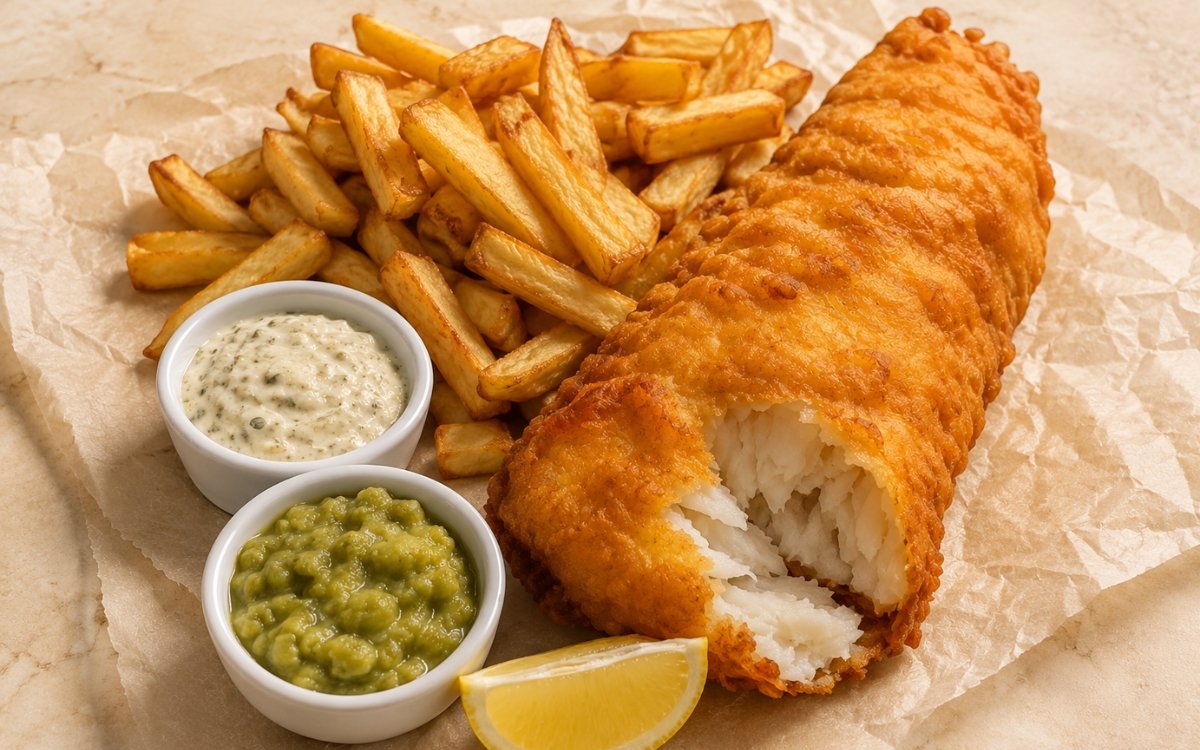
- Keep the oil at 180–185°C. Dip each floured fish fillet into the batter, letting excess drip away for a second, then lower carefully into the hot oil. Fry in batches for 6–8 minutes, depending on thickness, until the batter is deeply golden, crisp, and puffed, and the fish is just cooked through. Transfer to a wire rack, not paper towels, so the underside stays crisp. The batter should be dry, crisp, and evenly golden with a light blistered surface. The fish inside should flake easily into moist white pieces. If the crust softens quickly or seems greasy, the oil was too cool or the fish was crowded. Frying on a wire rack is important. Steam trapped underneath on a flat surface softens the batter and makes it soggy. This temperature window is calibrated for a fillet of real thickness — hot enough to crisp and puff the batter at a reasonable pace, without darkening the exterior before the fish itself has cooked through.
Serve
- Serve each portion with 1 large piece of beer-battered fish, a generous portion of thick-cut chips, a ramekin of tartar sauce, a ramekin or spoonful of mushy peas, and a lemon wedge. Serve immediately while the batter and chips are still fully crisp. Frying the fish last, immediately before serving, is what puts it on the plate at the peak of its crisp, puffed texture — every minute of delay afterward works against that crust.
Notes
Keeping the beer batter genuinely cold, right up until the moment it meets hot oil, deserves to be understood as the single technique most responsible for this dish's defining crust. The dramatic temperature contrast between cold batter and hot oil is what produces the light, puffy, crisp shell that distinguishes proper fish and chips batter from a heavier, denser coating. Batter that's allowed to sit and warm loses some of that contrast, and the resulting crust tends to be noticeably less crisp and more leaden.
The chips' double-fry follows the same two-stage logic used throughout this collection for fries that need both a properly cooked interior and a genuinely crisp exterior. The cooler first fry handles the interior gently, without pushing toward colour; the hotter second fry is reserved entirely for building that colour and crispness once the interior is already fully cooked. Skipping straight to a single fry at high heat forces a trade-off between an underdone centre and a burnt exterior.
Frying both the chips and the fish on a wire rack, rather than draining them on paper towels, protects the same vulnerability from two different directions. Any surface a hot, freshly fried item rests on traps some amount of steam underneath it — on a flat surface or absorbent paper, that trapped steam softens the crisp exterior from below within minutes. A rack lets that steam escape freely, keeping the bottom just as crisp as the rest of the piece.
The sequencing described in this recipe — chips first, fish last, immediately before serving — reflects a genuine understanding of which component has the shortest window at peak texture. Chips hold their crispness reasonably well for a short stretch once fried; the fish's puffed, blistered batter is considerably more fragile and time-sensitive, which is exactly why it's fried right at the end rather than earlier in the sequence.