Ingredients
Method
Build the Cherry Syrup
- Combine the 120ml of water and 60g of granulated sugar in a small saucepan. Granulated white sugar is the specifically correct sweetener for this preparation — its clean, neutral sweetness allows the cherry's specific deep, fruity character and the lime's sharpness to express without the additional aromatic complexity that honey or brown sugar would introduce. The lime rickey's character depends on the clean clarity of its components: cherry, lime, and soda without competing background notes. Place over medium heat and bring to a gentle simmer, stirring until the sugar has fully dissolved. Add the 250g of halved and pitted cherries. Cook over medium-low heat for 5 minutes, stirring occasionally. After the first 2 minutes the cherries will have begun releasing their juice, deepening the syrup from clear to a vivid ruby-red. Using a spoon or potato masher, begin crushing the cherries directly in the saucepan — pressing firmly enough to break each half down and release its remaining juice without requiring complete pulverisation. The first mashing at the 5-minute mark is the primary extraction — the majority of the cherry's colour and flavour releasing with this initial crushing. Add the lime zest and continue cooking over low heat for another 5 minutes, stirring occasionally. A second mashing during this second cooking period extracts any remaining juice from the partially cooked cherry pieces. The lime zest is added at this cooking stage rather than off heat because this is the larger, more robust zest quantity — 1 full lime's zest — and the brief additional cooking integrates its citrus oils into the surrounding cherry syrup differently from off-heat steeping: at low cooking temperature over 5 minutes, the zest's oils partially cook into the cherry syrup, contributing a specifically integrated citrus character that is different from the more vivid, more immediately aromatic quality of off-heat zest infusion. The result is a cherry-lime syrup where the citrus is present throughout the flavour rather than as a separate top note. Remove from the heat and allow to steep covered for 10 minutes — the cherry pieces and lime zest continuing to release their character at declining temperature.
Strain and Add Acids After Cooling
- Strain the mixture through a fine-mesh sieve over a clean jug, pressing firmly on the mashed cherry and lime zest solids. Cherries are high in pectin and the solids will feel thick and resistant during pressing — press persistently until the residue in the sieve is relatively dry. Discard the solids. The finished strained syrup should be a deep, vivid, clear ruby-red — specifically the deep cherry-red that the mashed extraction produces rather than the paler, more translucent result of cherries simply simmered without crushing. Allow the strained syrup to cool completely to room temperature — approximately 20 minutes at room temperature, or 10 minutes with the jug set in a bowl of ice. Once completely cool, stir in the 60ml of fresh lime juice and the 60ml of white verjus. Both are added after complete cooling for the same reason across this collection — their volatile aromatic and acidic character is preserved at room temperature and diminished at elevated temperatures. White verjus is the pressed juice of unripe white grapes — typically Chardonnay or other white varieties — that has been allowed to acidify to a stable, tart, specifically fruity condition. Its acidity (primarily tartaric acid, the same acid as in wine) is softer and more complex in character than citric acid — less immediately sharp, more lingering, with a slightly wine-adjacent depth that specifically complements the cherry's own wine-adjacent richness. In this recipe it is paired with lime juice rather than replacing it — the lime's immediate sharp citrus brightness and the verjus's rounder, more complex tartness together producing the specific layered acidity that the cherry lime rickey's flavour requires. Available at specialty food shops, wine merchants, and online. Transfer to the refrigerator and chill completely.
Assemble and Serve
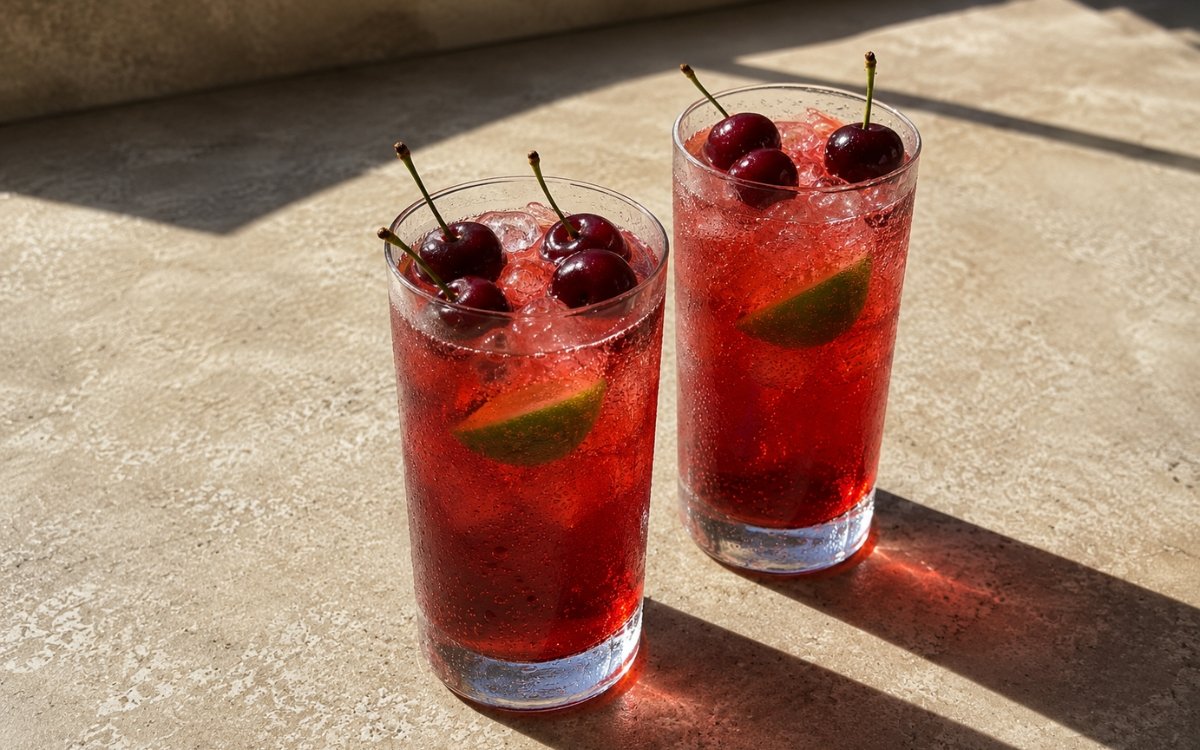
- Fill four tall glasses generously with ice cubes. Divide the chilled cherry-lime base evenly among the glasses — approximately 75–80ml per glass. Stir briefly against the ice to chill the base further. Top each glass with approximately 125ml of chilled club soda, poured gently down the inner side of the glass. Stir gently once or twice. Drop a lime wedge directly into each glass — not placed on the rim, but dropped in among the ice — the classic rickey presentation where the lime is part of the drink's assembly rather than purely decorative. Scatter 3 fresh cherries on top of the ice in each glass. Serve immediately, with the expectation that the lime wedge will be squeezed into the drink at the table for the additional fresh lime burst at the moment of drinking.
Notes
The cherry variety affects the finished syrup significantly. Morello cherries — sour cherries, deeply red, specifically tart — produce the most vibrant colour and the most specifically sharp, intensely cherry-flavoured syrup. Bing or other sweet black cherries produce a sweeter, slightly less tart, more deeply flavoured result. Both are correct; Morello cherries produce the more specifically rickey-appropriate tartness while sweet cherries produce a more rounded, slightly more accessible result. If fresh cherries are unavailable, frozen cherries are an excellent substitute and often produce even more vivid colour as the freezing has pre-broken the cell walls.
The lime rickey was specifically created in the 1880s at Shoomaker's Restaurant in Washington D.C. by George Rickey, a Democratic lobbyist, who specified that gin, lime juice, and soda water should be served together. The non-alcoholic cherry lime rickey emerged from American soda fountain culture in the early-to-mid 20th century, becoming a standard preparation at diner soda fountains that remains in the American drink repertoire over a century later.