Ingredients
Method
Prepare the Pan
- Heat the oven to 220°C / 425°F. Grease a 23cm / 9-inch springform pan with butter. Press one large sheet of parchment into the pan, letting it rise well above the sides. Add a second sheet crosswise so the whole pan is lined and the parchment forms tall crinkled walls. Place the pan on a baking tray. The parchment should extend at least 5cm / 2 inches above the pan. The cheesecake rises dramatically, then collapses as it cools. That generous parchment height gives the batter real room to expand upward during baking, protecting the tall walls from being overwhelmed once the cheesecake rises well past the pan's own edge.
Soften the Cheeses
- Add the cream cheese and mascarpone to the bowl of a stand mixer fitted with the paddle attachment. Mix on medium-low speed until completely smooth, about 2–3 minutes. Scrape down the bowl several times. The cheese must be truly room temperature. Cold cream cheese creates small lumps that are hard to remove later. That genuine room temperature softness lets the cheese actually break down smoothly under the paddle — cold cheese would resist blending evenly, leaving small lumps that become considerably harder to smooth out once other ingredients join.
Add the Sugar and Salt
- Add the sugar and salt. Mix on medium speed for 2 minutes, until smooth and creamy. Because this version uses half the sugar of the reference formula, the batter will be more tangy and less sweet, and the top may brown slightly less aggressively unless the oven is properly hot. The mixture should look glossy and smooth, with no visible cheese lumps. That reduced sugar amount shifts the finished cheesecake toward a genuinely more tangy, cheese-forward flavour — but it also means the oven's own real heat becomes even more important for building the characteristic dark, burnt top.
Add the Eggs
- With the mixer running on low, add the eggs one at a time. Add the extra yolk last. Wait until each egg is mostly incorporated before adding the next. Scrape down the sides and bottom of the bowl. Do not whip air into the batter. Basque cheesecake should be dense, creamy, and custardy, not fluffy. That deliberate, low-speed, one-at-a-time addition protects the batter from incorporating excess air — a cheesecake whipped too vigorously would bake up with a lighter, souffle-like lift rather than the dense, custardy texture this style depends on.
Add Cream, Vanilla, Flour, and Spices
- Add the heavy cream and vanilla. Mix on low until smooth. If using the autumn spice blend, whisk the spices into the sifted flour first so they distribute evenly. Sift the flour into the bowl and mix on low just until incorporated. Scrape down the bowl once more and mix briefly. Flour must be sifted. Small flour pockets are very visible in a soft custard cheesecake. That sifting step breaks up any clumps in the flour before it ever meets the batter, protecting the finished custard's own smooth, even texture from small, visible pockets a coarser addition would leave behind.
Optional Strain for the Smoothest Custard
- For the cleanest texture, pass the batter through a fine sieve into a large jug or bowl. Pour the batter into the prepared pan. Tap the pan gently on the counter to release large air bubbles. If the batter had any small cream cheese lumps, straining is the fix. Do not rely on baking to hide them. That deliberate straining step catches any residual lumps the mixing stage might have missed, protecting the finished custard's own smooth texture in a way baking alone genuinely cannot correct.
Bake Hard and Hot
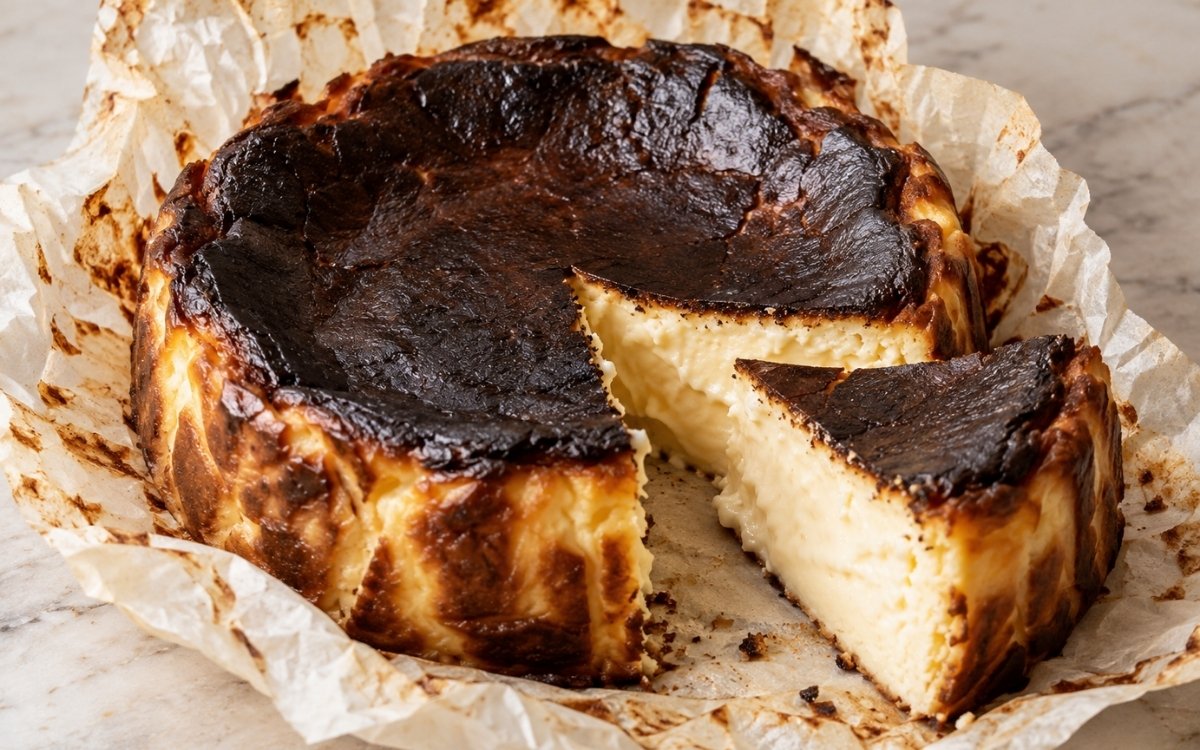
- Bake on the center rack at 220°C / 425°F for 50–60 minutes. The cheesecake is ready when the top is deeply browned to almost black in places, the edges are puffed and set, the center still has a strong wobble when the pan is gently shaken, and the surface has risen, cracked, and darkened dramatically. If the center is still very liquid but the top is already dark, lower the oven to 200°C / 390°F and bake another 5–8 minutes. If the cheesecake is set but the top is not dark enough, move it higher in the oven for the final 3–5 minutes. Do not wait for the center to look fully set. It will continue firming as it cools. Fully set in the oven means dry after chilling. That specific wobble-check, rather than waiting for visual firmness, accounts for real, substantial carryover setting the custard undergoes as it cools — a cheesecake pulled once it looks fully set in the oven would already be overbaked and dry by the time it's chilled.
Cool and Collapse
- Remove the cheesecake from the oven and leave it in the pan. It will be very puffed at first, then collapse as it cools. Cool at room temperature for 2–3 hours. For a soft but sliceable custard, chill for at least 4 hours, preferably overnight. For the creamiest texture, bring slices back toward room temperature before serving. The collapse is normal. The wrinkled top, cracks, and sunken center are part of the style, not a failure. That genuine, expected collapse reflects the same dramatic oven-spring reversing itself as the custard cools and the trapped structure settles — it's a real, intended visual signature of this style rather than any sign something went wrong.
Slice and Serve
- Release the springform pan and peel the parchment away carefully. Slice with a sharp knife dipped in hot water and wiped clean between cuts. Serve slightly cool or room temperature. The center should be creamy, soft, and custard-like, with a thin bitter-sweet burnt top. That hot, wiped knife technique lets each cut through the soft custard come out clean, rather than dragging and smearing the delicate interior with each successive slice.
Notes
Baking the cheesecake genuinely hard and hot deserves genuine recognition as the technique most directly responsible for this dessert's whole defining contrast. The recipe's own explicit target — a top "deeply browned to almost black in places" alongside a center that "still has a strong wobble" — reflects real, deliberate technique: only sustained, aggressive heat produces that dramatic surface colour within the same window the custard needs to set correctly.
Pulling the cheesecake while the center still shows a genuine wobble, rather than waiting for it to look fully set, deserves the same attention this technique receives throughout this collection's other custard-based desserts. The recipe's own explicit warning that "fully set in the oven means dry after chilling" reflects real, substantial carryover setting the custard continues undergoing well after it leaves the oven.
Letting the cheesecake's dramatic collapse happen naturally as it cools deserves genuine respect as a real, intended part of this style rather than something to correct or prevent. The recipe's own explicit framing — "the collapse is normal... not a failure" — reflects authentic Basque cheesecake technique, where the wrinkled top and sunken center are as much a visual signature as the burnt top itself.
Using genuinely room-temperature cream cheese and mascarpone deserves attention as a real, practical necessity rather than a minor convenience. The recipe's own explicit warning that "cold cream cheese creates small lumps that are hard to remove later" reflects a real, common failure point this simple preparatory step protects against from the very start.