Ingredients
Method
Cook the Bacon in a Cold Pan
- Place the 4 bacon slices in a large skillet or pan while it is still cold — do not preheat. Starting in a cold pan is the specific technique that produces consistently, evenly crisped bacon. In a preheated pan, bacon's exterior proteins seize and contract on contact with the high heat before the fat beneath has begun to render — producing uneven cooking, curling, and bacon that crisps on the outside while the fatty parts remain soft. Starting cold allows the fat to render progressively and evenly as the pan temperature rises, basting the meat in its own fat throughout the cooking process and producing a more uniformly golden, more evenly crisped strip from edge to edge. Set the burner to medium heat after placing the bacon. Cook, turning once, until golden and crispy at your preferred level of doneness — typically 6–8 minutes total. Transfer to a paper towel-lined plate to drain excess fat. Leave the pan on the heat and do not clean it — the rendered bacon fat remaining in the pan is the cooking fat for the eggs, providing the background pork-fat flavour that makes diner-style scrambled eggs specifically more satisfying than eggs cooked in plain butter or oil.
Toast the Bagels
- While the bacon cooks, slice each bagel horizontally in half. For the best result — a golden, butter-rich crust with extra depth — toast the bagel cut-side down in a separate pan with a small amount of butter over medium heat for 2–3 minutes until golden. The butter toasting produces a richer, more flavourful result than a toaster or air fryer's dry heat, and the cut-side-down placement creates a thin, butter-crisped surface that holds up under the egg and bacon's moisture. Set the toasted bottom halves on plates ready for assembly.
Prepare and Shape the Eggs
- Wipe most of the bacon fat from the pan with a folded paper towel, leaving a thin, even coating — enough fat for flavour and to prevent sticking, not enough to fry the eggs in deep fat. Crack the 4 eggs into a small bowl. Season with a pinch of salt and a crack of black pepper and whisk until the yolks and whites are completely combined and the mixture is uniform. Pour the beaten eggs into the fat-coated pan over medium-low heat. Using a silicone spatula, begin gently scrambling with large, slow folding strokes — pulling the set egg from the edges toward the centre. Continue until the eggs are approximately 70% set — still visibly wet and glossy across most of the surface, with soft, large curds forming. At this point, stop scrambling. Divide the partially cooked egg mass into two equal portions using the spatula and shape each into a round or square mound approximately the diameter of your bagel — wide and flat enough to cover the entire bagel surface rather than piling in a concentrated mound. Allow each portion to sit completely undisturbed for 45–60 seconds. During this time the bottom surface of each egg portion sets and crisps very slightly against the pan — developing enough structural integrity to be lifted and placed on the bagel cleanly without falling apart — while the top and interior remain moist, soft, and barely set. This is the distinction between a properly constructed bagel egg and a simply scrambled egg: the seared-bottom structure means the egg sits on the sandwich and holds its form; the soft interior means every bite is yielding and moist rather than dry.
Assemble the Sandwich
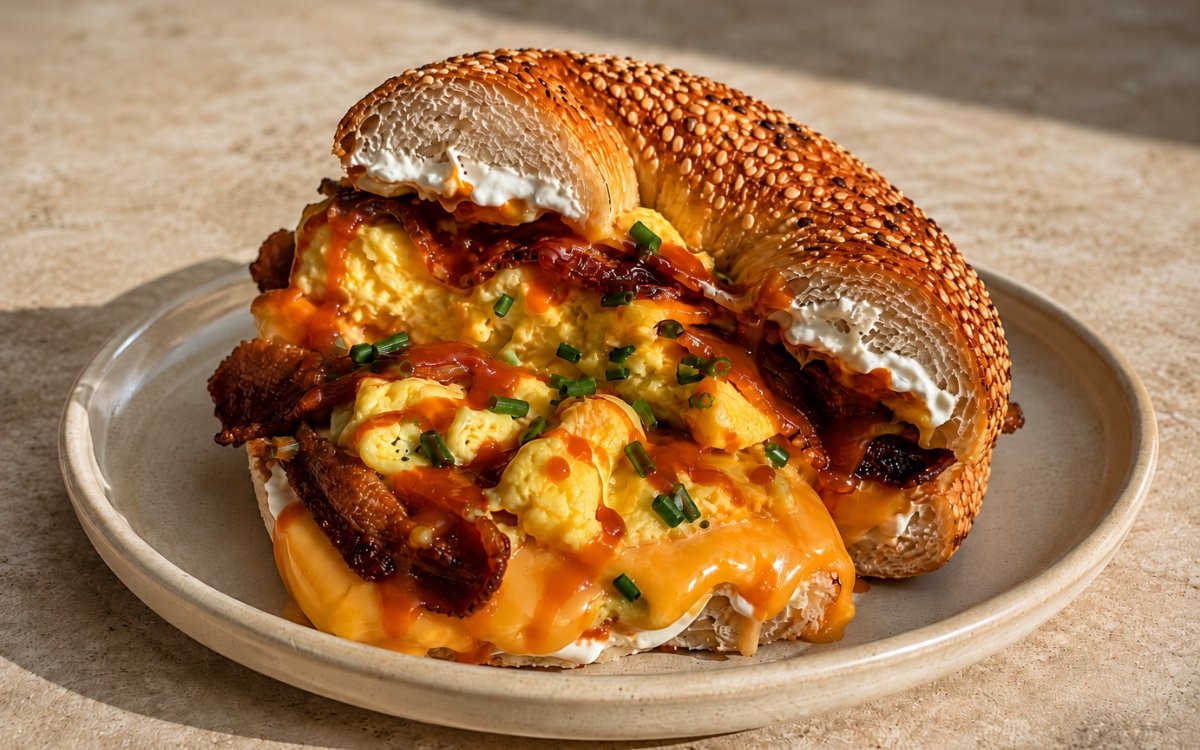
- On the toasted bottom half of each bagel, lay 2 slices of crispy bacon. Place 1 slice of American or cheddar cheese directly on top of the hot bacon — the bacon's residual heat immediately begins softening the cheese. Using a spatula, carefully lift one of the shaped egg portions from the pan and place it directly on top of the cheese slice, covering the bagel's full diameter. The egg's residual heat, combined with the hot bacon beneath, will continue softening and partially melting the cheese through the egg layer — pressing down gently on the egg for 10 seconds after placement accelerates this transfer.
Finish and Close
- Spread the 30g of cream cheese per bagel across the cut surface of the top half — generously enough to coat the entire surface in a visible, substantial layer. The cream cheese on the top half performs two functions: it provides the cooling, creamy dairy richness that balances the hot, savoury egg and bacon, and it adheres to the egg's moist surface when the top is pressed down, essentially gluing the sandwich together. Drizzle sriracha in a loose pattern across the cream cheese — its heat and garlic-forward character cuts through the cream cheese's richness and adds the background warmth that prevents the sandwich from tasting only rich and savoury. Scatter chopped chives over the egg on the bottom half. Press the cream-cheese-coated top half down onto the assembled bottom half.
Rest and Serve
- Allow the assembled bagel to rest for 3–5 minutes before eating. This is not impatience management — it is a specific functional step. During the rest, the cheese between the bacon and egg finishes melting from the retained heat; the cream cheese on the top half softens slightly from the egg's warmth and spreads more evenly when bitten through; and the flavours of all the components integrate rather than tasting as separate layers. A bagel eaten immediately after assembly tastes of its parts; a bagel rested for 4 minutes tastes of a sandwich. Slice in half diagonally if desired — the diagonal cut produces a clean cross-section showing all the layers. Eat immediately after resting.
Notes
The cold-pan bacon technique is worth making habitual beyond this recipe. The gradual rendering process keeps the meat flat against the pan surface throughout cooking — bacon laid in a hot pan contracts immediately and curls at the edges, producing uneven contact and uneven crispness. The cold start keeps each slice flat and in complete contact with the surface. Additionally, the slowly rendered fat produces a cleaner, less bitter flavour than bacon fat from a pan that is too hot — high heat can push the fat past its correct rendering temperature and into the beginning stages of breakdown, producing a slightly acrid background flavour.
The 70% scramble-and-shape technique for the eggs is the approach that produces what New York breakfast delis produce in their griddle egg preparations — a structured, slightly seared-bottom egg that holds its shape when placed on a sandwich and is bitten through cleanly. Fully scrambled eggs placed on a bagel either fall through the bread, are compressed awkwardly when bitten, or provide insufficient coverage for the bagel's diameter. The structured egg stays where it is placed, covers the bagel properly, and provides the correct ratio of egg to bread in every bite.