Ingredients
Method
Pound for Structure
- Place each pork portion between sheets of plastic wrap and pound evenly to about 5mm thickness. Work from the center outward to avoid tearing. This step defines the dish — schnitzel is not just thin meat, it is uniformly thin meat. Uneven thickness leads to overcooked edges and undercooked centers.
Season and Prepare Surface
- Season both sides with salt and pepper and allow the meat to sit briefly. This draws out slight surface moisture, which helps the flour adhere more effectively and contributes to the later puffing of the crust during frying.
Build the Breading System
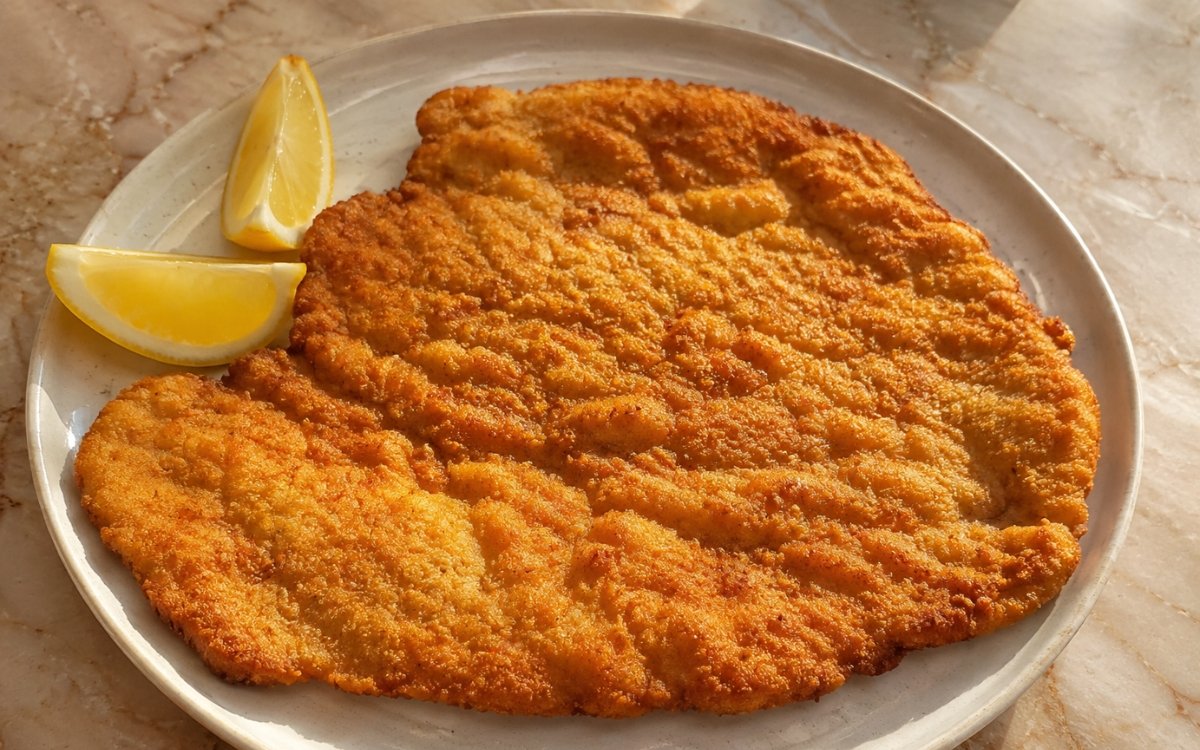
- Set up three stations: flour, beaten eggs, and fine breadcrumbs. Dredge each cutlet first in flour, then egg, then breadcrumbs. Do not press the breadcrumbs into the meat — they should sit loosely on the surface. This is critical, because compacted breadcrumbs create a dense coating instead of the characteristic light, wavy crust.
Heat the Frying Fat
- Heat oil and butter together in a wide skillet until the fat is hot but stable. The schnitzel should effectively "float" in the fat, not sit dry on the pan. Proper frying requires enough fat to surround the coating and cook it evenly.
Fry with Movement
- Place the schnitzel into the hot fat and cook for 2–3 minutes on the first side. While frying, gently swirl the pan and spoon hot fat over the top. This movement causes the coating to lift and separate slightly from the meat, forming the signature wavy structure.
Flip and Finish
- Carefully turn the schnitzel and cook the second side for another 2–3 minutes until golden and crisp. Handle gently — piercing or pressing the meat will damage the coating and release moisture.
Drain and Serve Immediately
- Transfer to paper towels briefly, then serve immediately with lemon wedges. Waiting too long allows steam to soften the crust and destroy the texture.
Notes
Uniform pounding thickness is the single most consequential technical step in this recipe. Working from the centre outward rather than pounding erratically produces meat that's genuinely even across its whole surface, which is what allows the cutlet to cook through consistently rather than leaving thick spots undercooked while thin edges overcook.
The loose breadcrumb application is what separates true schnitzel from a standard breaded cutlet. Pressing breadcrumbs firmly into the meat, as many breading techniques encourage, produces a coating that adheres tightly and stays flat against the surface — schnitzel's signature is the opposite: a coating that lifts and puffs away from the meat, creating pockets of air and the light, shattering texture the dish is known for.
The swirling and basting motion during the first side of frying is specifically what encourages that separation to happen. The hot fat lifting and moving around the coating as it fries is a mechanical action, not just a flavor step — it's actively helping create the wavy structure.