Ingredients
Method
Prepare the Bread
- Use 4 prepared semi-baguette rolls from the referenced Ciabatta Rolls / Semi-Baguettes recipe, or use 4 store-bought small baguettes. The roll should be crusty outside but not so hard that it shatters when pressed around the sausage. Split each roll open lengthwise, leaving a hinge if possible. Spread the cut sides lightly with softened butter. A hinged split, rather than cutting all the way through, holds the sandwich together as a single unit around the sausage rather than two loose halves — the same structural logic as a proper hot dog bun.
Prepare the Chimichurri
- Finely chop the parsley. Mix it with the chili flakes, garlic, bay leaves, olive oil, red wine vinegar, dried oregano, kosher salt, and black pepper. Let the chimichurri sit for at least 15 minutes before serving so the garlic, oregano, chili, and vinegar season the oil properly. Remove the bay leaves before spooning onto the sandwiches. The chimichurri should be loose, oily, sharp, and herb-heavy. It should spoon over the sausage and drip slightly into the bread, not sit like a dry paste. The resting period is doing real, active work here — raw garlic, oregano, and chili flakes all need time steeping in the acidic, oily base to actually infuse the whole mixture, rather than sitting as separate, sharp-tasting fragments floating in plain oil.
Prepare the Tomato-Shallot Salsa
- Combine the diced Roma tomatoes, shallots, olive oil, red wine vinegar, salt, and black pepper. Let sit for 10 minutes, then taste and adjust salt or vinegar. If the salsa releases a lot of liquid, spoon off the excess before assembling. Wet salsa will soften the bread too fast. This salsa is a genuinely different role from the chimichurri — a bright, acidic accent rather than the sandwich's main sauce — which is why it's used sparingly and why draining any excess liquid matters more here than it might in a dish where the salsa itself is the centrepiece.
Butterfly the Chorizo
- Slice each chorizo lengthwise down the middle without cutting all the way through, then open it like a book. Press gently so it lies flatter against the skillet or grill. Do not cut it into small pieces. Choripán needs one whole split sausage per roll so the cross-section stays bold and simple. Opening the sausage this way roughly doubles the surface area making direct contact with the hot skillet or grill compared to cooking it whole and round — that expanded contact is what produces faster, more even char across the sausage rather than a round exterior that chars unevenly while the centre lags behind.
Sear the Chorizo
- Heat a cast-iron skillet, grill pan, or grill over medium-high heat. Add a thin film of oil only if needed. Place the butterflied chorizos cut-side down and sear for 3–4 minutes, until browned, crisped, and charred in spots. Flip and cook the skin side for another 3–5 minutes, until glossy, deeply coloured, and cooked through. If using raw pork chorizo, cook until the centre reaches 71°C. If the outside is charring too quickly before the centre is hot, lower the heat and continue cooking more gently. Starting cut-side down puts the freshly exposed, flat interior in direct contact with the hottest part of the pan first, which is where the most dramatic char and colour development happens — the skin side, cooked second, finishes the sausage through while picking up its own glossy colour.
Toast the Bread
- Place the buttered rolls cut-side down in the same skillet or on the grill. Toast for 1–2 minutes, until golden, crisp at the edges, and lightly marked. Do not over-toast until dry. The bread needs enough structure to hold chimichurri and salsa, but it should still bite cleanly. Toasting in the same skillet used for the chorizo, rather than a clean pan, lets the bread pick up rendered fat and browned flavour left behind by the sausage — a small detail that adds real depth to the bread beyond what butter alone would provide.
Assemble the Choripán
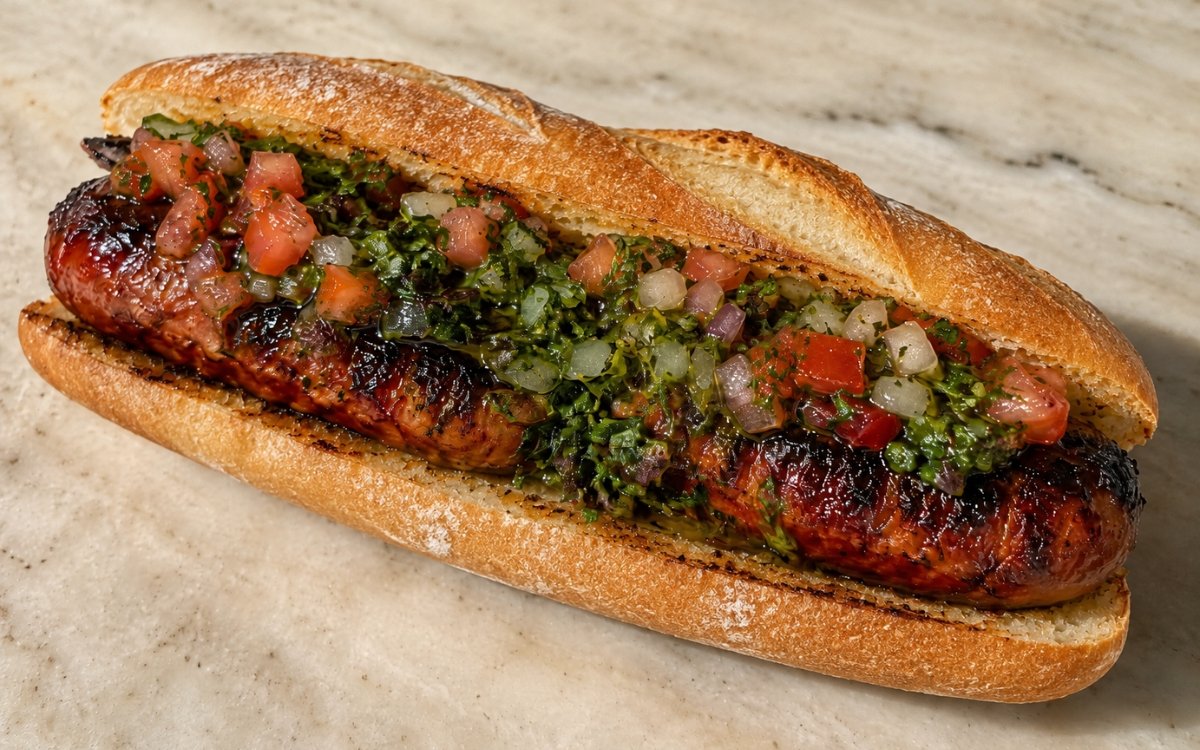
- Spoon a little chimichurri onto the toasted inside of each roll. Place one butterflied chorizo inside each roll, charred side facing up. Spoon more chimichurri generously over the sausage, letting the oil run slightly into the bread. Add a small amount of tomato-shallot salsa along the sausage. Spooning a little chimichurri onto the bread before the sausage even goes in, rather than only on top afterward, seasons the roll itself from the inside as well as the sausage from above — every bite ends up carrying some of that herb-oil flavour, not just the top layer.
Serve
- Serve immediately while the chorizo is hot and glossy, the bread is crisp, and the chimichurri is vivid green and oily. This sandwich has almost no holding window — the hot sausage's juices and the oily chimichurri both begin softening the bread from the moment of assembly, so serving without delay is what keeps the roll crisp enough to bite cleanly.
Notes
Butterflying the chorizo is worth understanding as the single most consequential technique decision in this recipe rather than a minor prep step. A whole, round sausage cooked as-is chars unevenly around its curved surface and takes considerably longer for the heat to reach the centre. Splitting it open and pressing it flatter against the hot surface both accelerates the cook and roughly doubles the area developing real char, which is directly why choripán reads as a dramatically charred, flat cross-section rather than simply a grilled sausage in a bun.
The chimichurri's resting time is not a flexible suggestion despite how simple the ingredient list looks. Raw minced garlic, dried oregano, and chili flakes all taste sharp and disconnected from each other immediately after mixing — the 15-minute rest is what allows the acidic, oily base to actually draw those flavours together into something that reads as a cohesive sauce rather than a collection of separate seasonings floating in oil.
The relationship between the chimichurri and the tomato-shallot salsa is worth being deliberate about rather than treating both as interchangeable toppings. Chimichurri is the sandwich's dominant sauce, meant to be spooned generously and to visibly drip into the bread. The tomato-shallot salsa plays a smaller, brighter supporting role, and using it too generously — or failing to drain it if it's released excess liquid — works against the roll's structure in a way that using plenty of chimichurri doesn't, since chimichurri is largely oil rather than watery tomato liquid.
Toasting the bread in the same pan used for the chorizo, after the sausages come out, is a small sequencing choice that adds real value for very little extra effort. Any rendered fat and browned bits left behind by the chorizo transfer directly into the bread during its brief toast, contributing a layer of savoury depth that toasting in a clean pan with butter alone wouldn't achieve.