Ingredients
Method
Dry-Brine the Steaks
- Pat the steaks completely dry with paper towels. Season all sides heavily and evenly with kosher salt, including the fat cap if present. Place the steaks on a wire rack set over a tray and refrigerate uncovered for 8–24 hours. This dries the exterior surface and pulls seasoning into the meat. Do not cover the steaks. Covered steak stays wet, and wet steak will not build the deep char this recipe needs. Leaving the steaks uncovered on a rack, rather than sitting directly on a tray, lets air circulate on all sides — the salt draws moisture to the surface initially, then that same moisture evaporates into the dry refrigerator air over the following hours, leaving behind a genuinely dry, well-seasoned exterior.
Prepare the Chimichurri
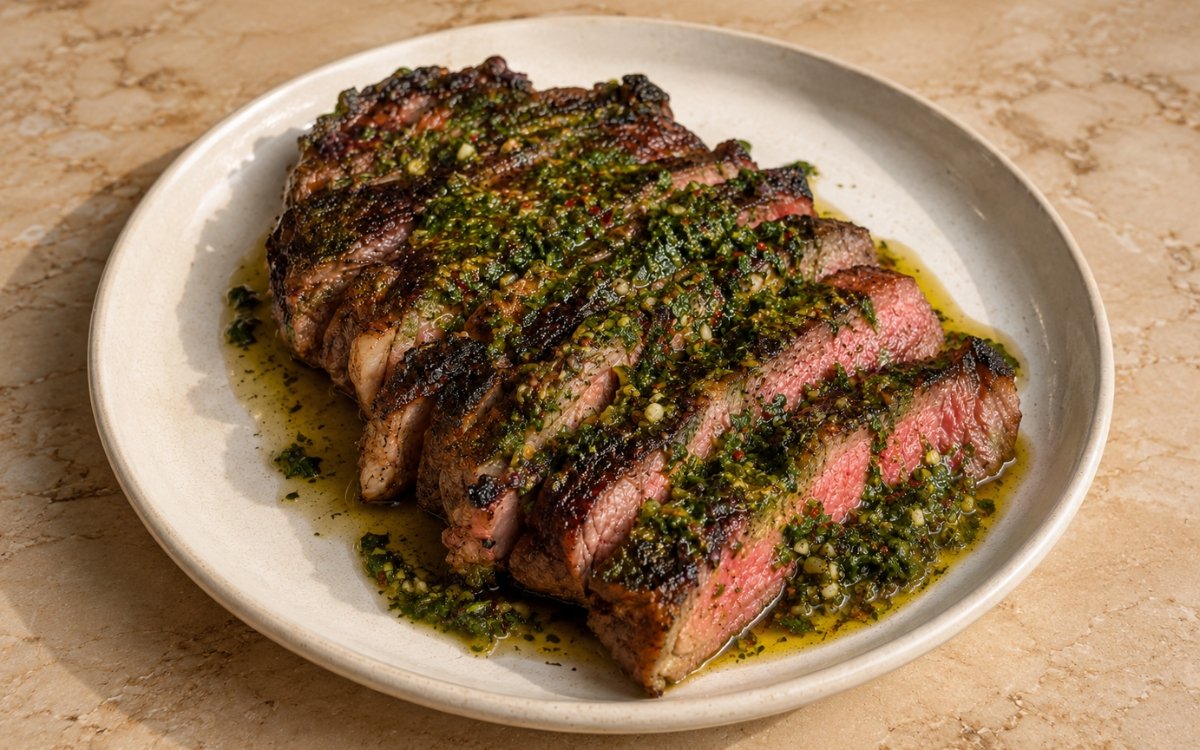
- Finely chop the parsley by hand. Mix it with the red chili flakes, garlic, bay leaves, olive oil, red wine vinegar, dried oregano, kosher salt, and black pepper. Let the chimichurri sit for at least 30 minutes before serving so the garlic, oregano, chilli, vinegar, and oil fully season each other. Remove the bay leaves before spooning over the steak. Do not blend the chimichurri. Blended chimichurri turns into green paste. This should stay loose, oily, and visibly textured with parsley, garlic, oregano, and chilli flakes. Hand-chopping rather than blending preserves the parsley's distinct texture and keeps the sauce visibly loose and oily rather than turning it into a uniform, blended purée — the textural contrast against the smooth, charred steak is part of the dish's appeal.
Temper the Steaks
- Remove the steaks from the refrigerator 30–60 minutes before grilling. Pat dry again if any surface moisture has formed. Season with black pepper after dry-brining. The steaks should lose the refrigerator chill before they hit the grill. Thick cold steaks burn outside before the centre reaches medium-rare. A steak straight from the refrigerator has a large temperature gradient to overcome before its centre reaches medium-rare — without this tempering step, the exterior would char and potentially burn well before that heat has had time to travel through to the middle of a cut this thick.
Preheat the Grill
- Preheat a charcoal, wood, or gas grill until very hot. For thick steaks, set up a two-zone fire: one very hot direct-heat side for searing and one cooler side for finishing if needed. Charcoal or wood gives stronger smoke and char. Gas gives more consistent temperature. Either works, but the grill must be properly hot before the steak goes on. If using a cast-iron skillet instead, heat it until very hot and just beginning to smoke. The two-zone setup exists specifically for a steak this thick — the hot direct side builds the crust quickly, while the cooler zone gives a controlled option for finishing the interior gently if the crust develops faster than the centre reaches temperature.
Render the Fat Cap
- If your steak has a thick fat cap, hold it upright with tongs and press the fat edge against the hot grill or skillet for 1–2 minutes until it starts to render, brown, and crisp. Skipping this leaves chewy, pale fat on an otherwise good steak. That is amateur work. Fat doesn't render or brown properly without direct, sustained contact with the heat source — briefly resting the steak flat won't expose the fat cap's edge to nearly enough heat, which is why this step calls for actively holding it against the surface.
Grill the Steaks
- Place the steaks over direct high heat. Sear for 2–3 minutes per side, turning only after a deep crust forms. Continue flipping every 1–2 minutes as needed until the exterior has dark char marks and the interior reaches medium-rare. For medium-rare, pull the steaks at 50–52°C in the centre for a final rested temperature around 54–56°C. If the crust is ready but the centre is still too cool, move the steaks to the cooler side of the grill and finish gently with the lid closed. Do not cook by time alone. Steak thickness, fat level, grill temperature, and cut all change the timing. The gap between the pulled temperature and the target resting temperature is carryover cooking — residual heat continues moving inward for several minutes after the steak leaves direct heat, which is why pulling at the final target temperature would overshoot it by the time it's rested and sliced.
Rest the Steaks
- Transfer the steaks to a board and rest for 10 minutes. Do not slice immediately. Resting keeps the juices inside and lets the internal temperature finish stabilising. During active cooking, muscle fibres contract and push moisture toward the centre of the cut; the rest period lets that pressure even back out across the whole steak, so slicing immediately after cooking would release most of that moisture onto the board rather than into the meat.
Slice and Finish
- Slice the steaks diagonally against the grain into thick slices. Arrange on a warm plate with the pink interior visible. Spoon chimichurri generously over the top, letting the golden green oil run over the charred crust and pool slightly around the steak. Finish with flaky salt if using. Slicing against the grain shortens the muscle fibres in each individual piece, which is what makes even a naturally firmer cut like sirloin noticeably more tender to bite through than slicing with the grain would.
Serve
- Serve immediately while the steak is warm, the crust is still defined, and the chimichurri is vivid, oily, and fresh. This dish is at its best in a narrow window right after slicing — the crust's crispness fades and the chimichurri's oil begins soaking into the meat the longer it sits, so serving without delay preserves both the visual and textural contrast the dish is built around.
Notes
The uncovered dry brine is worth understanding as doing two distinct jobs at once rather than a single simple step. The salt itself draws moisture to the surface and, over the extended 8–24 hour window, that moisture and the salt dissolved in it are reabsorbed back into the meat, seasoning it considerably deeper than a last-minute salt ever could. Simultaneously, the steak's surface dries out in the open refrigerator air, which is precisely the condition needed for the grill's heat to go straight into building a hard, deep crust rather than first evaporating surface moisture.
Chimichurri's texture is deliberately at odds with what a food processor or blender would produce, and that distinction matters more than it might seem. A blended chimichurri turns uniformly smooth, essentially becoming a green oil rather than a textured, chunky condiment — the visible, distinct pieces of parsley, garlic, and chilli flake in a hand-chopped version are part of what makes the sauce interesting against the steak's smooth, charred surface, both texturally and visually.
Rendering a thick fat cap before the main sear addresses a problem that's easy to overlook until it's too late to fix. Fat doesn't crisp or develop flavour the same way lean muscle does — without direct, sustained contact against a hot surface, it simply stays chewy and pale even after the rest of the steak is perfectly cooked. This is a small, separate step precisely because the fat cap's geometry (a thin edge, often held vertically) doesn't naturally get that same direct contact during a standard flat sear.
The gap between a steak's pulled temperature and its final rested temperature — carryover cooking — is one of the more counterintuitive things to internalise about cooking a cut this thick. Residual heat continues travelling inward toward the centre for several minutes after the steak leaves direct heat entirely, which is exactly why pulling at the actual target temperature would result in an overcooked steak by the time it's rested and ready to slice.