Ingredients
Method
Make the White Chocolate Sauce
- Add the heavy cream and milk to a small saucepan. Warm gently over low heat until steaming, but do not boil. Remove from the heat, add the chopped white chocolate, salt, and vanilla. Let it sit for 30 seconds, then stir until smooth and glossy. The sauce should be fully smooth and pourable. If it looks split, greasy, or grainy, the heat was too aggressive. White chocolate burns and separates easily, so treat it gently. Removing the pan from the heat before the chocolate is even added, rather than melting it directly over the burner, is what protects it from that separation — white chocolate's cocoa butter and milk solids can break apart under direct, sustained heat in a way dark chocolate is far more forgiving of, which is exactly why this recipe relies on the cream and milk's residual warmth to do the melting instead.
Brew the Espresso
- Brew 120ml espresso total, equal to 4 standard 30ml shots. While the espresso is hot, stir in 60ml white chocolate sauce until fully dissolved and smooth. Mix the white chocolate sauce into the hot espresso first. If you add thick white chocolate directly to cold milk, it clumps and sinks instead of becoming a clean mocha base. Hot espresso has real capacity to loosen and fully dissolve the sauce on contact, the same way it does for a standard chocolate sauce elsewhere in this collection — cold milk lacks that same dissolving power, and white chocolate sauce added there instead tends to firm back up into small, sunken clumps rather than blending smoothly.
Prepare the Glasses
- Fill 2 tall glasses generously with ice. Pour 140ml cold whole milk into each glass. The glasses should look pale and milk-forward, but not filled to the rim. You still need room for the white chocolate espresso base. Building this ice-and-milk foundation before the espresso mixture is even poured is what sets up the visual swirl that follows — the white chocolate espresso needs somewhere already-built and cold to fall into and disperse through.
Add the White Chocolate Espresso
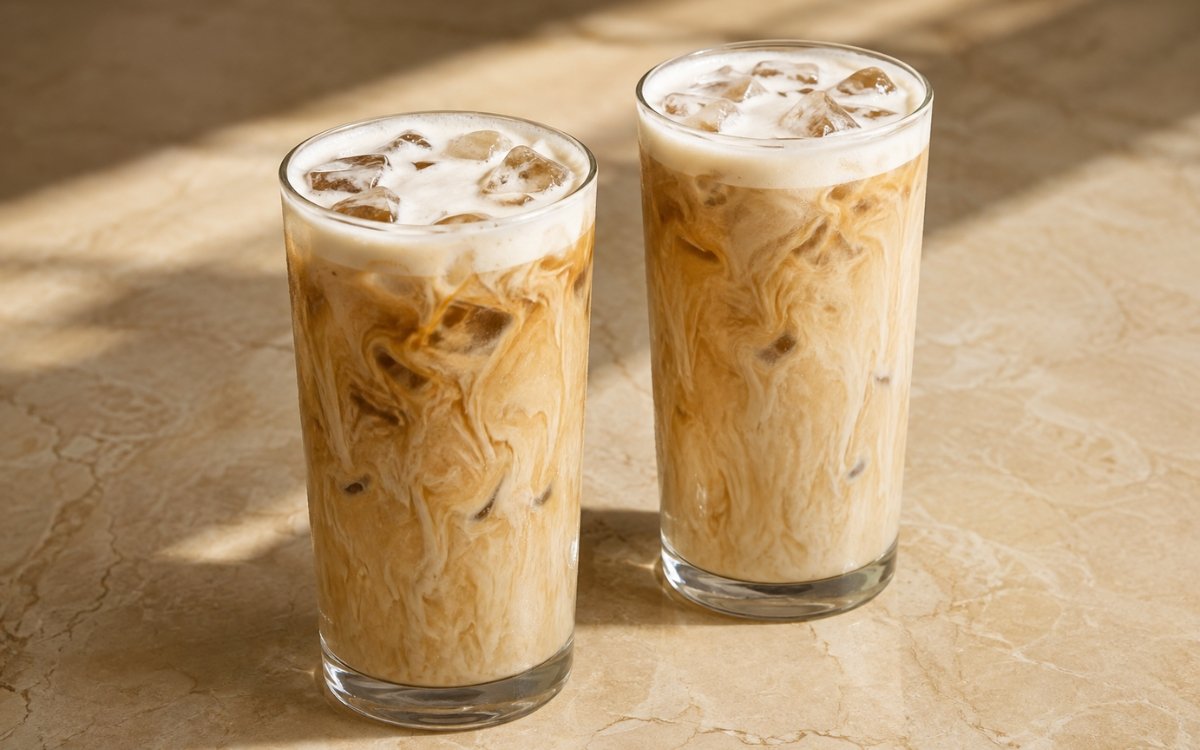
- Divide the hot white chocolate espresso mixture evenly between the 2 glasses, 60ml espresso base per glass. Pour slowly over the ice and milk so it creates a pale caramel swirl before mixing. The drink should become a creamy ivory-caramel colour, lighter than a regular mocha but warmer than plain milk. If it stays pure white, the espresso is too weak. If it turns dark brown, the ratio is too coffee-heavy for a white mocha. This specific target colour functions as a genuinely useful check on the drink's balance — landing in that ivory-caramel zone confirms the espresso and white chocolate are both properly proportioned relative to each other, rather than one dominating.
Optional Thin Foam Finish
- For a more café-style finish, froth a small amount of cold milk very lightly and spoon just a thin layer over the top of each drink. Do not make a thick cappuccino foam. The foam should be only a soft white sheen on top. The drink is still an iced mocha, not a foam drink. Keeping this optional foam genuinely light and thin, rather than building it into a substantial cap, preserves the drink's identity as an iced mocha with a delicate finishing touch rather than pushing it toward a cappuccino-style presentation.
Stir and Serve
- Serve immediately with the pale swirl visible, then stir before drinking. Once stirred, the drink should taste creamy, sweet, lightly vanilla-like from the white chocolate, and still clearly coffee-based. Presenting the drink briefly with its swirl intact before stirring showcases the same visual moment every layered iced coffee drink in this collection is built around — that pale caramel gradient is at its most striking right at the point of serving, before the first stir folds everything together.
Notes
Treating white chocolate gently through the sauce-making process is worth understanding as a genuine technical necessity rather than excessive caution. Unlike dark chocolate, which tolerates direct heat reasonably well, white chocolate's composition — heavier in cocoa butter and milk solids, with no cocoa mass to stabilise it — makes it considerably more prone to breaking, seizing, or turning grainy under aggressive or direct heat. Warming the cream and milk first, then removing the pan from the heat before the chocolate is even added, is what lets the chocolate melt gently from residual warmth rather than risking that separation.
Combining the white chocolate sauce with the hot espresso, rather than mixing it only with cold milk later, follows the same underlying logic used for the standard chocolate sauce elsewhere in this collection, and it matters just as much here. Hot liquid has genuine dissolving power that cold milk simply doesn't — sauce added directly to cold milk tends to firm back up and clump rather than smoothly integrating, producing a mocha base with unpleasant solid pieces rather than the clean, unified colour this drink calls for.
The specific ivory-caramel colour target given in this recipe is worth checking against deliberately rather than eyeballed loosely, since it functions as a genuinely practical diagnostic for the drink's balance. A result that stays too close to pure white signals the espresso hasn't come through strongly enough; one that turns notably dark brown signals the coffee-to-white-chocolate ratio has tipped too far toward standard mocha territory. Either extreme moves the drink away from the specific character a white chocolate mocha is meant to have.
The recipe's closing guidance — that a result tasting like melted candy milk should be corrected by reducing the white chocolate sauce or using stronger espresso, rather than simply accepting that outcome — reflects the drink's core design principle. White chocolate mocha is meant to stay recognisably espresso-based beneath its creamy sweetness, and that balance is worth actively protecting rather than letting the sweetness dominate by default.