Ingredients
Method
Char the Peppers
- Place the green bell pepper or Turkish green peppers and the red bell pepper directly over a gas flame — resting each directly on the burner grate over a medium-high flame — and char them, turning occasionally with tongs, until the skin is blistered and blackened in patches across all surfaces. Alternatively, char under a high broiler on a baking sheet, or on a very hot cast iron pan. The goal is a lightly charred, slightly softened pepper rather than a fully collapsed, steam-softened one — the charring should be uneven and natural rather than uniform. The direct flame contact produces the specific smokiness that is one of ezme's distinguishing background notes; a completely raw pepper provides none of this character. Transfer the charred peppers to a bowl and cover with a plate or plastic wrap for 5 minutes — the trapped steam loosens the charred skin without over-softening the flesh. Remove most of the loose, blackened skin by rubbing it off gently — some remaining char is correct and contributes flavour; painstakingly clean peppers lose the smokiness that justified the charring. Remove the seeds and stem. Finely chop the flesh until the pieces are very small — 3–5mm — and set aside.
Prepare and Drain the Tomatoes
- Core the tomatoes and cut each in half. Use a spoon or your fingers to scoop out the seed chambers and the attached watery pulp — the thin, clear, water-heavy gel surrounding the seeds. Remove enough to leave the firm, meaty tomato flesh but do not remove every trace of seed. The watery pulp is specifically what makes an undrained ezme loose, liquid, and salsa-like; removing it at this stage rather than relying on later draining produces a firmer, more cohesive result. Finely chop the remaining tomato flesh by hand, working until the pieces are very small and almost paste-like in their consistency while still retaining some structure. Do not use a food processor — the machine produces a smooth, aerated tomato paste rather than the finely chopped, slightly chunky texture that distinguishes ezme. Transfer the chopped tomatoes to a fine-mesh strainer set over a bowl. Sprinkle with approximately half the salt, toss briefly, and allow to drain for 10–15 minutes. The salt draws additional moisture out of the tomato flesh through osmosis — accelerating and extending the drainage beyond what gravity alone would produce. After 15 minutes, press the tomatoes gently with the back of a spoon to expel the remaining liquid. Discard the drained liquid.
Prepare the Onion
- Finely dice the white onion into very small pieces — 3–5mm. For a sharper ezme where the onion's raw pungency is a prominent note, use the diced onion as-is. For a cleaner, milder flavour where the onion provides its aromatic sweetness without the aggressive raw sharpness, place the diced onion in a fine-mesh strainer and rinse briefly under cold running water for 30 seconds. Rinsing removes a significant proportion of the surface allicin and sulfur compounds responsible for raw onion's harshness while leaving the onion's structural texture and mild sweetness intact. Shake well and press firmly to remove as much water as possible — wet onion dilutes the ezme's texture progressively as it sits.
Prepare the Remaining Raw Components
- Finely mince the 4 garlic cloves and the small red chili (if using fresh chili rather than flakes). The garlic and chili mince should be fine enough to distribute evenly through the finished ezme rather than appearing as identifiable pieces in every spoonful. Finely chop the fresh parsley with a knife — cutting until the leaves are small and distributed without being completely dissolved into the mixture. Do not process the parsley in a blender or food processor: the blades create a wet, green paste that bleeds its colour through the ezme and loses the specific fresh, slightly vegetal texture of hand-chopped leaf. Parsley in ezme should be present as fresh green specks throughout, not as a colouring agent.
Bloom the Tomato Paste and Spices
- Heat approximately 1 tbsp of the olive oil in a small pan over medium heat. Add the 30g of tomato paste and cook, stirring constantly, for 2–3 minutes until the paste darkens from its original bright red to a deeper, slightly brownish-red and smells noticeably sweeter and more concentrated — the caramelisation of the paste's sugars and the Maillard reaction of its proteins removing the raw, acidic edge and producing the rounded, deeply savoury depth of cooked tomato paste. This blooming step is the difference between a flat, slightly metallic tomato paste flavour and a rich, rounded one. Add the 1 tsp of cumin, 1–2 tsp of Aleppo pepper or pul biber, 2 tsp of sumac, and 1 tsp of black pepper directly into the hot tomato paste. Stir constantly for 20–30 seconds — just long enough for the spices to bloom in the oil and paste, releasing their aromatic essential oils. Remove from heat immediately; spices at this small quantity in a small pan burn in under 60 seconds.
Combine Everything
- In a large bowl, combine the drained tomatoes, charred chopped peppers, prepared onion, minced garlic, minced fresh chili (if using), and chopped parsley. If using chili flakes or pul biber instead of fresh chili, they have already been added at Step 5. Pour the warm tomato paste and spice mixture over the vegetables. Add the remaining olive oil, 30ml of lemon juice, 1 tbsp of pomegranate molasses, the remaining salt, and if using chili flakes or pul biber these go in with the tomato paste already — fold and press everything together firmly with a large spoon. The pressing motion — pushing down into the mixture rather than simply stirring — is specifically effective at helping the vegetables release a small amount of their juice and allowing the spiced tomato paste to coat every piece rather than sitting only on the surface.
Taste and Adjust
- Taste the assembled ezme and assess each flavour dimension individually before adjusting. The finished ezme should taste bright, savoury, lightly smoky, tangy, and warm-spiced with a clear heat. Adjust systematically: if the tomatoes taste flat or the overall flavour is muted, add additional salt in small increments — salt amplifies every other flavour and is the most impactful single adjustment. If the brightness is insufficient, add additional lemon juice in 5ml increments. If the depth and sweet-tart complexity is lacking, add additional pomegranate molasses — its fermented, concentrated sour-sweet character provides the specific Turkish condiment depth that lemon juice alone cannot replicate. If the heat is insufficient for the intended use, add additional pul biber or a pinch of fresh chili.
Rest and Serve
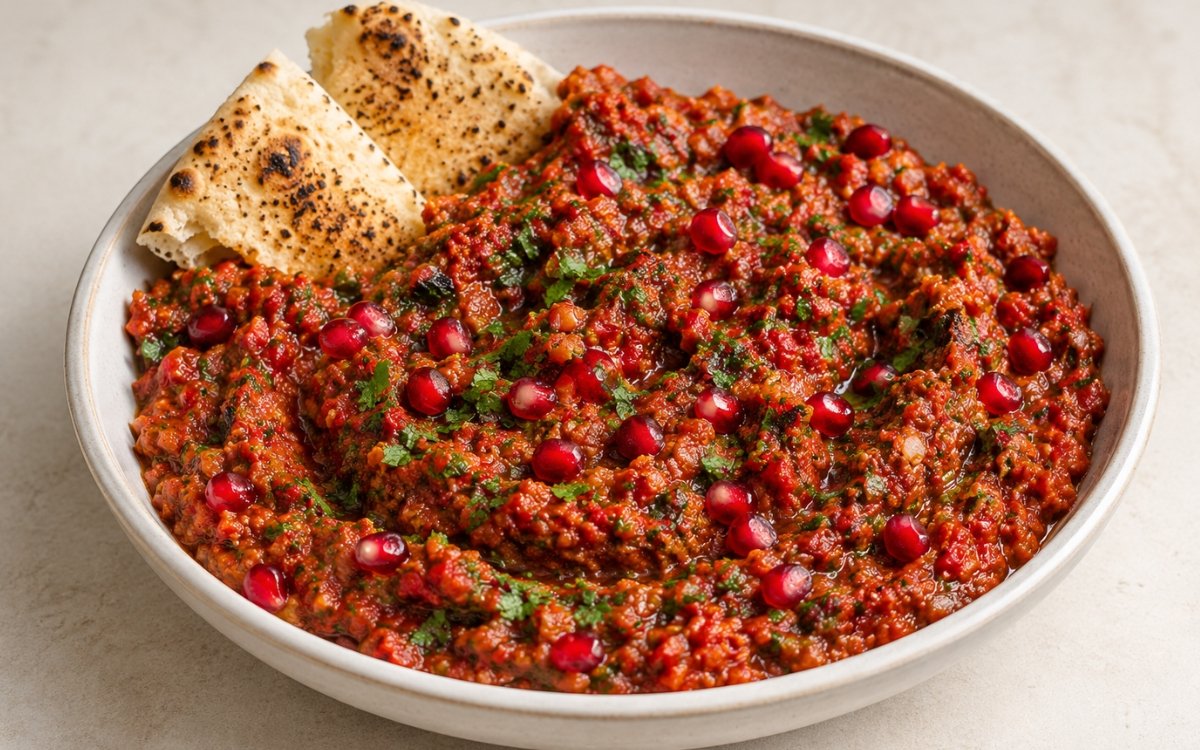
- Allow the assembled ezme to rest at room temperature for a minimum of 20–30 minutes before serving — covered but not refrigerated. During this rest the salt continues drawing moisture from the vegetables, the spices integrate with the fresh components, and the pomegranate molasses' sweetness distributes more evenly through every part of the mixture. After resting, if excess liquid has pooled at the bottom of the bowl, stir well to redistribute it — the starch and pectin from the tomato paste will have partially thickened the released liquid by this point. If the liquid is excessive, drain a small amount before serving. Serve at room temperature or very lightly chilled garnished with chopped parsley and pomegranate seeds, alongside warm Homemade Lavash Flatbread, Homemade Pita Flatbread, or Simple Beef Kofta Skewers.
Notes
Pomegranate molasses is the ingredient that most specifically defines Turkish and Levantine cooking's sweet-tart flavour register and the ingredient most commonly omitted in non-authentic versions of dishes like ezme that call for it. It is produced by reducing pomegranate juice to a thick, dark, intensely flavoured syrup — producing a concentrated sweet-tart-slightly-fermented condiment that provides both acid and fruit depth simultaneously. In ezme, it provides the background complexity that distinguishes the dish from being simply spiced chopped tomatoes. It is available at Middle Eastern grocery stores, Turkish markets, and increasingly at mainstream supermarkets in the international foods section. A partial substitute — 1 tsp tamarind paste dissolved in 1 tsp of honey — approximates the sweet-tart profile without the pomegranate's specific character.
Pul biber — Turkish red pepper flakes — is specifically different from standard chili flakes in its flavour profile, heat level, and intended application. Pul biber is made from sun-dried Aleppo-style red peppers with a moderate heat level (approximately 10,000 Scoville units — hot but not aggressive), a fruity, slightly oily character, and a specific depth of flavour that generic chili flakes from cayenne or arbol chili cannot replicate. Aleppo pepper (named for the Syrian city and widely used in Turkey as well) has the same general character. Both are available at Middle Eastern grocery stores and increasingly online. Standard Italian-style chili flakes can substitute at half the quantity but produce a more aggressively hot, less fruity result.