Ingredients
Method
Make the Peanut Sauce
- Prepare the peanut sauce first and completely — before the pan is heated, before the chicken is cut, before anything else. Having it ready means the final combining step is nothing more than pouring rather than concurrent preparation at the most active cooking moment. In a medium bowl, combine the 120g of peanut butter, 60ml of soy sauce, 45ml of rice vinegar, 30g of honey, 15g of sriracha, 15g of minced ginger, and 10g of minced garlic. Begin whisking — the peanut butter will initially resist smooth incorporation with the surrounding liquids, appearing thick and separated. Add the 30ml of warm water while continuing to whisk. The warm water reduces the peanut butter's viscosity more effectively than cold water, allowing the fat-based paste to disperse into the surrounding water-based soy and vinegar as a unified, smooth sauce rather than remaining as separated clumps. Continue whisking until completely smooth, uniform, and pourable — the sauce should drop in a slow, thick ribbon from the whisk rather than flowing freely. Taste: it should be simultaneously rich from the peanut butter, salty from the soy, bright from the vinegar, sweet from the honey, and warmly spiced from the sriracha and ginger. Adjust — more sriracha for heat, more rice vinegar for brightness, more honey for sweetness. Set aside at room temperature. If the sauce thickens significantly before it is needed, add additional warm water one tablespoon at a time while stirring to restore the pourable consistency.
Cook the Flat Rice Noodles
- Bring a large pot of water to a full rolling boil. Add the 300g of flat rice noodles and cook according to the package directions until tender but still slightly chewy — typically 6–8 minutes for flat rice noodles, though this varies significantly by brand and noodle thickness. Flat rice noodles — wider than rice vermicelli and with the broad, flat surface area that makes them specifically suited to cling-style sauces — cook faster than egg noodles or wheat noodles and can move from correctly al dente to soft and breaking in under a minute. Taste frequently from the 5-minute mark. Drain immediately when correctly cooked and rinse under cold running water — the cold rinse stops cooking instantly and removes the excess surface starch that causes flat rice noodles to stick together irreversibly within minutes of draining without rinsing. Toss with a small amount of oil if not combining with the sauce within 5 minutes. Set aside.
Sear the Chicken
- Season the 680g of chicken breast cubes with the 6g of salt and 3g of black pepper. Heat the 30ml of vegetable oil in a large skillet or wok over medium-high heat until shimmering. Add the chicken cubes in a single layer — work in batches if the pan cannot accommodate all pieces without crowding, as crowded chicken steams rather than sears. Cook for 6–8 minutes, stirring occasionally rather than continuously — allowing brief stationary contact between the chicken pieces and the hot surface to develop the golden brown colouring that contributes both visual appeal and the Maillard depth that distinguishes seared chicken from simply cooked chicken. The chicken is cooked through when it reads 74°C internal temperature in the thickest piece and shows no pink when a piece is cut through. Transfer to a plate and set aside — the chicken returns to the pan at the final combining step.
Stir-Fry the Vegetables
- Without cleaning the skillet, add the 200g of sliced red bell pepper, 150g of snap peas, and 100g of shredded carrots to the remaining chicken fond and oil. Increase the heat to high. Stir-fry for 3–4 minutes, tossing continuously and allowing brief stationary contact between the vegetables and the hot surface for the light char that adds smoky character. The vegetables should reach tender-crisp — fully heated through and slightly yielding when bitten but retaining clear, clean crunch throughout. The three-vegetable combination is specifically chosen for colour variety, textural contrast, and complementary flavour: red bell pepper for its fruity sweetness and vivid colour; snap peas for their clean, bright sweetness and satisfying crunch; shredded carrot for earthy sweetness and the fine, distributed texture that carries through every forkful of noodle. Overcooked vegetables — soft and dull — lose both their visual contribution and the textural contrast that makes each bite interesting against the soft noodles.
Combine Everything in the Sauce
- Return the seared chicken pieces and any accumulated resting juices to the skillet with the vegetables. Add the drained rice noodles. Pour the entire prepared peanut sauce over everything. Reduce the heat to medium. Toss and fold continuously for 2–3 minutes using tongs or two spatulas — turning the noodles through the sauce, the chicken, and the vegetables until every noodle is evenly coated and the sauce has warmed through and distributed uniformly. This 2–3 minute combining step is the step that makes the finished dish taste cohesive rather than assembled: the noodles absorb a portion of the sauce into their surface structure during the warm toss, the chicken's resting juices integrate into the sauce, and the peanut butter's fat distributes through every component. If the sauce appears to have tightened beyond the correct cling-without-being-dry consistency, add additional warm water in 15ml increments while continuing to toss.
Serve
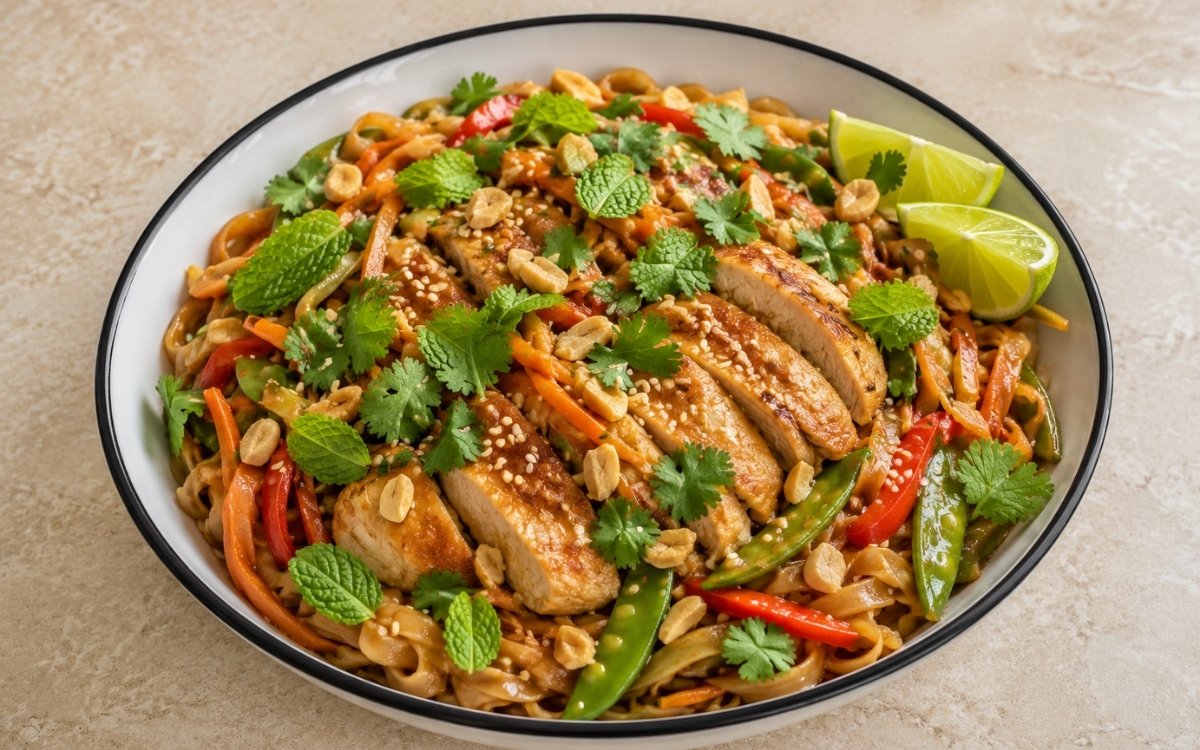
- Divide the noodle mixture among four wide bowls immediately — flat rice noodles continue absorbing the sauce and tightening after removing from the heat. Scatter the garnishes over each bowl: the 80g of roughly crushed roasted peanuts provide the textural crunch that the soft noodles and sauce specifically need; the 20g of cilantro leaves provide the clean, slightly citrusy herbal freshness; the 20g of mint leaves provide the cooling, aromatic counterpoint that makes the bowl taste specifically Thai-inspired rather than simply peanut-noodle; the 20g of toasted sesame seeds provide the nutty, aromatic finishing note. Place lime wedges alongside each bowl — the fresh lime squeezed immediately before each bite amplifies the rice vinegar's acidity already in the sauce and adds the volatile aromatic freshness that makes the bowl taste vivid rather than simply rich.
Notes
The two-herb garnish — cilantro and mint together rather than a choice between them — is the specifically Thai approach to fresh herbs as a bowl component rather than a decoration. In Thai cooking, large quantities of fresh herbs are served alongside or scattered over noodle dishes specifically because their contrasting aromatic characters — cilantro's citrusy, slightly soapy freshness and mint's cooling, menthol-adjacent clarity — together produce the complexity that neither herb provides alone. At 8g each for four servings the herbs are deliberately generous rather than token — enough to be present in every few bites rather than concentrated at the surface of the bowl where they are consumed in the first three forkfuls.
The warm water addition to the peanut sauce is the technique step that produces smooth emulsification. Natural peanut butter's fat is un-stabilised and has a tendency to separate from water-based liquids rather than forming a smooth sauce without mechanical assistance. Warm water reduces the peanut butter's viscosity significantly at the temperature of the fat's melting range, allowing it to disperse into the surrounding soy and rice vinegar as a unified emulsion rather than remaining as floating fat separated from the aqueous components. This is the same principle used in the Spicy Peanut Butter Noodles recipe — hot water for that application, warm water here because the sauce is used at room temperature rather than immediately in a hot pan.