Ingredients
Method
Roast the Tomatoes
- Preheat the oven to 200°C (400°F). Place the cherry tomatoes on a rimmed baking sheet and drizzle with olive oil, salt, and black pepper. Toss directly on the tray to coat evenly, then spread in a single layer — crowding the tomatoes causes them to steam rather than roast, which produces a different and inferior result. Roast for 12–15 minutes until the skins are blistered and split and the tomatoes have collapsed slightly and taken on caramelized color at their edges. The goal is concentrated, intensely sweet tomatoes with some structural integrity remaining rather than fully collapsed sauce. The juices that pool on the baking sheet are valuable — scrape them up and include them when adding the tomatoes to the finished bowl. Set aside to cool to warm or room temperature before assembly.
Temper and Sear the Steak
- Pat the sirloin steak completely dry on all surfaces with paper towels — moisture on the surface of meat creates steam when it hits the pan, which prevents the Maillard reaction browning that produces the flavourful crust this salad depends on. Season generously on both sides with the kosher salt and black pepper, pressing the seasoning firmly into the surface. Allow to rest at room temperature for 15 minutes — this is not a courtesy step but a practical one that reduces the temperature gradient between the steak's exterior and interior, producing more even cooking throughout. Heat a large cast iron skillet over high heat for 3 full minutes until smoking. Add the olive oil and swirl to coat. Lay the steak in the pan and do not move it — allow it to sear undisturbed for 3–4 minutes until a deep, dark brown crust has formed on the bottom and the steak releases from the pan naturally without sticking. Flip once and sear the second side for a further 3–4 minutes. For medium-rare, pull the steak at an internal temperature of 55°C (130°F) — the temperature will continue to rise to 57–60°C during resting. Transfer to a cutting board and rest for a minimum of 8–10 minutes. Resting is not optional — it allows the muscle fibres that contracted during high-heat cooking to relax and reabsorb the juices that were driven toward the centre, redistributing moisture evenly throughout the meat.
Make the Garlic Vinaigrette
- In a medium bowl, combine the red wine vinegar, Dijon mustard, minced garlic, honey, salt, and black pepper. Whisk together until fully incorporated. The Dijon mustard in this recipe is doing two jobs simultaneously — contributing its own complex, fermented sharpness as a flavour element, and acting as an emulsifier that allows the oil and vinegar to form a temporarily stable, cohesive dressing rather than separating immediately. Begin adding the olive oil in a very thin, steady stream while whisking continuously and vigorously. The constant motion breaks the oil into tiny droplets and distributes them throughout the aqueous vinegar-mustard base, creating the emulsification that gives the finished vinaigrette its slightly creamy, unified appearance. Add the first third of the oil most slowly — once the emulsion is established it is more stable and the remaining oil can be added more quickly. Taste and adjust: the vinaigrette should be bold, garlicky, and tangy with a clean honey sweetness softening the vinegar's edge. If it tastes flat, add more salt. If too sharp, add a small additional amount of honey.
Toast the Pine Nuts
- Place the pine nuts in a dry, ungreased skillet over medium heat. Toast, stirring constantly, for 2–3 minutes until golden and fragrant. Pine nuts go from perfectly golden to burnt very quickly — remove from the pan immediately to a plate the moment they reach golden color, as the residual heat of the pan will continue cooking them. Do not walk away from pine nuts at any point during toasting.
Prepare the Salad Base
- In a large mixing bowl, combine the mixed salad greens, arugula, thinly sliced cucumber, and shaved red onion. The combination of mixed greens and arugula is deliberate — mixed greens provide mild, varied texture while arugula provides the peppery, slightly bitter edge that gives the salad the character needed to stand up to the steak's richness. Shaved red onion rather than diced provides a more elegant presentation and a less aggressive onion bite — use a mandoline or the thinnest knife setting you can manage for translucent, paper-thin rings. Crumble the feta directly into the bowl from above to allow it to distribute naturally rather than clumping. Add half the vinaigrette and toss gently but thoroughly, lifting from the bottom of the bowl to coat every leaf. The dressed greens should be lightly coated — glistening rather than wet or pooling with dressing at the bottom.
Slice the Steak and Assemble
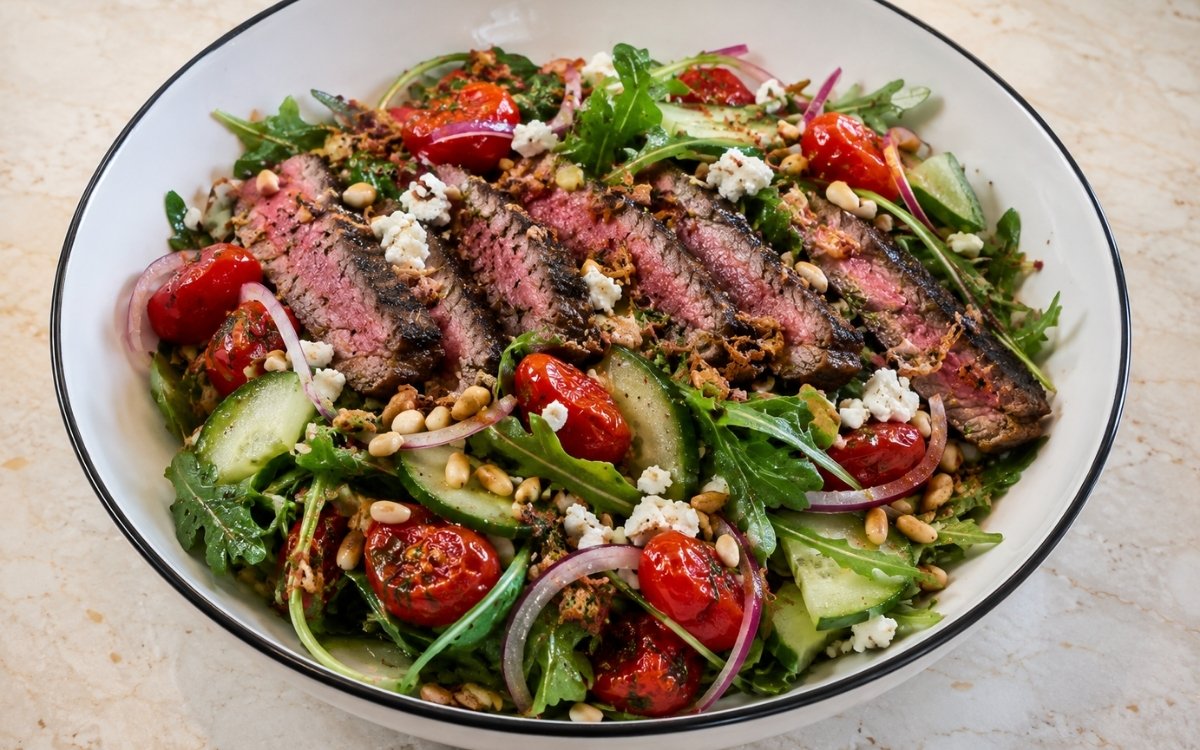
- After the full 8–10 minute rest, identify the grain direction of the steak — the visible parallel lines of muscle fibre running through the meat. Slice firmly against the grain into strips approximately 5–7mm thick. Cutting against the grain shortens the individual muscle fibres in each slice, which dramatically reduces the chewing resistance and produces tender, pleasant mouthfuls rather than stringy, chewy ones regardless of the cooking quality. Divide the dressed salad among four bowls. Fan the sliced steak over the top of each portion. Add the roasted cherry tomatoes alongside the steak, including any caramelized pan juices. Scatter the crispy fried shallots and toasted pine nuts over the entire surface. Drizzle the remaining vinaigrette over the steak slices specifically — they benefit most from the additional dressing as a protein without their own sauce. Serve immediately.
Notes
Sirloin is the correct cut for this salad for specific reasons. It has sufficient fat marbling to remain moist and flavourful when seared to medium-rare, but is lean enough that sliced thinly it does not feel heavy or rich in the context of a salad. Ribeye would be richer and more flavourful but too fatty for clean slicing; flank or skirt steak would be more economical but require more careful grain management. Sirloin sits at the intersection of flavour, tenderness, and sliceability that makes it the best choice for a composed steak salad.
The crispy fried shallots are the textural element that prevents this salad from being a pleasant but one-dimensional combination of soft and tender components. Their crunch persists against the moisture of the dressing longer than croutons and their flavour — sweet, deeply savory, slightly caramelised — is far more complex. Ready-made crispy fried shallots are available in most Asian grocery stores and are an excellent pantry ingredient. Making your own involves slicing shallots thinly, tossing in flour, and frying in oil at 170°C until golden — excellent but time-intensive.
The garlic quantity in the vinaigrette — 15g of minced raw garlic — is deliberately assertive. This is a bold dressing designed to stand up to steak. If you prefer a milder garlic character, reduce to 8g and macerate the garlic in the vinegar for 5 minutes before whisking to soften its sharpness, or use roasted garlic paste for a sweet, mellow garlic note rather than sharp raw garlic heat.