Ingredients
Method
Prepare Everything Before the Wok Is Turned On
- Cold, day-old rice is not a suggestion but the single most important variable in this recipe — and no technique compensates for fresh rice. Freshly cooked rice contains excess residual moisture: when it enters a hot wok, instead of frying to develop individual slightly-crisped grains, it steams in its own water and produces a sticky, clumped, gummy mass regardless of heat level. Overnight refrigeration transforms the texture completely — the starch undergoes retrogradation, firming and drying each grain so it separates cleanly and fries rather than steams. Remove the cold rice from the refrigerator and break up every clump thoroughly with your hands — compacted clumps that enter the wok intact will not break apart evenly during stir-frying and produce uneven texture throughout. If day-old rice is genuinely unavailable, spread freshly cooked rice in a single layer on a baking sheet and refrigerate uncovered for a minimum of 2–3 hours as an imperfect but workable substitute. Pat the 500g of shrimp completely dry on all surfaces with paper towels — surface moisture produces steam rather than sear and prevents the caramelised, slightly golden edge that gives the shrimp their flavour and textural presence in the finished dish. Season lightly with white pepper. Beat the 3 eggs in a small bowl, add a pinch of white pepper, and set aside. In a small jug or bowl, combine the 45ml of soy sauce, 30ml of oyster sauce, 15ml of sesame oil, and 4g of MSG — combining them before cooking means the sauce is poured in a single, decisive pour at the correct moment rather than adding each component separately while the wok demands attention. The MSG is the ingredient that makes restaurant fried rice taste more complete and more vivid than home versions without being identifiable as a distinct flavour — at 4g for four servings it amplifies the soy and oyster sauce's umami compounds, the garlic's savouriness, and every other flavour compound present simultaneously. Organise every ingredient within arm's reach of the wok — once the cooking sequence begins it moves too quickly for concurrent preparation.
Sear the Shrimp
- Place a large wok — a 14-inch carbon steel wok is the ideal vessel — or the heaviest, largest skillet available over the absolute highest heat your stove produces. Allow it to heat for a full 2–3 minutes until genuinely smoking. This preheat is not procedural — it is the prerequisite for wok hei, the slightly smoky, lightly charred, almost caramelised quality that distinguishes restaurant fried rice from home versions. A home stove cannot match the BTU output of a restaurant wok burner, but fully preheating the wok before any ingredient enters it closes much of the gap. Add 15ml of vegetable oil and swirl immediately to coat the surface. Add the dried shrimp in a single layer without any overlap. Leave completely undisturbed for exactly 90 seconds — the caramelised edge that forms during this undisturbed contact is the shrimp's flavour contribution to the finished dish. Flip each shrimp and cook for a further 60–90 seconds until just barely opaque throughout — pull them at the minimum cooked point as they will return to the wok at the final combining step. Overcooked shrimp at this stage become rubbery in the finished rice. Transfer to a plate and set aside.
Scramble the Eggs
- Without cleaning the wok, return it to high heat. Add another 15ml of vegetable oil and allow it to heat for 30 seconds. Pour in the beaten eggs and leave undisturbed for 15 seconds — the high-heat wok surface immediately sets a thin layer around the edges and bottom. Using a flexible spatula, begin scrambling with large, slow, folding strokes — pulling the set egg from the outer edges toward the centre in continuous slow passes. Remove the eggs while they are still visibly wet and significantly underdone. Eggs scrambled in a screaming-hot wok carry through significantly after removal, and the correctly timed pull produces large, soft, custardy curds that are the correct texture in finished fried rice. Dry, fully cooked scrambled egg in fried rice is one of the most common and most avoidable quality failures. Transfer to the plate with the shrimp.
Cook the Aromatics and Vegetables
- Return the wok to high heat and add another 15ml of vegetable oil. Add the 100g of finely diced carrots immediately — they require the longest cooking time of any ingredient and go in first. Stir-fry continuously for 2 minutes, allowing brief contact with the wok surface between each stir. Add the 4 minced garlic cloves, 20g of minced ginger, the white parts of the scallions, and the thinly sliced Thai chili simultaneously. Stir-fry continuously, pressing everything firmly against the hot wok surface, for exactly 30 seconds. This window is the most time-critical in the recipe: in a smoking wok, minced garlic and ginger go from raw to perfectly fragrant to burnt in under 60 seconds, and the continuous pressing and moving is what controls the outcome. The Thai chili's capsaicin and aromatic compounds bloom into the surrounding oil during these 30 seconds alongside the garlic and ginger — its heat integrating into the cooking fat that every subsequent ingredient is tossed in. Add the 150g of frozen peas directly from the freezer without thawing — they require only 1 minute to heat through and their cold temperature briefly moderates the wok temperature before the rice goes in, which prevents the rice from scorching on initial contact.
Fry the Rice
- Add all the cold, broken-up rice to the wok at once. Using a wok spatula, immediately begin breaking up any remaining clumps and spreading the rice across the entire wok surface. Press the rice firmly against the hot wok surface with the spatula for 20–30 seconds — hold the press rather than moving it, allowing the direct contact to develop a very light crisping on the grain surfaces at the base of the wok. Then toss everything, spread again, and press again. This press-toss-press cycle is the technique that produces the slight individual crispness and the faintly toasted, slightly charred character that defines proper fried rice — it creates direct, sustained contact between rice grains and the hot wok surface. Continue the cycle vigorously for 3–4 minutes total. The rice is ready for sauce when it looks noticeably drier and slightly translucent at the edges of each grain, and when you can hear a faint crackling from the wok. Pour the prepared sauce mixture — soy sauce, oyster sauce, sesame oil, and MSG combined — around the perimeter of the wok rather than directly over the rice. The perimeter pour causes the sauce to hit the smoking-hot wok surface rather than the rice, producing a brief intense caramelisation of the soy and oyster sauce's sugars before they coat the rice. This one technique produces visibly more complex, deeper-flavoured fried rice than pouring sauce directly over the food. Toss vigorously for 1 minute until every grain is uniformly and evenly coated in the dark, glossy sauce.
Combine and Serve
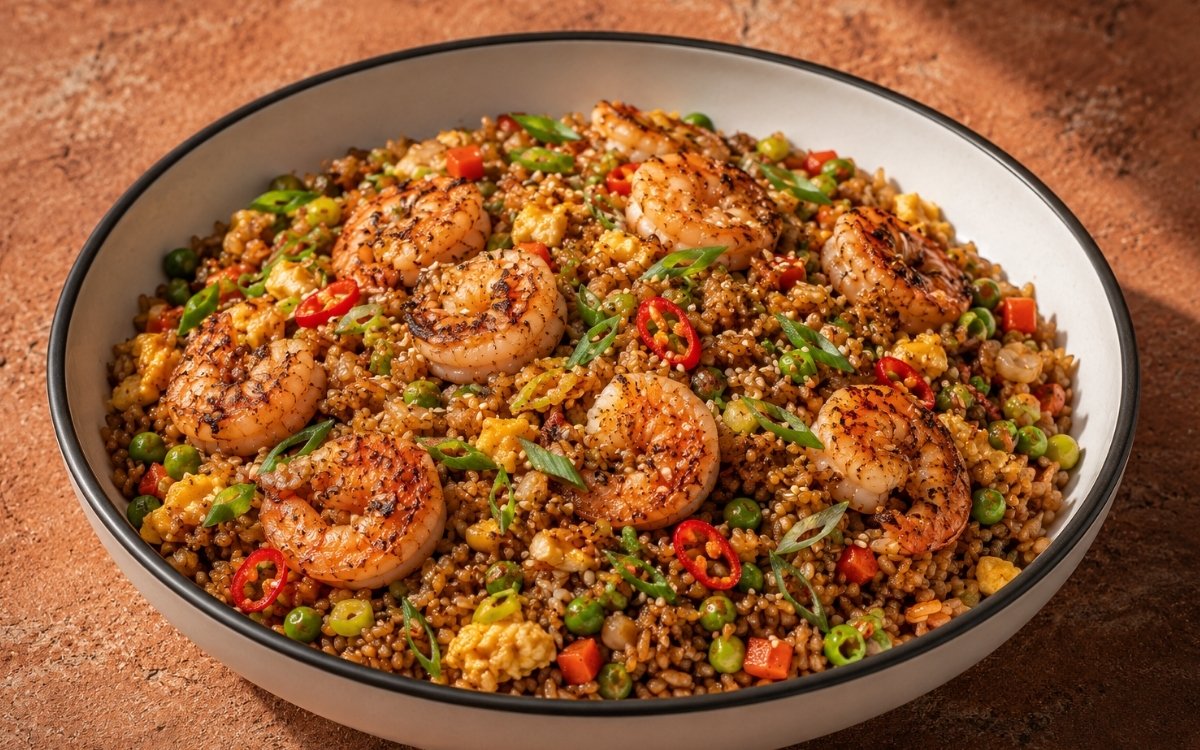
- Return the seared shrimp and soft scrambled eggs to the wok. Add the green parts of the scallions. Toss continuously for 1–2 minutes until the shrimp are heated through and the eggs and scallions are evenly distributed throughout the rice. Taste and adjust — more soy sauce if the rice needs salt and savory depth, more white pepper if it needs the specific earthy, fermented warmth that white pepper provides in Chinese cooking. White pepper is specified throughout rather than black for a specific reason: white pepper's character — produced by the removal of the outer hull, concentrating the piperine and other aromatic compounds differently — is an earthier, more fermented, more aromatic heat than black pepper's sharpness. The chili's heat and white pepper's warmth together produce a more layered spice character than either alone. Serve immediately in four wide bowls. Scatter sliced scallion greens generously over each bowl. Add toasted sesame seeds if desired.
Notes
Wok hei — literally "breath of the wok" in Cantonese — is the characteristic slightly smoky, lightly charred quality that distinguishes restaurant fried rice from every home version. It is produced by the combustion of vaporised cooking oil at extreme temperatures above the wok, and it requires both screaming-hot heat and the tossing technique that briefly throws food through the air above the flame. A home stove cannot fully replicate this — restaurant wok burners produce 10–15 times more BTU than domestic gas burners, and the temperatures achievable at home are simply lower. Three practices close the gap substantially: fully preheating the wok for the entire 2–3 minutes before adding any ingredient, using the absolute maximum heat your stove produces without reduction throughout the entire cooking sequence, and cooking in batches rather than filling the wok completely and catastrophically dropping the temperature.
MSG — monosodium glutamate — is the flavour amplifier that explains why restaurant fried rice tastes more vivid, more complete, and more satisfying than the same recipe made at home without it. At the culinary quantity used here (4g for four servings — 1g per person), MSG does not taste of itself — it amplifies the umami compounds already present in the soy sauce, oyster sauce, shrimp, and egg, producing a more fully realised flavour from each ingredient. MSG occurs naturally in soy sauce, Parmesan cheese, tomatoes, and many fermented foods — the standalone ingredient simply concentrates this effect. It is safe at normal culinary quantities and is used throughout professional kitchens globally.
The Thai chili added at the aromatics stage — rather than as a raw garnish — allows its capsaicin and aromatic compounds to bloom into the cooking oil and distribute through every grain of rice during the frying step, producing a pervasive background heat rather than concentrated pockets of spice from a raw chili garnish.