Ingredients
Method
Make the Salted Caramel Sauce
- Add the sugar and water to a small saucepan. Cook over medium heat without stirring, swirling the pan occasionally, until the sugar turns a deep amber colour. Remove from the heat and carefully pour in the warm cream. It will bubble aggressively. Stir until smooth, then add the butter, fine sea salt, and vanilla if using. Let the sauce cool completely before using it in the cold foam. The caramel should be smooth, glossy, salty-sweet, and pourable. If it is too pale, it tastes flat. If it is burnt, the whole drink becomes bitter. The caramel must be cold before it goes into the cream. Warm caramel thins the foam and makes it collapse. Swirling the pan rather than stirring it while the sugar cooks lets it colour evenly without risking crystallisation back into a grainy mass — a spoon dragged through at this stage can trigger exactly that kind of unwanted recrystallisation.
Make the Salted Caramel Cream Base
- In a small jug, combine the heavy cream, whole milk, salted caramel sauce, and fine sea salt. Whisk until fully smooth. The mixture should taste clearly caramel-forward but not aggressively salty. The salt should sharpen the caramel, not dominate the drink. This restrained amount of salt works through contrast rather than direct seasoning — its role is to heighten and sharpen the caramel's own sweetness, which is the entire principle behind a proper salted caramel flavour rather than simply making the drink taste salty.
Froth the Cold Foam
- Froth the salted caramel cream with a handheld frother, milk frother, French press, or drink mixer until thick, smooth, and softly aerated. It should be spoonable and dense, but still loose enough to slowly sink into the cold brew. The foam should sit on top of the coffee as a defined caramel-cream layer. If it pours like milk, it is under-frothed. If it stands like whipped cream, it is over-frothed. This target texture sits deliberately between two failure states — thin enough to eventually marble downward at the edges, but dense enough to hold its shape as a genuine top layer immediately after pouring.
Build the Cold Brew Base
- Add 10ml vanilla syrup to each glass. Fill each glass generously with ice, then pour in 180ml cold brew coffee per glass. Stir briefly to combine the vanilla syrup with the cold brew. The base should stay dark and strong. Salted caramel foam is rich, so weak cold brew gets buried fast. Given how rich and assertive the salted caramel foam is, this coffee base needs genuine strength specifically to remain the drink's dominant flavour once the two components are combined.
Add the Salted Caramel Cold Foam
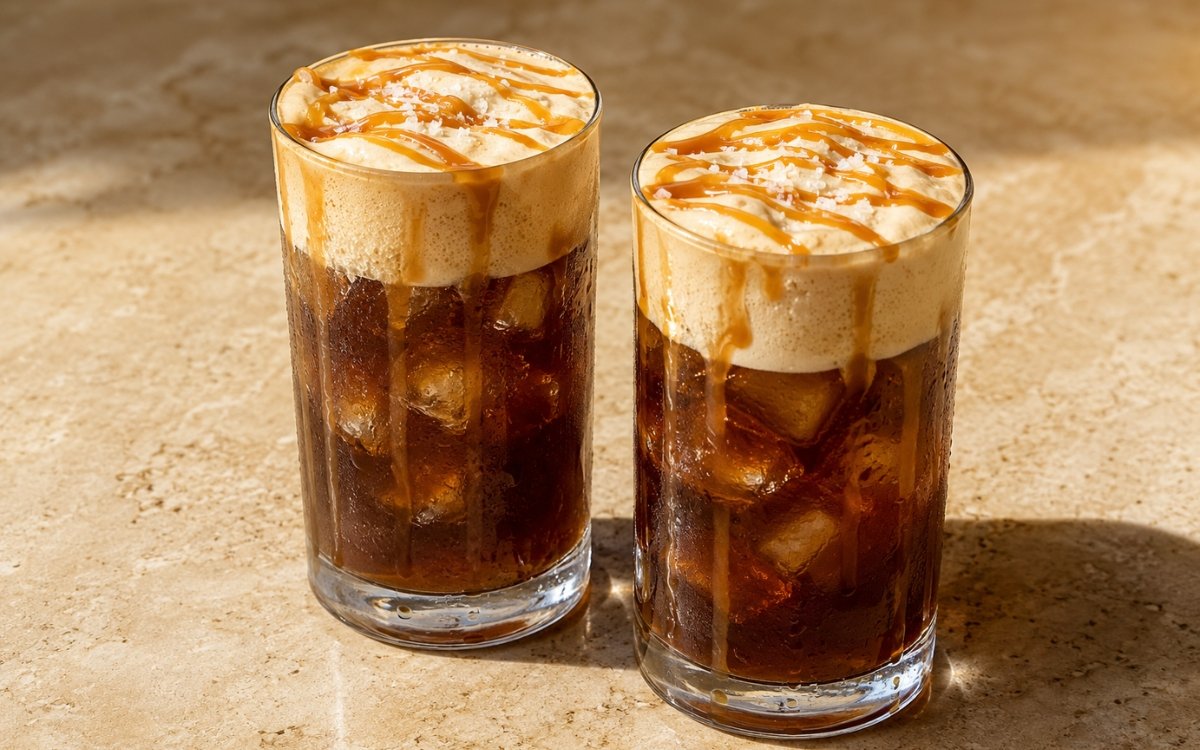
- Spoon or slowly pour the salted caramel cold foam over each glass, dividing it evenly. Let the foam sit clearly on top before serving. The finished drink should show a dark cold brew base with a thick pale caramel foam cap. The foam should slowly marble downward at the edges, not disappear instantly. This slow, edge-first marbling is exactly the visual behaviour a properly frothed foam produces — dense enough at its centre to hold structure, while its outer edges are the first to begin gently dispersing into the coffee below.
Finish and Serve
- Add a tiny pinch of flaky sea salt over the foam if desired. Serve immediately without stirring first, then stir before drinking if desired. The finished drink should taste like strong cold brew first, then vanilla, caramel, cream, and a clean salty finish. It should not taste like melted caramel milk with coffee hiding underneath. This flavour ordering functions as a genuine diagnostic for the drink's balance — if the result reads as caramel milk with coffee somewhere in the background, that signals the cold brew wasn't strong enough relative to the rich foam on top.
Notes
Cooking the caramel to a genuine deep amber, rather than pulling it early out of caution, is worth understanding as the step most responsible for this foam's actual depth of flavour. A caramel stopped too pale hasn't developed the complex, slightly bitter-edged notes that separate real caramel from simple sweetened sugar — it tastes flat and one-dimensional instead. Pushed too far past deep amber into genuinely dark territory, the sugar's own compounds turn bitter in a way that carries straight through into the finished drink, since nothing added afterward fully corrects for it.
Cooling the caramel sauce fully before it's combined with the cream deserves the same attention given to it throughout this collection's other caramel-and-cream drinks. Warm caramel added to cold cream and milk introduces temperature inconsistency right at the base of the foam mixture, and that warmth actively works against the frothing process that follows — thinner, less structured foam is the direct result of skipping this cooling step.
The restrained salt finish, both within the caramel sauce itself and the optional flaky pinch at serving, reflects a real principle about how salt interacts with sweetness rather than an arbitrary limit. A small, carefully measured amount of salt heightens and sharpens caramel's own sweetness through genuine flavour contrast — this contrast is the entire mechanism behind why "salted caramel" works as a flavour profile in the first place. Oversalting instead introduces a competing, straightforwardly salty flavour that fights the caramel rather than complementing it.
The specific mid-point foam texture called out in this recipe — thick and spoonable, never pouring like milk, never standing stiff like whipped cream — deserves checking by feel and appearance rather than a fixed frothing time, since different equipment and slightly different cream temperatures reach that target at different speeds. Getting it right is what produces the slow, edge-marbling visual this drink's presentation depends on.