Ingredients
Method
Prepare All the Vegetables
- Remove the papery husks from the tomatillos — they peel away easily by hand — and wash the tomatillos thoroughly under running water, rubbing the surface to remove the slightly sticky, waxy coating that the husks leave behind. This coating is harmless but unpleasant-tasting if left on. Dry briefly with a paper towel. Cut each tomatillo in half through the equator. Cut the peeled sweet onion into 8 equal wedges, cutting through the root so each wedge holds together at its base rather than falling apart into layers. Peel the garlic cloves and place each one on the cutting board, then press the flat side of a knife over each clove and apply firm, quick pressure with the heel of your hand — just enough to lightly crush and split each clove without flattening it completely. This light smashing cracks the garlic open and exposes its internal surface for better oil penetration and more complete roasting, while keeping the pieces large enough to handle easily and to char slightly on the surface without burning through as quickly as finely minced garlic would. Deseed both jalapeños and cut each into 4 large chunks. Large chunks are correct here — they will be blended after roasting and the large surface area of each piece allows good charring without the risk of burning through that small-cut jalapeño faces under a broiler.
Set Up the Tray for Broiling
- Position your oven rack as close to the broiler element as possible — approximately 10–12cm below it. Preheat the broiler to its highest setting. Line a large, rimmed baking sheet with foil — this makes cleanup dramatically easier as the tomatillos will release significant juice under the broiler that bakes onto an unlined tray. Place all the prepared vegetables on the tray: onion wedges, jalapeño chunks, smashed garlic cloves, and the tomatillos. Drizzle the olive oil over everything and season generously with salt. Toss directly on the tray to coat every surface in oil. Now arrange the tomatillos deliberately: place them all cut-side down, skin-side up. This orientation is specifically important. With the cut side facing down onto the hot tray surface, the tomatillo's interior heats rapidly and its juice begins to bubble and caramelise against the hot foil. Simultaneously, with the skin facing up toward the broiler element, the skin blisters, chars, and blackens — concentrating the tomatillo's flavour, developing Maillard-reaction caramelised compounds on the skin surface, and producing the characteristic smoky sweetness that distinguishes broiled salsa verde from raw or simmered versions. Leave the onion, jalapeño, and garlic in whatever arrangement fits — they do not require a specific orientation.
Broil Until Properly Charred
- Place the tray under the broiler and cook for 12–15 minutes, watching closely and continuously from the 8-minute mark onward. You are looking for specific visual targets on each component: the tomatillo skins should be deeply blistered and blotchy with patches of brown and black — not uniformly black, but showing the irregular charring pattern of skin that has been exposed to intense radiant heat at different distances. The onion wedges should have browned edges and caramelised surfaces with some dark colour at the thinnest edge points — this browning converts the onion's sharp, pungent raw sulfur compounds into sweet, caramelised sugars that make the finished salsa noticeably rounder and less harsh than raw onion would produce. The garlic should show golden to light-brown surfaces. The jalapeño chunks should have blistered skin with brown patches. A broiler operates differently from an oven — heat comes from one direction only, from directly above, which means the top surfaces of all vegetables receive the most intense heat while the undersides are affected only indirectly. Rotate the tray 180 degrees halfway through if your broiler heats unevenly. Remove the tray when the majority of tomatillo skins show the target charring — do not wait for uniform blackening, which would indicate the sugars have moved past caramelisation into burning.
Decide on the Skins
- Allow everything to cool for 3–5 minutes on the tray after removing from the broiler — hot tomatillos are difficult to handle and will steam-burn your fingers. Now make a deliberate decision about the tomatillo skins: leave them on or peel them off. This is a genuine fork in the recipe, not a matter of convenience. The charred tomatillo skins contain the most concentrated smoky, slightly bitter, caramelised compounds produced under the broiler. Leaving them on produces a salsa with a deeper, more complex, distinctly smoky character that has a slightly rough edge to it. Removing the skins produces a cleaner, brighter, less smoky salsa where the tomatillo's natural tartness and the lime's acidity come through more clearly. Both are excellent and both are authentic — choose based on intended use. For heavy, smoky grilled meats and pulled proteins, the skins-on version is the stronger pairing. For lighter applications — fish tacos, fresh bowls, lighter chicken dishes — the peeled version is more complementary. If peeling, simply pinch each skin off — they will slip away easily from the cooked tomatillo. Do not discard the accumulated juices on the tray — add them to the blender with everything else.
Blend to the Correct Consistency
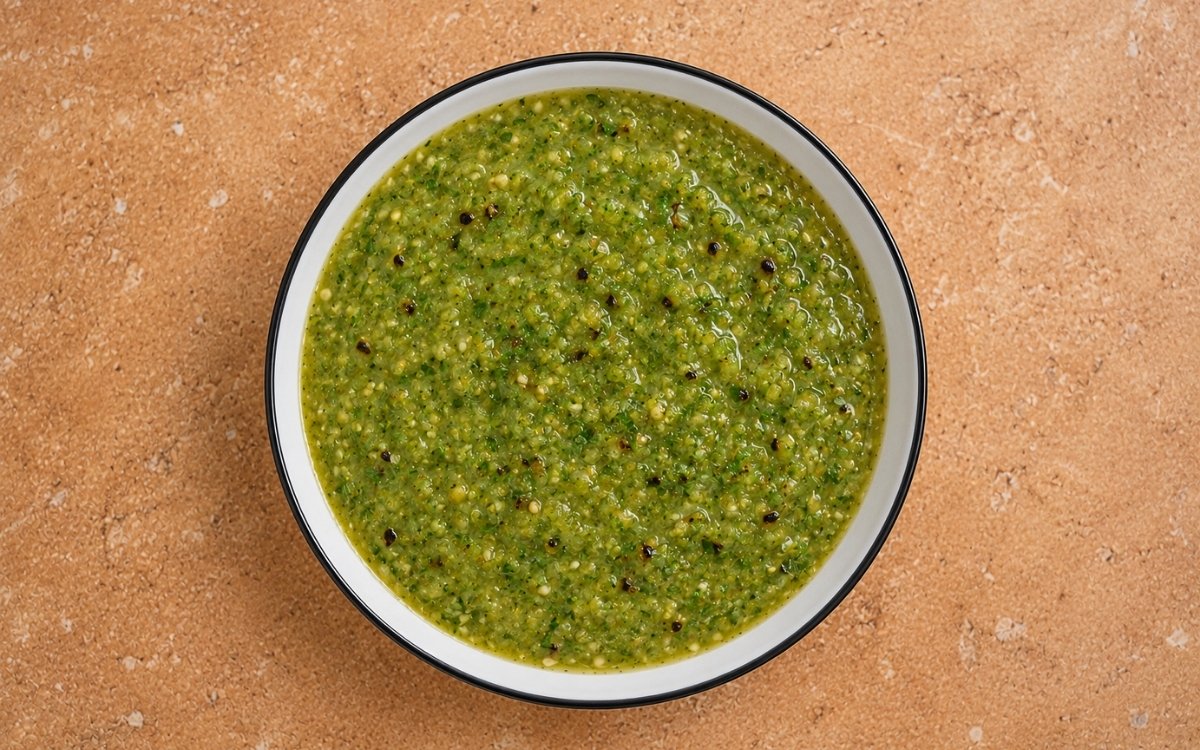
- Transfer everything from the tray to a standing blender — all the roasted vegetables, all accumulated tray juices, the fresh cilantro with stems, the lime juice, 3 tablespoons of water, and a generous pinch of salt. The cilantro stems are intentionally included rather than discarded. The lower portion of cilantro stems — the thin, tender stems attached to the leaves — contains essentially the same flavour compounds as the leaves and blends completely smoothly. Including them produces a more herbaceous, more intensely cilantro-flavoured salsa than leaves alone, reduces waste, and in a blended preparation produces no textural disadvantage whatsoever. Only the very thick, hollow lower stems of the bunch should be discarded. Place the lid firmly on the blender. Blend in a pulse pattern rather than continuous running — 3 seconds on, 2 seconds off, repeatedly, for a total blending time of approximately 20–30 seconds of actual blade contact. This pulsed approach gives you significantly more control over the final texture than continuous blending, which produces a smooth, featureless purée in seconds. The target consistency is smooth overall but retaining some visible small texture — not a perfectly uniform liquid, but a slightly chunky sauce where individual small pieces of roasted vegetable are still faintly visible and the surface is not glassy-smooth. This texture gives the salsa character and presence when spooned over food. Taste immediately after blending and add salt as needed — the salt requirement may be substantial as tomatillos, cilantro, and lime are all acidic and need significant salt to bring their flavours into balance. If the salsa is thicker than desired, add additional water one tablespoon at a time, blending briefly after each addition.
Notes
Tomatillos are a member of the nightshade family closely related to gooseberries — not green tomatoes, with which they share a superficial visual similarity but almost no flavour relationship. Their natural character is tart, slightly vegetal, and faintly citrus-like, with less sweetness and significantly more acidity than ripe tomatoes. This natural acidity is what gives salsa verde its characteristic brightness and what makes it specifically well-suited to rich, fatty proteins — the acid cuts through fat in the same way that lemon cuts through butter, sharpening the flavour of the meat by contrast. Broiling concentrates and caramelises the tomatillo's sugars and moderates its sharpness, producing a more rounded, complex flavour than raw tomatillos provide.
The choice of sweet onion over red or white onion is deliberate and specific to the broiled preparation. Sweet onion has a higher natural sugar content than standard white or yellow onion — these sugars are what caramelise so effectively under the broiler, producing the browned edges and sweeter, less pungent character that makes the finished salsa rounded and rich rather than onion-forward and sharp. Red onion can be substituted for a slightly different, more assertive result; standard white onion works but caramelises less dramatically.
Mexican salsa verde has no relationship to Italian salsa verde — they share a name that simply means "green sauce" in their respective languages, are made from entirely different ingredients, use different techniques, and serve entirely different purposes. This version is specifically the Mexican roasted tomatillo salsa that appears throughout Mexican and South American cooking as a condiment, cooking sauce, and enchilada sauce base.