Ingredients
Method
Braise the Pork Shoulder
- Preheat the oven to 160°C. Season the 700g of pork shoulder generously on all surfaces with salt and black pepper — the seasoning applied directly to the meat's surface rather than into the braising liquid ensures the pork itself is properly seasoned throughout rather than relying entirely on the liquid's flavour penetrating from outside. In a Dutch oven or heavy, tightly lidded oven-safe pot, combine the 480ml of chicken stock, 60ml of soy sauce, 45ml of rice vinegar, 30g of brown sugar, 20g of ginger sliced into coins, 15g of smashed garlic cloves, 2 star anise pods, and 1 cinnamon stick. Stir to dissolve the sugar. Place the seasoned pork shoulder into the braising liquid — the liquid should come approximately halfway up the pork's sides rather than fully submerging it. Cover the Dutch oven tightly with its lid. Place in the preheated oven and braise for 3 hours without opening the lid during the cooking period. The combination of aromatics is specifically Asian in character: star anise provides the specific liquorice-like, deeply warm aromatic that is the backbone of Chinese braised pork preparations; cinnamon adds sweet, warm depth that amplifies the star anise; ginger provides sharp, spiced warmth; and the soy-brown sugar-rice vinegar combination provides the sweet-savoury-acidic framework. After 3 hours, the pork should be completely fork-tender — a fork or chopstick inserted into the thickest part should meet no resistance, and the meat should show visible separation along its natural fat lines. Remove from the oven.
Make the Pickled Vegetables
- While the pork braises — the 3-hour window provides ample time for preparation of all other components. In a medium bowl, combine the 120ml of rice vinegar, 120ml of water, 25g of sugar, and 6g of salt. Stir until the sugar and salt have completely dissolved — undissolved granules produce unevenly sweet or salty pickle brine with concentrated pockets. Add the 150g of julienned carrot and 150g of julienned daikon radish. Toss to ensure every strip is coated in the brine and allow to sit at room temperature for a minimum of 20 minutes — stirring once at the midpoint to redistribute the brine over all surfaces. During this time the rice vinegar's acidity begins a very light pickling process, softening the vegetables' rawness slightly and mellowing the daikon's mild pungency into a cleaner, more balanced tangy crunch. The pickled vegetables can be prepared up to 3–4 days ahead — they improve significantly over 24 hours as the brine penetrates the vegetable structure more completely.
Make the Sriracha Mayo
- In a small bowl, whisk together the 60g of mayonnaise and 15ml of sriracha sauce until completely smooth and uniformly pink-orange. The sauce is deliberately simple — two ingredients producing a creamy, moderately spiced, slightly garlicky condiment that drizzles cleanly over the assembled bowl and connects the rich pulled pork with the bright pickled vegetables through a common creamy-spiced note. Taste and adjust the sriracha quantity — for a milder version use 10ml, for a more assertively spiced version increase to 20ml. Refrigerate until assembly.
Shred the Pork and Reduce the Glaze
- Remove the braised pork shoulder from the Dutch oven and transfer to a cutting board or large plate. Using two forks, shred the meat by pulling it apart along the natural muscle and fat lines — it should separate with very little resistance after the 3-hour braise. Discard any large pieces of excess fat or connective tissue. Strain the remaining braising liquid through a fine-mesh sieve into a medium saucepan, pressing on the solids to extract as much flavoured liquid as possible before discarding the ginger, garlic, star anise, and cinnamon. Measure 240ml of this strained liquid — the remainder can be discarded or reserved for another use. Return the 240ml to the saucepan over medium-high heat. Simmer vigorously, uncovered, for approximately 10 minutes until reduced by approximately half and visibly thickened — the surface should look glossy and the liquid should coat the back of a spoon clearly rather than flowing off like water. The reduction concentrates the long-braised spice compounds, the soy's umami, the brown sugar's caramelised sweetness, and the pork's own fat and gelatin into a glaze that is the most concentrated expression of the braising liquid's character. Add the shredded pork to the reduced glaze and toss to coat every strand — every piece should show a glossy coating.
Cook the Jasmine Rice
- While the glaze reduces, rinse the 250g of jasmine rice under cold water until clear. Combine with 375ml of water and a pinch of salt in a medium saucepan. Bring to a full rolling boil, reduce immediately to the lowest possible heat, cover tightly, and simmer for 15 minutes without lifting the lid. Remove from heat and allow to stand covered for 5 minutes. Fluff with a fork.
Assemble the Bowls
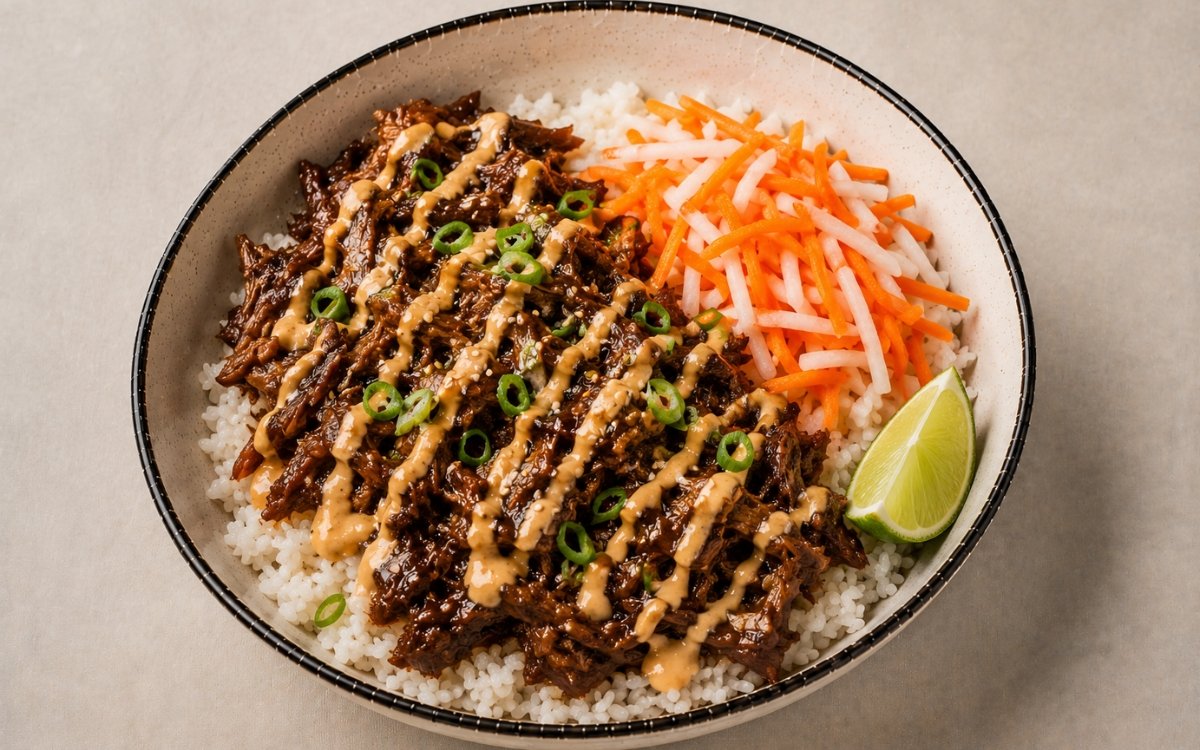
- Divide the jasmine rice among four wide bowls. Top each bowl with one-quarter of the glazed pulled pork — generously mounded so the sticky, caramelised glaze and the pulled meat's texture are both visible. Drain the pickled vegetables and arrange alongside the pork — their vivid orange-and-white colours against the dark, glazed pork provide the visual contrast that makes the bowl immediately appetising. The pickled vegetables' sharp, vinegary acidity specifically and deliberately cuts through the braised pork's richness and the mayonnaise's creaminess — they are not optional. Drizzle the sriracha mayo over the pork and rice in a generous, loose pattern. Scatter the 40g of sliced scallions over each bowl. Scatter the 15g of toasted sesame seeds. Place lime wedges alongside each bowl — the fresh lime squeezed at the table provides the bright citrus top note that ties the bowl's Asian-inspired character together.
Notes
The glaze reduction step is the element that elevates this recipe from simple braised pork over rice to a specifically restaurant-quality preparation. After 3 hours of braising, the liquid contains dissolved pork collagen now converted to gelatin, concentrated soy and brown sugar compounds, the aromatic oils of the ginger and star anise, and the acidic counterpoint of the rice vinegar — all of which progressively concentrate during the 10-minute reduction. The resulting glaze has a viscosity and flavour complexity that neither a fresh sauce nor an unreduced braising liquid can approximate. The gelatin from the pork's collagen gives the glaze a specific silky, slightly sticky body that coats each shredded strand evenly.
The star anise and cinnamon combination in the braising liquid is the specifically Chinese-inspired element that identifies this bowl as Asian rather than simply soy-braised. Star anise — the dried fruit of the Illicium verum tree — provides a specifically warm, liquorice-adjacent, slightly medicinal aromatic that is the defining note of Chinese red-braised pork (hong shao rou) and many other Chinese braised preparations. At 2 pods for 480ml of liquid it provides background warmth and aromatic depth rather than a detectable anise flavour in the finished dish — it is present as the compound complexity rather than a single identifiable note.