Ingredients
Method
Cook the Jasmine Rice
- Rinse the 300g of jasmine rice under cold running water until clear. Combine with 450ml of water and a pinch of salt in a medium saucepan. Bring to a full rolling boil, reduce immediately to the lowest possible setting, cover tightly, and simmer for 15 minutes without lifting the lid. Remove from heat and allow to stand covered for 5 minutes. Fluff with a fork and keep covered while the stir-fry is prepared.
Velvet and Marinate the Beef
- For the easiest, most consistent thin slicing of flank steak, place the steak in the freezer for 30 minutes before slicing — partially frozen beef is firmer and can be cut to the required 5mm thickness with significantly more control and consistency than fully thawed beef. Slice the 600g of flank steak against the grain — cutting perpendicular to the direction of the muscle fibres — into strips approximately 5mm thick. Cutting against the grain shortens each individual muscle fibre so the strips are inherently more tender when bitten rather than requiring tearing through long intact fibres. In a medium bowl, combine the sliced beef with the 30ml of Shaoxing rice wine, 15ml of soy sauce, 10g of cornstarch, and 5ml of sesame oil. Mix thoroughly to coat every strip. Allow to marinate for 10 minutes at room temperature. This preparation is the Chinese velveting technique — Shaoxing wine tenderises the outer surface of the beef proteins through its alcohol and acid content; the cornstarch coating creates a protective layer that seals moisture into the beef during the high-heat sear and produces the specific silky, tender exterior on each strip that distinguishes Chinese restaurant beef from beef simply seasoned and seared; the sesame oil adds aromatic depth. After the 10-minute marinade, the surface of each beef strip should feel slightly tacky from the cornstarch — this is correct and is what allows the caramelisation during searing.
Make the Peking Sauce
- While the beef marinates, whisk together the 80g of hoisin sauce, 45ml of low-sodium soy sauce, 30ml of rice vinegar, 20g of light brown sugar, 15ml of sesame oil, 10g of grated fresh ginger, 4 minced garlic cloves, and 5g of chili paste until completely combined and uniform. The sauce should be thick, glossy, and taste simultaneously of the hoisin's deep sweet-savoury complexity, the soy's umami saltiness, the vinegar's bright acid counterpoint, the ginger's spiced warmth, and the chili paste's background heat. Hoisin sauce is the primary character ingredient — a fermented soybean-based sauce with a specifically Chinese sweet-savoury-spiced depth that is the defining flavour note of Peking-style preparations. Low-sodium soy is specified because the hoisin already contributes significant saltiness — full-sodium soy in combination with hoisin produces an aggressively salty sauce after the brief reducing toss. Set the sauce aside — ready to pour at the combining step without any delay.
Sear the Beef in Two Batches
- Heat the wok or large heavy skillet over the absolute highest available heat for 2–3 minutes until genuinely smoking — not simply hot, but producing visible smoke from the surface. This preheat is the prerequisite for wok hei, the slightly smoky, caramelised character that separates restaurant Chinese cooking from home versions. Add 15ml of vegetable oil and swirl to coat. Add exactly half the marinated beef strips in a single layer with clear space between each strip — the cornstarch coating on each strip must make direct, unimpeded contact with the hot wok surface for the caramelisation to occur. Leave completely undisturbed for 90 seconds — the cornstarch coating caramelises against the smoking wok surface during this sustained contact, producing the deep golden-brown, slightly chewy exterior that characterises properly seared velveted beef. Any movement before 90 seconds prevents the caramelisation from completing. Flip each strip and sear the second side for 60 seconds. Transfer immediately to a plate. Allow the wok to return to smoking temperature before proceeding. Add another 15ml of oil and repeat identically with the second batch.
Stir-Fry the Vegetables
- Reduce the heat to medium-high. Add the remaining 15ml of oil to the wok. Add the 200g of julienned red bell pepper, 150g of julienned carrots, and 100g of thinly sliced white onion simultaneously. Stir-fry vigorously for 3–4 minutes — keeping the vegetables in near-constant motion but allowing brief moments of stationary contact with the hot wok surface for the slight char at edges that contributes smoky depth. The target is tender-crisp throughout — fully heated through and slightly yielding when bitten while retaining clear crunch. The julienned carrot and pepper formats are specifically chosen to cook at the same rate as the sliced onion in this 3–4 minute window — uniformity of cut size ensures no component is overcooked while another remains raw.
Combine with Sauce and Finish
- Return the seared beef strips and all accumulated resting juices to the wok with the stir-fried vegetables. Pour the entire prepared Peking sauce over everything. Add the 100g of trimmed snow peas and the white parts of the 80g of scallions. Increase the heat to high. Toss continuously for 2–3 minutes — turning everything through the sauce with a wok spatula, ensuring the sauce coats every beef strip and vegetable piece. During this 2–3 minute toss, the sauce's sugars concentrate and caramelise slightly, the cornstarch from the beef marinade that has released into the sauce thickens it progressively, and the hoisin and soy reduce to a glossy, sticky coating that clings to every surface. The sauce should visibly thicken and develop a sheen during this tossing period — the correct finished consistency clings to each piece without pooling excessively at the bottom of the wok. In the final 30 seconds, add the green parts of the scallions and toss once more — the greens wilt slightly but retain their colour and fresh aromatic character from the brief heat exposure.
Assemble and Serve
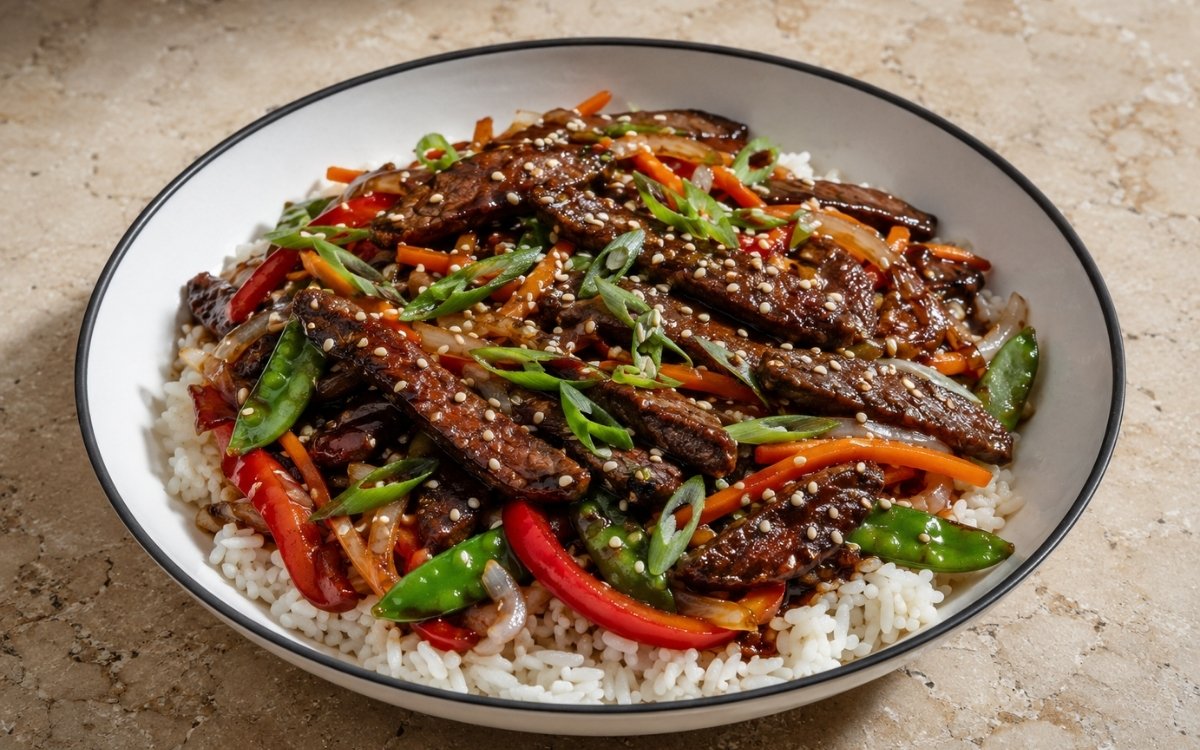
- Divide the jasmine rice among four wide bowls. Top each bowl with the Peking beef and vegetables — arranging them so the glossy, sauce-coated pieces are visible. Scatter the 20g of toasted sesame seeds over each bowl. Add additional sliced scallion greens if desired. Serve immediately — the sauce continues to thicken as it cools and the wok hei character in the beef and vegetables fades quickly after leaving the heat.
Notes
The velveting marinade — Shaoxing wine, soy, cornstarch, and sesame oil — is the specifically Chinese preparation technique that produces the silky, tender, distinctively textured beef found in Chinese restaurant stir-fry that home cooks typically cannot replicate without knowing this technique. The mechanism is multi-stage: the Shaoxing wine's alcohol and mild acidity denature the outermost surface proteins, slightly softening them. The cornstarch coating seals moisture within the beef during the high-heat sear, preventing the rapid moisture loss that toughens the exterior. The sealed moisture produces a specific silky, yielding exterior texture even after direct contact with a smoking-hot wok. The same velveting technique works with chicken, pork, and shrimp — it is the foundation of most Chinese restaurant stir-fry preparations.
Shaoxing wine — 绍兴酒 — is a Chinese fermented rice wine aged in terracotta urns, producing a dry, nutty, complex character with a colour and aromatic profile somewhere between dry sherry and sake. It is the single most important ingredient in Chinese cooking that Western cooks consistently omit or substitute, and its flavour contribution — present in both the marinade and the aroma at the wok stage — is not replicated by any single substitute. Available at Asian grocery stores and increasingly at mainstream supermarkets in the Asian foods section. Dry sherry is the closest Western substitute at equal quantity.