Method
Build the Ginger Honey Base
- Combine the 150ml of water, 60g of honey, and 30g of thinly sliced fresh ginger in a small saucepan. Honey rather than granulated sugar is the specifically correct sweetener here — honey's aromatic floral compounds are among the few flavours that complement and specifically amplify pear's delicate character rather than simply sweetening it. White sugar's neutral sweetness provides no additional aromatic context; honey's own florality creates a resonance with the pear's floral-aromatic character that makes the finished drink more specifically elegant. Place over medium-low heat and bring just to a gentle simmer, stirring to fully dissolve the honey. The honey's viscosity requires more active stirring to dissolve than granulated sugar — continue stirring until the liquid appears uniform and the honey is no longer visible as a separate, more viscous layer. Remove from the heat immediately once the first gentle bubbles appear and allow the ginger to steep off heat for 10 minutes. The ginger steep at off-heat temperature follows the same principle as across this collection — the initial brief simmer having converted enough of the harsher gingerols into warmer, more rounded shogaols, and the off-heat steep continuing the extraction of aromatic character at declining temperature without further aggressive compound development.
Add Pear at the Lowest Possible Heat
- After the 10-minute ginger steep, add the 2 pears — skin on, cut into 1cm cubes — to the saucepan with the ginger infusion. Add the zest of ¼ lemon and a pinch of fine sea salt simultaneously. The skin-on approach, consistent with the kiwi lime preparation, contributes the pear skin's concentrated aromatic compounds alongside the flesh's more delicate juice. Return the pan to the absolute lowest available heat. Cook gently for 5 minutes, stirring occasionally. The visual indicator of the correct temperature: the liquid should show occasional very small bubbles rising from the pan bottom but no simmering movement across the surface — a temperature below 70°C throughout. Pear's most characteristic volatile aroma compounds — the pear esters responsible for the specific sweet, fruity, floral character of ripe pear — evaporate at or above simmering temperature within minutes. At this gentle warmth they release slowly from the softening pear cubes into the surrounding ginger-honey liquid while the bulk of the aromatic character is preserved in the fruit's remaining cellular structure until pressing. Remove from the heat after 5 minutes. Allow to stand, covered, for 10 minutes — the off-heat rest allowing the pear to continue softening in the warm liquid as the temperature declines and additional gentle aromatic extraction to occur without any ongoing heat risk.
Mash, Strain, and Chill
- After the 10-minute off-heat rest, use the back of a large spoon or a potato masher to press the softened pear cubes firmly into the liquid — working the pieces against the pan's surface until they have broken down and the juice is as fully extracted as possible. Pear pressed in this way releases the concentrated ester-rich juice from its softened cells that has been the preparation's goal — extracting maximum flavour from the minimum gentle heat applied. Strain through a fine-mesh sieve over a clean jug, pressing firmly on the mashed pear solids and ginger slices to extract as much liquid as possible. Discard all solids. The finished strained base should be a clear pale gold — very light in colour but specifically fragrant from the pear's aromatic compounds, the ginger's warmth, the honey's florality, and the lemon zest's background citrus thread. The pale colour is characteristic and correct — pear is a delicate, light-coloured fruit and the gentleness of the preparation preserves this rather than cooking it to a darker, more caramelised amber. Transfer to the refrigerator and chill completely — a minimum of 30 minutes.
Assemble and Serve
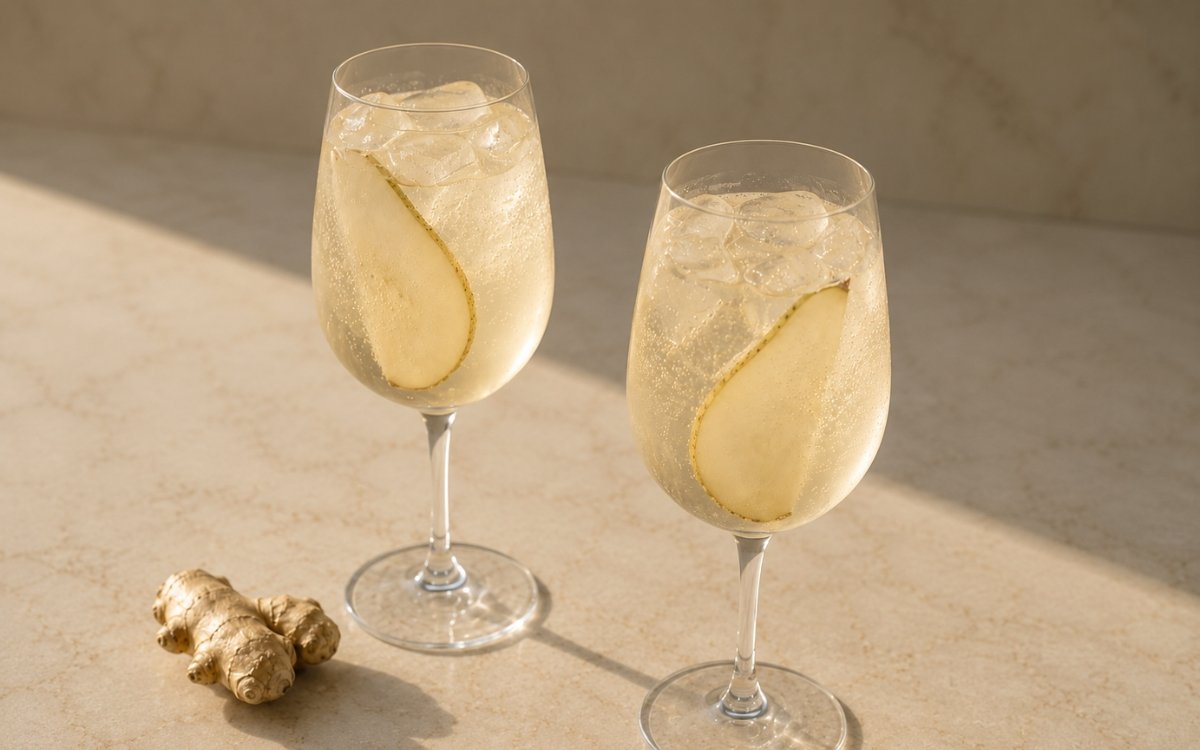
- Fill four wine glasses generously with ice cubes. The wine glass format is the appropriate vessel for this preparation's specific character — the wide bowl form allowing the pale gold colour's delicate elegance to be visible and the larger vessel providing the space for the thin pear garnish to be displayed cleanly. Divide the chilled pear-ginger base evenly among the glasses — approximately 70–75ml per glass. Stir briefly against the ice. Top each glass with approximately 125ml of chilled club soda, poured gently down the inner side of the glass to preserve the carbonation. Stir gently once or twice. For the pear garnish, slice the garnish pear very thinly — a mandoline set to 1–2mm produces the translucent, almost paper-thin slices that display the pear's core pattern most attractively and slip easily into the drink alongside the ice. If a mandoline is not available, a very sharp knife and careful thin cutting produces an acceptable result. Slip one thin pear slice into each glass against the ice. Serve immediately.
Notes
Pear variety selection affects both the flavour and the colour of the finished base. Comice pears — particularly soft, very sweet, and specifically fragrant when fully ripe — produce the most aromatic base with the strongest pear character. Williams or Bartlett pears produce a similarly sweet, fragrant result with slightly more acidity. Bosc pears are firmer and slightly less sweet with a more subtle, more complex aromatic profile that is specifically good in this recipe's honey-and-ginger context. Conference pears are milder and more delicate — the finished base from Conference pears will be lighter in flavour and require the full honey quantity for sufficient sweetness.
The pears must be fully ripe — soft enough that pressing with a thumb leaves a clear indentation. Under-ripe pears have a significantly lower ester concentration and produce a mild, slightly astringent base rather than the specifically sweet, floral, pear-forward result that the recipe requires.