Ingredients
Method
Cook the Peaches to Release Their Juice
- Combine the thinly sliced peaches and 350ml of water in a small saucepan. The thin wedge cut — approximately 3–5mm — is specifically important and not simply a preparation convenience: the thin slices' high surface-area-to-volume ratio allows the peach's juice and aromatic compounds to diffuse into the surrounding water significantly faster and more completely than thick chunks at the same temperature and time. Thick peach pieces at a brief, gentle simmer produce a mildly flavoured water with only the surface of each piece contributing; thin slices produce a specifically peach-forward base where the interior of each piece has diffused fully into the surrounding liquid within the 10-minute cooking window. Place over medium-low heat and bring to a gentle simmer — not a rolling boil, which would drive off the most volatile aromatic compounds in the peach and produce a flat, slightly cooked result. Simmer gently for 10 minutes, stirring occasionally and using the back of a spoon to lightly press the softened peach slices against the pan's surface — the gentle mashing accelerating the juice release without the full breakdown of the potato-masher approach used in other preparations. At the end of 10 minutes the peach slices should be noticeably soft and the surrounding water a pale golden-pink.
Cool to the Correct Temperature Before Adding the Tea
- Remove the saucepan from the heat. This is the preparation's most technically specific step — the liquid must cool from the simmering temperature to between 70°C and 85°C before the white tea is added. Too hot and the tea will produce harsh, bitter tannins that overwhelm the delicate peach flavour; too cool and the extraction will be too slow and too light for the 4–5 minute steep to produce meaningful tea character. Allow the pan to stand uncovered for approximately 3–5 minutes — the temperature drops relatively quickly off the heat at this small volume. A cooking thermometer inserted into the liquid confirms the correct window; alternatively, a drop of the liquid on the inside of the wrist should feel hot but not scalding — approximately the temperature of a very hot bath. Once in the 70–85°C window, add the white tea bags or loose-leaf tea in a closed infuser, and add the 3 thyme sprigs simultaneously. Steep for exactly 4–5 minutes. White tea's tannin threshold — the point at which extended steeping begins extracting harsh rather than smooth compounds — is reached faster and at lower temperatures than black or green tea. The 4–5 minute window at this temperature extracts the soft, floral, slightly honeyed character of white tea at its most pleasant concentration. Set a timer.
Remove the Tea, Continue the Residual Infusion
- After 4–5 minutes, remove the tea bags or infuser immediately — leaving them in beyond this point begins the tannin extraction even at this reduced temperature. Leave the peach slices and thyme sprigs in the liquid for an additional 5 minutes of residual infusion at the naturally declining temperature. The peach's continued gentle infusion at this lower temperature extracts additional aromatic compounds into the tea-flavoured liquid; the thyme's residual extraction contributes a barely-detectable herbal depth at the declining temperature that is more controlled than continued steeping at the higher temperature would produce.
Strain, Add Honey and Salt, and Chill
- Strain the entire mixture through a fine-mesh sieve into a clean jug or bowl, pressing lightly on the peach solids and thyme — light pressure for the clean, bright base that gentle pressing produces rather than the cloudier, slightly more astringent result of aggressive pressing. Discard the strained solids. While the strained liquid is still slightly warm — warm enough to dissolve honey readily but no longer actively hot — stir in the 60g of honey and the pinch of fine sea salt until fully dissolved. The salt is sub-threshold in quantity — the finished drink should taste specifically cleaner, more vivid, and more specifically peach-forward with the salt than without, without any perceptible salt flavour. The same amplifying principle applied in the kiwi lime, passion fruit, and melon agua fresca preparations. Transfer to the refrigerator and chill completely — a minimum of 30 minutes.
Assemble and Serve
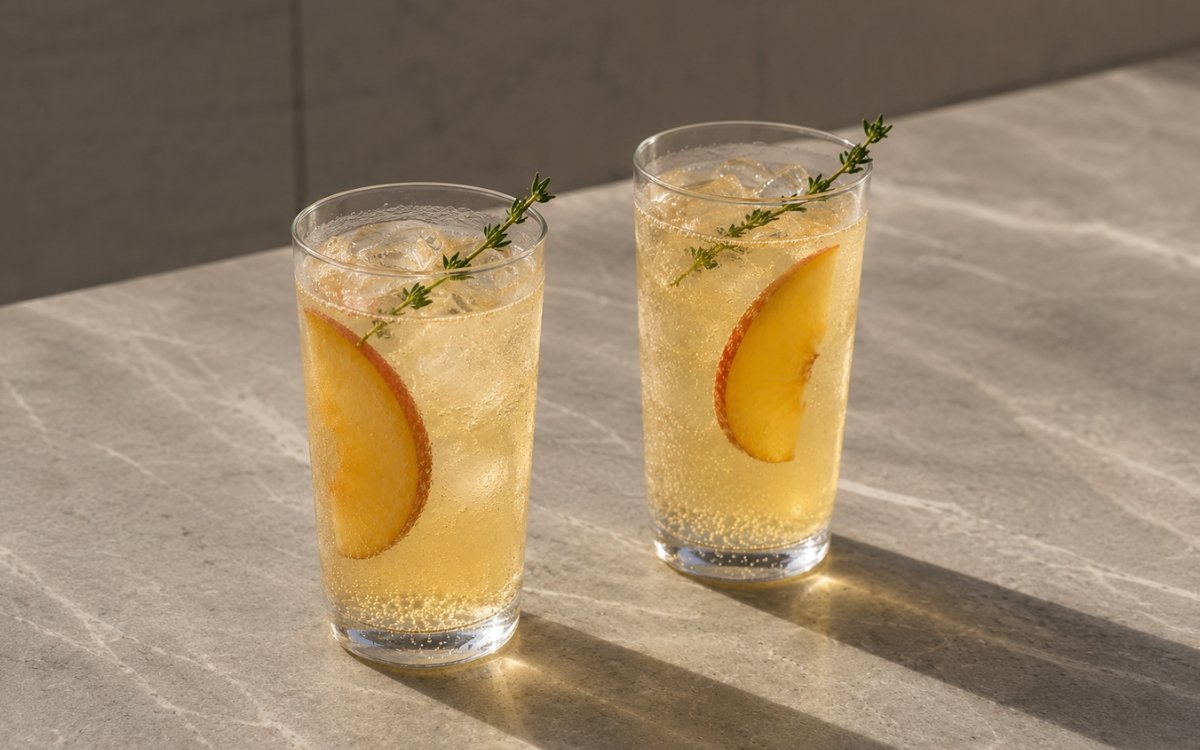
- Fill four tall glasses generously with ice. Divide the chilled peach white tea concentrate evenly — approximately 80–85ml per glass. Top each glass with approximately 125ml of chilled club soda, poured gently down the inner side. Stir once or twice gently. Sink a thin peach slice into each glass alongside the ice — the pale gold of the peach visible through the drink. Rest a small thyme sprig on the ice with the leaves above the rim — the thyme's herbal aroma rising with the condensation from the cold glass providing the first aromatic impression before the drink is tasted. Serve immediately.
Notes
White tea — Camellia sinensis, the same plant as all tea — is produced primarily in China's Fujian province and Darjeeling, from unopened buds or very young leaves harvested before significant processing or oxidation. Silver Needle (Baihao Yinzhen) — made from unopened buds only — is the most delicate and most specifically floral white tea; White Peony (Bai Mu Dan) — made from buds with the first two leaves — is slightly more robust and produces a slightly fuller-bodied cup. Either variety is appropriate in this recipe; Silver Needle produces the most delicate, most floral result while White Peony produces a slightly more substantial flavour that stands more clearly against the peach.
The specific 70–85°C temperature range for white tea is not a preference guideline but a flavour outcome determinant. At 95–100°C (boiling), white tea's catechins and galloylated compounds extract rapidly, producing a cup that is astringent, slightly bitter, and specifically flat in its floral character — indistinguishable from a mildly flavoured green tea. At 70–85°C, the more desirable, more delicate aromatic compounds extract ahead of the harsher ones, producing the soft, faintly floral, slightly sweet cup that is white tea's specific character.