Ingredients
Method
Boil the Sweet Potatoes
- Peel the sweet potatoes and cut them into roughly uniform cubes — approximately 4–5cm per side. Uniformity is the key consideration here: uneven pieces cook at different rates, producing a mix of waterlogged, over-soft chunks alongside dense, slightly undercooked ones that will never mash into a smooth, cohesive result. Place the cubed sweet potatoes in a large 4–5L pot and cover with cold water by approximately 3cm. Add a pinch of salt to the water and bring to a full rolling boil over high heat. Once boiling, reduce to medium heat and simmer steadily for 15–20 minutes. The cooking time is a range rather than a fixed point because sweet potato cube size, variety, and the freshness of the potato all affect how quickly the interior softens. Begin testing at the 15-minute mark by piercing the thickest piece with a fork or skewer — it should slide through with zero resistance. If any firmness remains or the centre of a cube still looks slightly translucent and dense rather than uniformly opaque and soft all the way through, the potato needs more time. Sweet potato that is not fully cooked through will not break down into the smooth, velvety texture this recipe requires — it will leave grainy, dense patches that the subsequent mashing cannot resolve.
Drain and Steam Dry
- Drain the cooked sweet potatoes thoroughly through a colander, shaking it firmly several times to remove standing water from the surfaces of each cube. Immediately return the drained sweet potatoes to the hot, empty pot. Place the pot over low heat and leave the sweet potatoes to sit in the dry pot for 2 minutes, shaking the pot occasionally to prevent any pieces from sitting in direct contact with the hot surface long enough to stick or colour. During these 2 minutes, visible steam will rise from the sweet potato surfaces — this is excess water evaporating. This drying step is more important for sweet potatoes than for regular potatoes because sweet potatoes naturally contain more moisture in their flesh, which means they absorb and retain more cooking water during boiling. Skipping or shortening this step does not produce a catastrophic failure, but it does mean the mash will require less milk to reach the correct consistency — and the less milk is needed, the more diluted the flavour of the finished mash becomes. Concentrated sweet potato flavour requires that the cooking water has been driven off rather than remaining as a diluting presence. If the sweet potato surfaces still look visibly glossy and wet after 2 minutes, allow an additional minute of drying before proceeding.
Mash with Butter First
- Remove the pot from heat. Add the unsalted butter to the hot sweet potatoes and begin mashing with a potato masher, working through all the pieces until the butter is fully melted and incorporated and the mixture is mostly smooth. Butter is added before the milk for the same reason it is added first in classic mashed potato preparation: fat introduced before water-based liquid coats the individual starch granules in a thin protective film. This coating limits the starch granules' ability to absorb the subsequent milk and bloat into the sticky, glutinous chains that produce a gummy or dense mash. The butter essentially acts as a barrier between the starch and the milk, allowing the dairy to contribute richness and creaminess without causing the starch to over-hydrate. Unlike russet potato mash where a ricer produces the finest texture, a standard potato masher works very well for sweet potato — its naturally moister, denser flesh breaks down more readily than russet and produces a smooth result without needing the additional mechanical assistance of a ricer.
Add the Warm Milk Gradually
- If the milk is not already warm from the butter-mashing process, warm it briefly in a small saucepan or microwave to approximately 60°C — warm to the touch but not simmering. Add the warm milk to the buttered mash in a thin, gradual stream while stirring with a wooden spoon or flexible spatula. The gradual addition is important because sweet potato varieties differ considerably in their natural moisture content and in how much cooking water they retained despite the drying step — some batches will reach the desired consistency after two-thirds of the milk, others will absorb the full amount and could take slightly more. Stop adding milk the moment the mash reaches a smooth, creamy, slightly flowing consistency that holds its shape on a spoon without being stiff. Once milk has been added, keep all subsequent mixing gentle — slow, folding strokes rather than vigorous beating. Over-mixing sweet potato mash after liquid is added develops the starch in the same way that over-mixing any starch-based preparation does, producing a progressively gummier, more elastic texture. If you want the absolute smoothest result, mash the potato with the butter to the point of mostly smooth, then fold in the milk with a spatula rather than continuing to mash — the folding motion distributes the liquid evenly without the mechanical action that promotes starch chain development.
Season and Serve
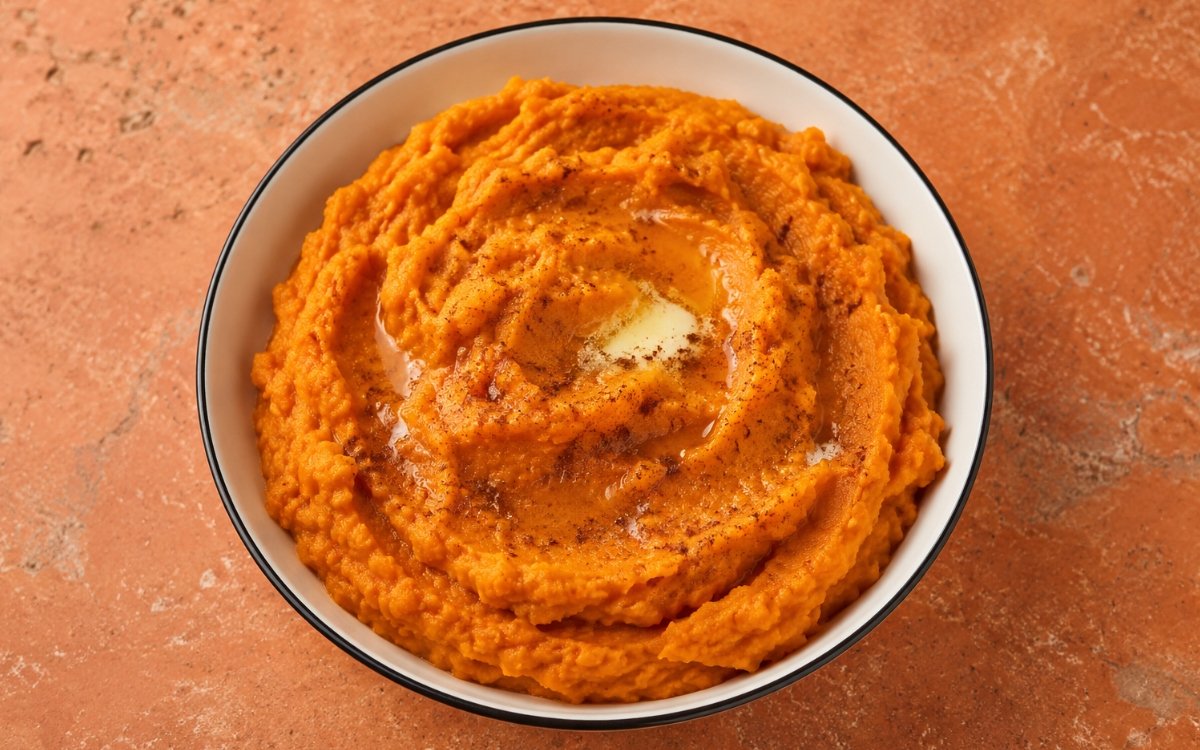
- Add the salt, freshly ground black pepper, and ground cinnamon to the mash and stir gently to distribute them throughout. The cinnamon is calibrated at 2g — enough to provide a detectable warm, aromatic note that complements the sweet potato's natural sweetness without pushing the dish into dessert territory. At this level, the cinnamon reads as warmth and spice rather than sweet flavouring, bridging the natural sugars of the potato and the savoriness of the butter and salt. Taste carefully after seasoning: sweet potato varieties vary considerably in their natural sugar content — some specimens are intensely sweet, others more neutral — and the calibration of salt, pepper, and cinnamon should be adjusted based on what your specific sweet potatoes taste like. If the mash tastes too sweet and dessert-like, add a small amount of additional black pepper rather than more salt — pepper's heat provides savory contrast that re-balances the sweetness more effectively than additional salt at this stage. Serve immediately in a warm bowl or directly onto warm plates while the mash is still at its optimal temperature and texture. If the mash thickens and stiffens as it sits — which sweet potato mash does faster than regular mash due to its higher sugar content causing faster starch retrogradation — loosen with a small splash of warm milk and stir gently to restore consistency.
Notes
Sweet potato varieties produce noticeably different mash results depending on type. The orange-fleshed varieties most commonly sold in supermarkets — often labelled 'yam' in North America despite not being botanical yams — have high moisture content, intensely sweet flavor, and a naturally creamy texture that mashes beautifully with minimal dairy. White or purple sweet potato varieties have drier flesh, less sweetness, and a slightly denser mash character that requires more dairy to reach a similar consistency. This recipe is calibrated for the standard orange-fleshed sweet potato — adjust the milk quantity and cinnamon level if using a different variety.
Cinnamon's role in savory sweet potato preparation is frequently misunderstood. At the quantity specified — 2g per 900g of potato — it does not make the mash taste sweet or dessert-like. Instead, it performs as a warm background spice that amplifies the sweet potato's own aromatic character and adds complexity without adding flavor that can be identified as 'cinnamon' by most tasters. It is the same principle as adding a small amount of nutmeg to classic béchamel — present to enhance, not to announce itself. If your specific sweet potatoes are very sweet, reduce to 1g. If the mash will accompany a richly spiced main dish, omit the cinnamon entirely and increase the black pepper for a more neutral savory base.
The butter-before-milk sequence is particularly important for sweet potato because sweet potato starch behaves slightly differently from potato starch under hydration — it is marginally more prone to becoming gummy when over-hydrated due to the higher sugar content that affects starch gelatinisation. This makes the protective fat coating from the butter even more valuable as a structural step here than it is in regular mash.