Ingredients
Method
Toast the Coconut
- Place the coconut flakes in a dry skillet over low to medium-low heat. Toast for 3–5 minutes, stirring frequently, until lightly golden and fragrant, then immediately transfer to a cool plate. Coconut continues browning from residual heat, so remove it as soon as the edges turn golden rather than waiting for every piece to brown. That residual heat is exactly why timing here is less forgiving than it looks — the pan and the flakes themselves stay hot enough to keep cooking for a few seconds even off the burner.
Prepare the Toppings
- Dice the fresh mango and slice the bananas, then measure the toasted coconut and chia seeds. Chill the serving bowls for 5–10 minutes before assembling if possible. All toppings should be ready before blending — the smoothie base begins softening as soon as the frozen fruit is processed. That immediacy is the same reason every smoothie bowl in this collection calls for toppings prepped in advance, since there's no time to slice and measure once the thick base is already sitting in the blender.
Load the Blender
- Add to the blender in this order: 180ml coconut milk, coconut yogurt, honey or maple syrup if using, lime juice, vanilla, salt, frozen banana, and frozen mango. Start blending on low, then gradually increase the speed, using a tamper if available. Use the minimum amount of coconut milk initially — a smoothie bowl should be substantially thicker than a drinkable smoothie. That restraint matters because it's considerably easier to loosen a too-thick base with a splash more coconut milk than to recover one that's already gone thin.
Blend to a Spoonable Texture
- Blend only until completely smooth, stopping and scraping the sides as necessary. If the blades can't circulate the fruit, add additional coconut milk 1 tablespoon at a time. The finished base should be glossy, dense, and thick enough that a spoon dragged through it leaves a visible trail for several seconds, with the toppings sitting on the surface rather than immediately sinking. That visible trail is a genuinely useful, checkable marker here, since "thick enough" is otherwise a matter of feel that's easy to misjudge by sight alone.
Taste and Balance
- Taste the base before portioning and adjust if necessary: more lime juice if the mango tastes overly sweet or flat, a little honey or maple syrup if the mango is tart, or a small pinch more salt if the coconut and mango flavours seem muted. Lime should brighten the mango, not make the bowl taste distinctly lime-flavoured. That distinction matters because the lime's job here is acidity working quietly in the background against the coconut's richness, not a flavour meant to announce itself on its own.
Portion
- Divide the mixture evenly among 4 chilled bowls, approximately 350–400ml smoothie base per serving, then smooth the surface gently with the back of a spoon. Working quickly here matters because the base is at its thickest and coldest the moment it leaves the blender, and every minute afterward works against that texture.
Add the Toppings
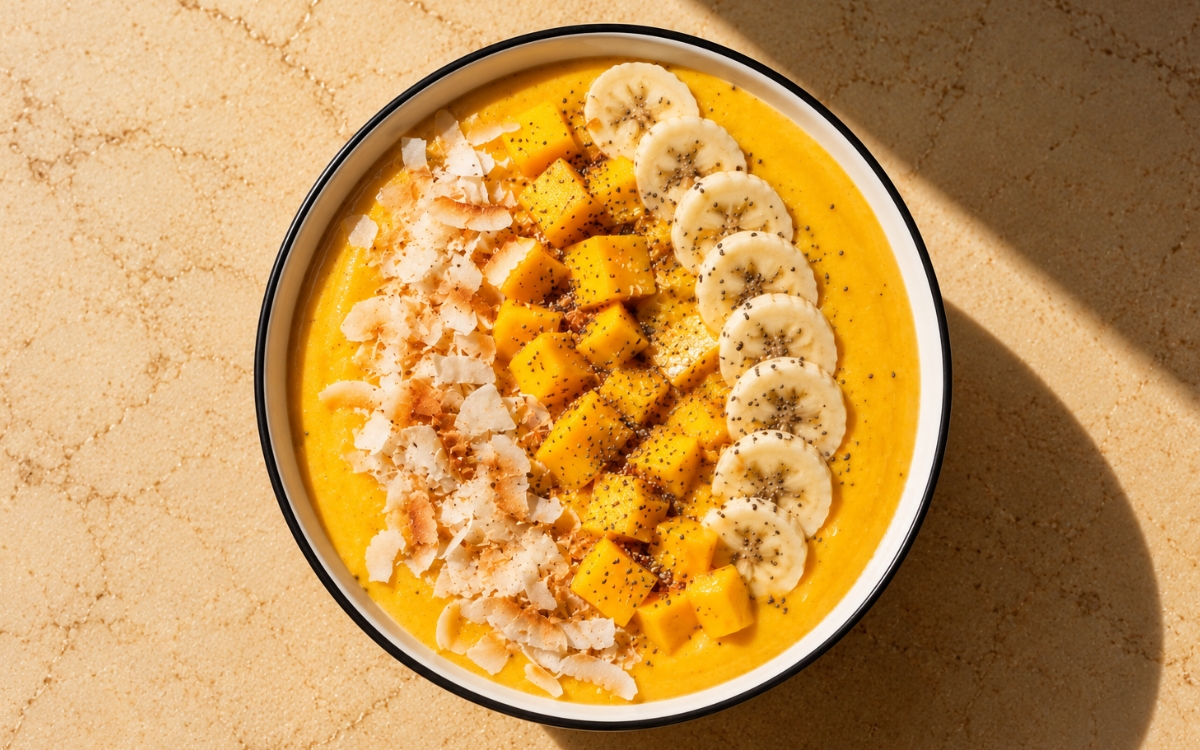
- Arrange the toppings in clean sections: a generous line of mango cubes, an overlapping row of banana coins, a generous section of toasted coconut flakes, and a light scatter of chia seeds, then serve immediately. That immediate serving protects the toasted coconut's crispness and the clean, sectioned presentation alike, both of which fade the longer the finished bowl sits before reaching the table.
Notes
Frozen mango is essential to this bowl's structure and its vivid yellow colour, and using fresh mango alone produces a noticeably softer result, since fresh fruit simply carries no frozen body of its own to contribute the way the frozen version does.
A thick, unsweetened coconut yogurt is worth seeking out specifically, since a thinner variety may require reducing the coconut milk to compensate for the extra liquid it brings. Full-fat coconut milk also gives a noticeably more pronounced coconut flavour and richer texture than a carton coconut beverage, which is considerably more diluted by comparison.
Lime is especially useful here precisely because the coconut is so rich — its acidity is what keeps the finished bowl from tasting heavy or one-dimensional, the same role citrus plays across several of this collection's richer tropical and dairy-based recipes.
Chia seeds are kept primarily as a topping rather than blended into the base in any real quantity, since they begin hydrating and swelling the moment they're wet, which changes the base's texture in a way that's difficult to predict or time consistently.